

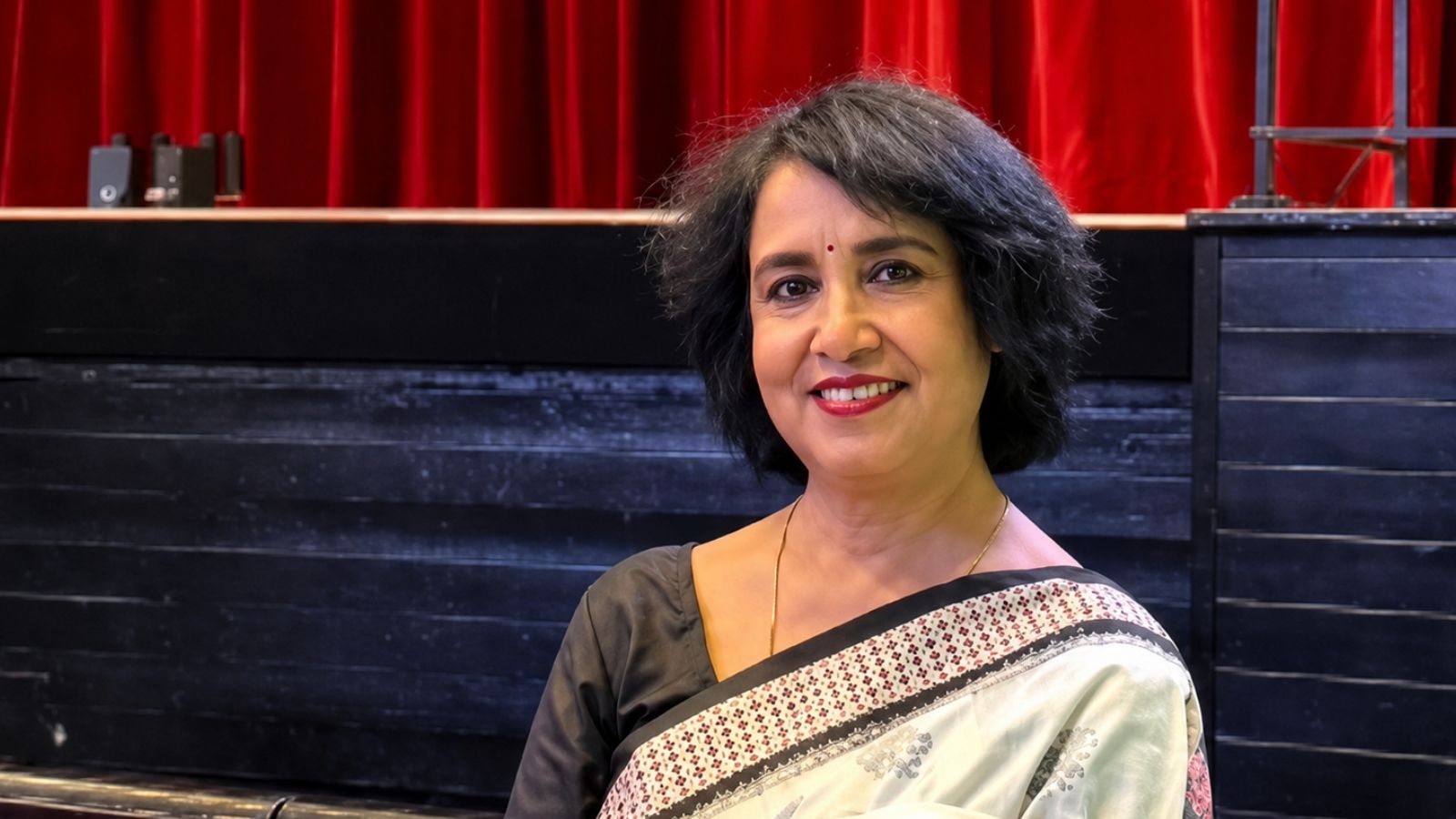
Almost two decades after she was forced to leave Kolkata following protests against her writing, Bangladesh-born author Taslima Nasreen is set to appear in a public event in the city on August 1.
The programme at the city’s Rabindra Sadan cultural centre is being organised by three organisations: Secular Mission, Paschimbonger Jonno (For West Bengal), and Human Rights Beyond Frontiers. The organisers said Chief Minister Suvendu Adhikari and author Shirshendu Mukhopadhyay were also expected to attend the event. This will be Nasreen’s first public appearance in Kolkata since 2007, when protests against her book Dwikhondito (Split: A Life) forced her to leave the city she had made her home since her exile from Bangladesh a decade earlier.

“The event is organised by three organisations, including ours. It will feature Nasreen’s poems and songs. The CM will also be present,” Mohit Roy of “Paschimbonger Jonno” told The Indian Express.
“Kolkata is known as the cultural capital of India. She (Nasreen) was driven away from here because of protests by fundamentalists and that pained us. We tried to organise her visit during the previous government, but were unsuccessful. This time, we approached Adhikari, who assured us that proper security arrangements would be made. We then contacted the author and she agreed to visit Kolkata and participate in the event. She will speak about her years in exile, recount the circumstances under which she had to leave Kolkata, and read her poems,” said Osman Mallick of Secular Mission. Mallick, an advocate at the Calcutta High Court, is one of the nine members of the panel set up by the West Bengal government to submit a report on the implementation of the Uniform Civil Code (UCC) in the state.
A life in exile
Nasreen has been at the centre of controversy over her writings for decades. Her writing primarily focuses on women’s rights, gender equality, patriarchal norms, and domestic and structural violence that women face. Her best-known novel, Lajja (Shame), published in 1993, brought her international recognition. The book chronicled the persecution of a fictitious Hindu family in Bangladesh in the aftermath of the Babri Masjid’s demolition.
Facing death threats and protests, Nasreen left Bangladesh in 1994 and lived in exile across Europe, including Germany, and North America. During this period, Sweden granted her citizenship. She subsequently found refuge in Kolkata, the city closest to her home culturally.
In 1998, Nasreen published Meyebela (My Bengali Girlhood), the first volume of her autobiography. However, her troubles began in 2003 after Dwikhondito, the second volume of her autobiography, was published. The book contained passages that were deemed offensive to religious sentiments. On November 18, 2003, the Calcutta High Court approved an injunction against the publication of the book after poet Sayed Hasmat Jalal filed a defamation suit against Nasreen. Ten days later, the Buddhadeb Bhattacharya-led Left Front government banned the book, concerned that it might cause communal discord. However, the publisher challenged the ban. In September 2005, the High Court struck it down, ruling that the book did not intend to outrage religious feelings and declaring the government’s move unjustified.
By then, Nasreen had received a temporary residence permit from the Union government (in 2004) and moved to Kolkata, where she regularly wrote columns for Bengali newspapers. However, the tension over the book continued to simmer. In June 2006, Syed Noor-ur-Rehman Barkati, then the imam of Kolkata’s Tipu Sultan Mosque, announced a reward for anyone who “blackened” Nasreen’s face. Several organisations also demanded that she leave the country. In August 2007, while attending an event in Hyderabad related to the Telugu translation of her novel Shodh (Revenge), Nasreen was roughed up by alleged members of the AIMIM.
Though the controversial pages were retracted that year, in November 2007, the tensions spilt over onto the roads as demonstrations organised by the All India Minority Forum led to road blockades and incidents of arson in parts of Kolkata. To bring the situation under control, the Left Front government led by Buddhadeb Bhattacharya called in the Army to help restore order. Facing political pressure and worried about the situation spiralling out of control if Nasreen remained in the city, the government pressured her to leave, with senior CPI(M) leaders such as Biman Bose publicly calling on her to move elsewhere to allow the political situation in Kolkata to cool down.
Nasreen moved to New Delhi and in March 2008, she left the country, staying away for at least two years. Nasreen continued to live in India, receiving a residence permit. In 2024, the author publicly thanked Union Home Minister Amit Shah after her request to extend the permit was granted hours after she put up a post on social media expressing concern about her legal status.
While the Trinamool Congress that succeeded the Left Front government avoided the issue despite periodic demands from members of civil society, the BJP has sought to project her as a symbol of resistance against religious orthodoxy. The BJP has claimed that Nasreen’s ordeal was the result of the “appeasement politics” of the Left and the TMC.
“The CPI(M) buckled under pressure from religious fundamentalists. They bowed their head to such forces and drove out Taslima Nasreen. Thereafter, Mamata Banerjee engaged in appeasement. Now the BJP government is here. The terror of fundamentalists has ended. Now there is freedom of speech for everyone. West Bengal is for everyone and the door is wide open,” said BJP’s Rajya Sabha MP Rahul Sinha.
Nasreen has authored more than 40 books in Bengali, including poetry, novels, essays, and a multi-volume autobiography. Her works have been translated into more than 30 languages.

