

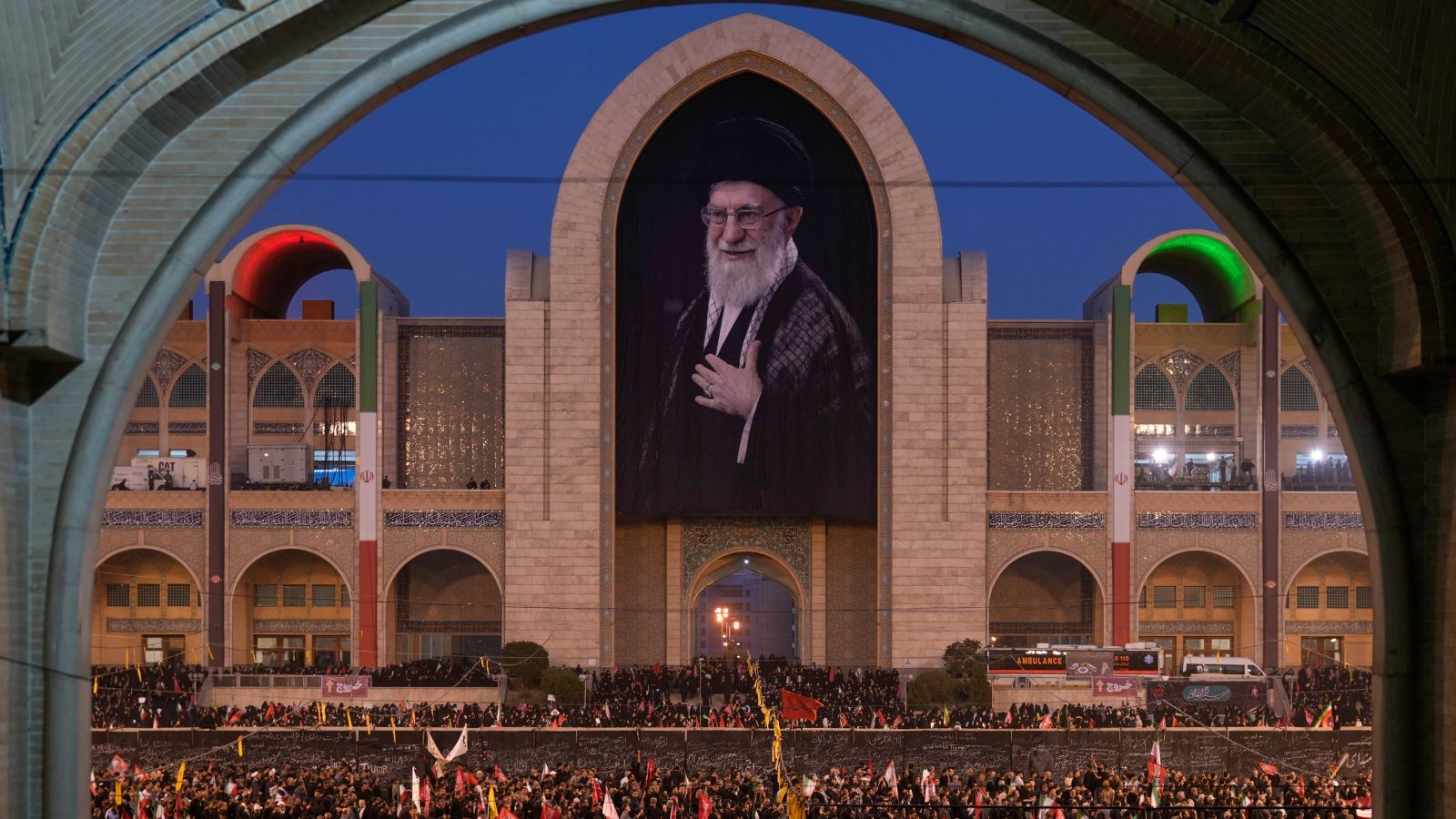
Barely a week after Ayatollah Ali Khamenei was laid to rest in Mashhad, Iran and the United States are trading blows again. The collapse of the ceasefire and the intensification of military hostilities in the Gulf is a reminder that the “third republic” now emerging in Tehran is being forged in the crucible of war and peace with America.
Iran’s internal rearrangement after Khamenei cannot be separated from its prolonged conflict with the US. The nature and terms of engagement with Washington have become the principal fault lines in the struggle to shape the new political order in Iran. The Indian foreign policy community must come to terms with post-Khamenei Iran entering a period of internal restructuring and external reorientation, with important consequences for India’s interests in the Middle East and beyond. It must also pay more attention to the internal debates in Iran on the nation’s future.

For nearly four decades, Khamenei stood at the apex of a state that combined clerical authority with the expanding power of the Islamic Revolutionary Guard Corps. The transition to a new order was bound to be contested. The American-Israeli military campaigns of 2025 and 2026, culminating in Khamenei’s assassination earlier this year, compressed what might have been a gradual political transition into an abrupt one.
The swift elevation of Mojtaba Khamenei as Supreme Leader has not resolved the deeper questions surrounding the succession. There is intense jockeying among the different factions constituting the Iranian establishment. As the anti-government demonstrations at the turn of this year have shown, there is also a serious questioning of the political legitimacy of the Islamic Republic.
What distinguishes Iran’s transition is that it is unfolding in a state of conflict and engagement with the US. The nuclear question, sanctions relief, Gulf security, navigation through the Strait of Hormuz, and Iran’s regional role are all now in play. Every choice the new Iranian leadership makes about escalation or restraint is also a choice about the internal balance of power — and every internal realignment reshapes Iran’s capacity to make war or peace with Washington.
To see where post-Khamenei Iran might be heading, it is useful to view the Islamic Republic’s evolution in two distinct phases. The first republic emerged from the 1979 revolution under Ayatollah Ruhollah Khomeini. It was defined by revolutionary mobilisation, the Iran-Iraq War, and the transformation of a broad anti-monarchical movement into a state dominated by the clergy. Institutions were built around the doctrine of “Velayat-e Faqih” that places ultimate authority in the hands of the religious figure.
The second republic belonged to Khamenei. He inherited a country devastated by the eight-year war with Iraq and rebuilt the Islamic Republic into a more resilient and centralised state. Domestic dissent was tightly regulated, while the Revolutionary Guards evolved into one of the country’s most powerful military, political, and economic institutions.
Externally, Khamenei’s Iran pursued influence across the Middle East through proxies such as Hezbollah and Hamas, invested heavily in military capabilities, and presented itself as the principal centre of resistance to American and Israeli power. The result was a formidable regional presence, but also a deepening economic crisis at home and strained ties with most Gulf Arab neighbours.
The burial of Khamenei marks the symbolic end of Iran’s second republic and the uncertain beginning of a third. Every revolutionary state eventually reaches a point where preserving the state matters more than perpetuating the revolution at home and promoting it abroad. Iran may now have arrived at that moment.
For realists, the question is about the nature and degree of change in Iran, not the inevitability of it. Iran’s relationship with America sits at the heart of the unfinished Iranian debate on the organising principles of the third republic.
The first republic under Khomeini was defined by revolution. The second under Khamenei consolidated that revolution through stronger state institutions, the expansion of the Revolutionary Guards, and sustained resistance to the United States. The third, if it takes shape, will almost certainly be defined by how it answers the American question — whether to persist with confrontation or negotiate a durable accommodation.
That Iran was negotiating with Washington within weeks after the assassination of the Supreme Leader and that talks were going on over the last weekend even amid the mounting military tensions show the difficulty of abandoning the engagement with America. They also show how hard it is to generate an Iranian internal consensus on the engagement with the United States.
Within Iran, hardliners want revenge – in the form of “death to Trump” for the killing of late Khamenei and the continuation of the war against America. Moderates defend the negotiations with the US by calling them a different form of war. Pragmatists argue that a permanent confrontation with America is bankrupting Iran and is unsustainable. The factional lines of the third republic are being drawn around this divide — over the nature, sequence, and the terms of engagement with the US. Beyond the establishment are those that demand an end to the Islamic Republic.
The Islamic Republic was born in revolt against America, and consolidated under Khamenei through resistance to Washington. Tehran is now in the throes of deciding whether its third incarnation of the Islamic Republic can be built on an accommodation with America. The resolution of that issue, in whatever form, will shape the geopolitics of the region and generate new imperatives for India’s Middle East policy.
The writer is contributing editor on international affairs for The Indian Express. He is distinguished professor at the Motwani Jadeja Institute of American Studies, and Korea Foundation Chair on Asian Geopolitics at the Council on Strategic and Defense Research, Delhi

