

5 min readNew DelhiJul 27, 2026 07:20 AM IST
First published on: Jul 27, 2026 at 07:20 AM IST
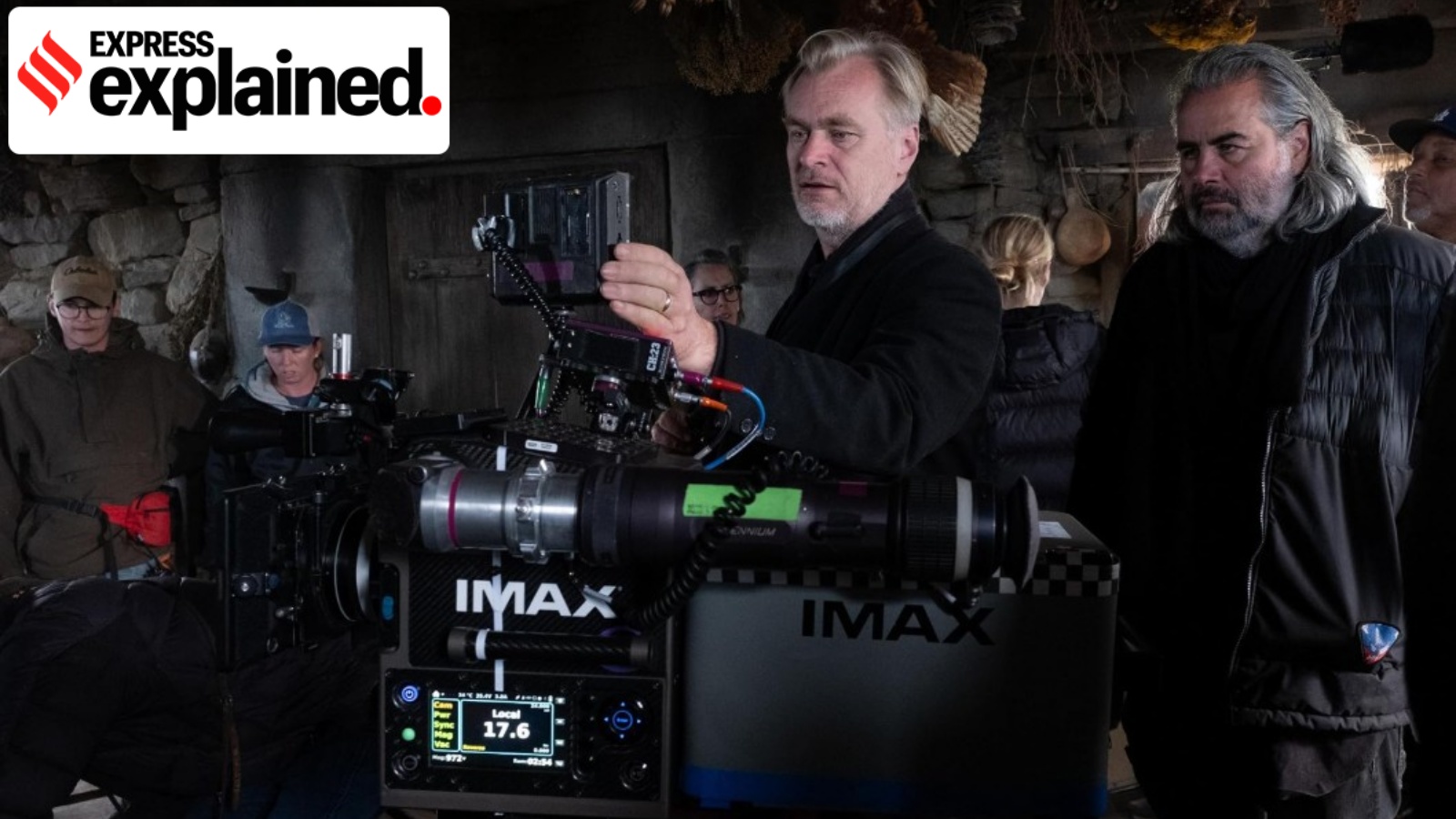
‘A sewing machine in a fight with a stapler’ — that’s how Matt Damon, who plays the lead role in Christopher Nolan’s adaptation of the film version of Homer’s The Odyssey, described the sound of the IMAX cameras rolling and the clatter created by the mechanism that pulled the film past the shutter.
The loud din prevented sync sound capture (the process of recording audio at precisely the same time as video) and was one of the two major challenges with this filming format, the other being that the IMAX camera needed to stop and be reloaded every two-and-a-half minutes or so. Given that the format is so huge, this is the most film the camera can hold at one time, making filming a constant stop-and-go exercise.

Tech breakthrough
For The Odyssey, Nolan inspired the IMAX Corporation — the Canadian production theatre company that designs and manufactures cameras and projection systems — to engineer a soundproof enclosure for housing the camera, which, while being massive and cumbersome, worked to cut down the clatter by a third. According to Preetham Daniel, VP, Theatre Development, India, South East Asia and Australasia at IMAX, this new breakthrough blimp technology will likely be used by more filmmakers in the future. “There was an extensive process to develop the new blimp technology, which was a critical piece of the production on The Odyssey. We anticipate this will be used extensively by future filmmakers, as it addresses one of the main challenges of shooting with IMAX Film Cameras, enabling for the first time sync sound capture,” Daniel told The Indian Express.
The Odyssey is the first feature film shot entirely with IMAX film in the large-scale format, which uses considerably more film than standard 35mm cameras. Nolan has said he used more than 2 million feet — or over 600 km — of film for shooting the movie over 91 days.
Each frame has resolution or image quality up to three times higher than digital. Production challenges included the limited options in processing and colour correction, given the handful of production intermediaries in the business that can handle the requirements of this format. Photochem in Burbank, California, for instance, is the only motion picture film lab in the world that still produces 70 millimeter (mm) prints and the production crew had to rely on this one lab for getting the processing done.
The strip of film used in the format is the highest quality imaging format that’s ever been devised, entailing a massive negative, which, when correctly exposed, printed, and projected onto a huge screen, offers unmatched image quality. Both in terms of unparalleled sharpness and very little visible grain — yielding an image resolution equivalent to 18K and an imposing 1.43:1 aspect ratio. The aspect ratio refers to the proportions between the width and height of the image displayed, and a 1.43:1 essentially lends itself to a near squarish display. Common aspect ratios for non-IMAX formats are 1.85:1 and 2.39:1, which is far more rectangular from a display perspective.
India’s IMAX gap
India, however, shall only be screening digital versions of the film across the various IMAX screens operated across the country. While the most ‘IMAX theatres’ in India offer bigger screens, and brighter projection than regular theatres, they are not in a position to project the taller, squarish film prints that the native analogue format entails and instead have to rely on purely digital formats displayed in retrofitted theatres. IMAX’s proprietary system of high-resolution cameras, film formats, film projectors work best in theaters having steep stadium-style seating and large screens with a tall aspect ratio.
India does not have any commercial cinema equipped to screen the movie in its original IMAX 70mm version. But the Ontario-based, NYSE-listed firm, which has grown significantly in India by expanding its footprint by almost 60% since 2020 to 34 locations, plans to double down on its success here. India has ranked among IMAX’s top ten markets for the past decade, and 2025 marked IMAX India’s best-ever box office year with a record haul of $26 million, including $8 million from global content.
“India is an incredibly important part of IMAX’s growth strategy, and a priority global market… We’ve already made incredible strides in the country — our network in the country has grown by nearly 60% since 2020, with a handful more locations contracted to open this year, and has consistently been one of our top global markets for box office. IMAX is also dramatically expanding our Filmed for IMAX program in India, including the highly-anticipated ‘Ramayana – Part 1’ and ‘Varanasi’, showcasing a continued demand from audiences and filmmakers in India for IMAX. We plan to lean in and continue to build on our existing momentum in the market to fuel further expansion,” Daniel said.

