

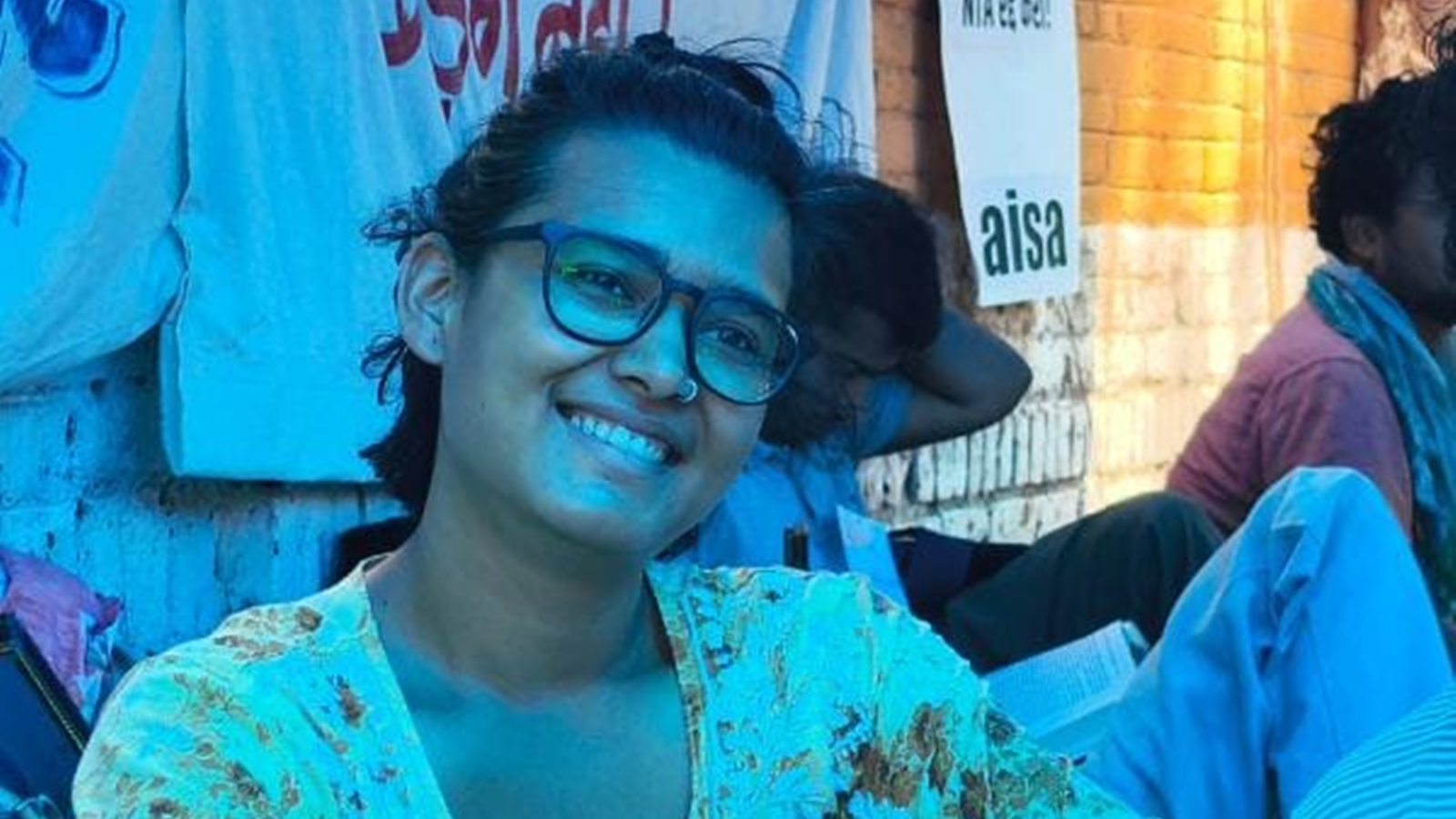
Whenever someone asked Neha how she was holding up through the hunger strike at Jantar Mantar, she found herself looking at another, much older protester, also on a fast, a few metres away.
“There was this 60-year-old man,” Neha said, referring to Ladakhi activist Sonam Wangchuk. “He’s not even from Delhi, and he is braving this (hot and humid) climate. If he is sitting, we will sit for another four days. If he’s sitting for four days, we’ll sit for nine days,” she said.

29-year-old Neha was not on the same platform as Sonam Wangchuk. He occupied the main stage at the Cockroach Janta Party (CJP) protest, while Neha and five other student activists from the Left students’ organisation All India Students’ Association (AISA) protested on a separate platform nearby.
“We got a lot of inspiration from his presence at the protest,” Neha said. At Least Two of her comrades were taken to hospital after some days of fasting. By the end three, including Neha, continued for 23 days, until July 20, when they were persuaded to break their fast by Opposition MPs and leaders of civil society.
As the days passed, Neha lost several kilograms and her body took a toll. But she was convinced that giving up the fast would mean abandoning a generation of students who were angry and frustrated over years of paper leaks and examination failures.
The hunger strike was not a part of the plan initially, Neha, a scholar of Theatre and Performance Studies at Jawaharlal Nehru University, said. “But after we learnt that Sonam Wangchuk would go on a fast, we had a discussion with them (CJP), and decided that as a student organisation we too would go on a hunger strike to demand the resignation of [Education Minister] Dharmendra Pradhan,” she said.
Neha would go on to become one of the most recognisable faces of the movement that eventually culminated in the resignation of Pradhan.
Neha, the daughter of an Army man, was raised in Khatima in Uttarakhand’s Udham Singh Nagar district. After coming to Delhi, she was initially simply studying and trying to find her footing in the city. Then, a Theatre senior at Delhi University’s Sri Aurobindo College introduced her to progressive politics and feminism.
“My senior was a member of AISA, and he introduced me to a political theatre group. It consisted of feminists. From there to AISA was not a very long journey,” Neha said.
“And ever since”, she said, “I stayed there and believed that this was where I should be, and this was where everybody else should also be.” Several years on, after getting a Master’s degree from Ambedkar University and now studying for a PhD at JNU, Neha leads AISA as its national president.
Frustration over paper leaks and the mismanagement of job and admission competitive exams had been building up over years, Neha said. “And we had exhausted every other form of protest,” she said.
“So we thought, OK, this (going on a hunger strike) is another form of protest, let’s explore this as well. Basically, let’s explore everything in pursuit of our demands.”
In the beginning, the protest drew only a small number of people, but Neha and her comrades refused to be disheartened.
“Our hunger strike was anyway about exposing the government…exposing the fact that no matter what the government says, it will simply choose to watch us waste away smack in the middle of the capital of this country, and not have an unaccountable and completely incapable Minister of Education resign,” she said.
So when Pradhan finally quit on Saturday, Neha could not believe it at first. “Earlier too, several memes and fake resignation letters had circulated. So I asked a comrade to read the entire two pages (of Pradhan’s post on X) before I could finally believe that, oh yes, this has happened,” she said.
“We were all hugging each other. We were happy that we would not have to continue the protest at Jantar Mantar. At last, we will be able to sleep,” she said.
But she also knows that her struggle will continue. “As student activists, we know that this is a job that we must keep doing until things are better in this world… Until that happens, I guess we’re all going to be at it. You’ll be asking me what is happening in the movement. And we’ll be there to give you the answer.”

