

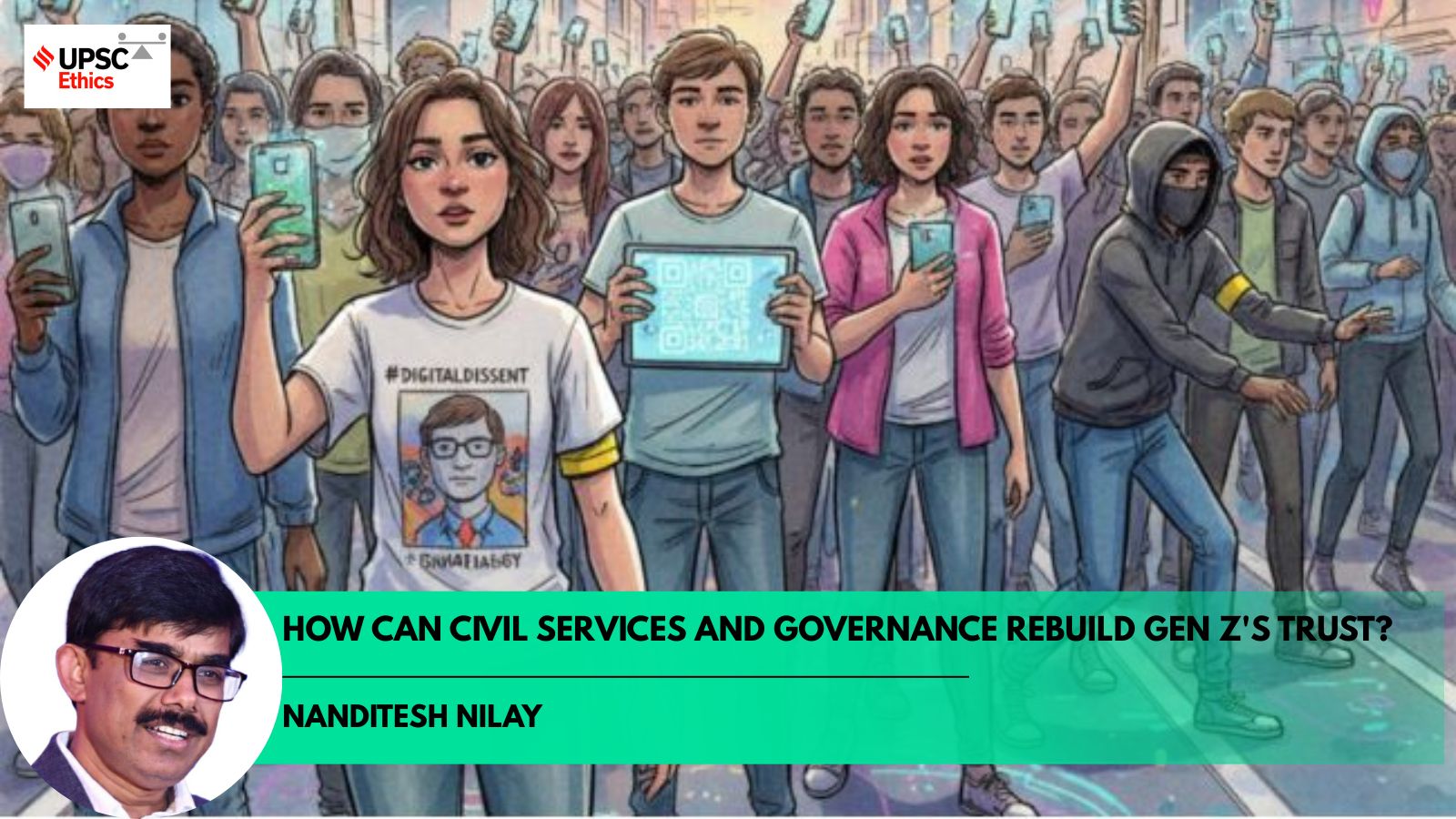
(UPSC Ethics Simplified is a special series under UPSC Essentials by The Indian Express that examines current affairs through the lens of ethics and governance. Today’s article explores a pressing question: how can India rebuild trust among its youth, especially Gen Z, amid recurring controversies and governance issues? Through key GS Paper IV concepts such as public trust, accountability, empathy, and ethical leadership, it examines what institutions must do to restore confidence in the system.)
The late Manoj Kumar captured the fragility of trust in society through words that still resonate: “Kasme vaade pyaar wafa sab, baatein hain baaton ka kya…” Today, those lines reflect a crisis of trust between citizens and institutions.

Recent examination-related controversies have shaken the confidence of millions of students and their families. For young people especially Gen Z, examinations represent years of hard work, sacrifice, and hope. When their credibility is questioned, trust itself suffers. In public administration, trust is the invisible capital that binds citizens to institutions.
India’s youth are expected to carry forward the nation’s development story. Yet repeated governance failures have left many questioning whether the system can uphold its side of the social contract.
The Problem
The concern is not limited to a single incident. Recent events point to a broader crisis of public trust arising from multiple governance challenges:

1. Questions of fairness and procedural integrity: Examination-related controversies have raised concerns about merit, equal opportunity, and the credibility of public institutions.
2. Deficit of empathy in governance: The image of an eight-year-old girl running to save her books from bulldozers became a reminder that development and enforcement actions are often judged by how they affect the most vulnerable.
Story continues below this ad
3. Failures in public safety and crisis response: Whether it is a fire in a residential building, the collapse of public infrastructure, or administrative negligence that costs lives, the pattern remains painfully familiar. Safety protocols exist, rules are framed, and authorities are designated. Yet when crises unfold, the system often appears unable to respond with either competence or urgency.
4. Weak accountability mechanisms: In many cases, responsibility becomes diffused after a crisis, leaving citizens uncertain whether meaningful corrective action has been taken.
Viewed individually, these incidents may appear unrelated. Viewed together, they point to a common problem: the gradual erosion of public trust.
The Crisis
Examples of this erosion are not difficult to find. Examination controversies have raised doubts about whether merit alone determines outcomes. Images of children attempting to save their books amid demolition drives have raised questions about the human face of governance. Preventable fires and infrastructure failures continue to expose gaps between regulations on paper and their implementation on the ground.
Everyone is present: the machinery, the manpower, the regulations, and the institutions. Yet lives are lost, accountability becomes diffused, and public memory gradually moves on. The issue is not merely one of administrative capacity. It is increasingly one of public confidence.
Story continues below this ad
Many students and parents now approach crucial examinations with anxiety that goes beyond performance. Their concern is whether the system itself can be trusted. Can institutions be depended upon to protect the aspirations invested in them? Can citizens rely on public authorities to act fairly, competently, and consistently?
The Ethical Question
Every such incident raises questions not merely about compliance with rules but about the values underlying governance itself. Integrity, accountability, responsiveness, and compassion are often described as the core values of public service. Their real test, however, comes not during routine administration but in moments of crisis. Rules can exist on paper, but ethical governance requires the moral courage to implement them in spirit.
In a democracy, trust is among the most valuable forms of public capital. Citizens routinely place their faith in institutions they cannot directly control. They trust examination bodies to conduct fair assessments. They trust public authorities to enforce safety standards. They trust civil servants to act in the public interest. Such trust creates what ethicists call a fiduciary relationship, one in which authority is exercised not for personal benefit but as a sacred responsibility towards those who have placed their faith in it.
This relationship is inherently unequal. Citizens may scrutinise governments, question policies, and vote out elected representatives, but they cannot oversee every administrative decision. Much of the machinery of governance operates through institutions and public servants who remain beyond the cycle of electoral accountability. Consequently, citizens must rely on them to act with integrity, impartiality, and competence. That reliance is the foundation of trust.
Story continues below this ad
Ironically, many young Indians today place greater trust in markets and digital platforms than in public institutions. Technology companies and online marketplaces have built systems that reward transparency and responsiveness. Consumers expect grievances to be addressed, products to be replaced, and commitments to be honoured. Citizens may forgive inefficiency on occasion, but they rarely forgive a perceived absence of fairness. Procedural justice, the assurance that processes are transparent, impartial, and equitable, often matters as much as outcomes themselves.
This is why examination controversies hurt so deeply. They are not merely about question papers or administrative processes. They are about fairness. They are about equal opportunity. They are about the belief that merit will be respected and that the rules of the game will remain the same for everyone. When that belief weakens, the damage extends beyond a single examination and begins to affect the legitimacy of institutions themselves.
The Way Forward
How can trust be restored?
1. Restore moral sensitivity: The system must recognise that governance failures have consequences that extend far beyond official reports and statistics. A paper leak is not merely a procedural lapse. It is a betrayal of the faith placed by millions of students in a promise of fairness. A preventable accident is not merely a failure of compliance. It is a failure to honour the trust citizens place in public institutions. Empathy and compassion, therefore, are not signs of administrative weakness. They are essential attributes of ethical governance.
2. Strengthen accountability: Citizens must see that mistakes are acknowledged honestly, responsibility is fixed, and corrective measures are implemented. Trust cannot be rebuilt through assurances alone. It requires visible action and consistent conduct.
Story continues below this ad
3. Promote ethical leadership: Ethical philosopher James Rest argued that moral action begins with moral sensitivity, followed by moral judgment, ethical intent, and ethical action. These principles apply as much to institutions as they do to individuals. A governance system that consistently places public interest above convenience, integrity above expediency, and fairness above favouritism is more likely to earn the trust of its citizens.
4. Build citizen-centric institutions: Public institutions must become more transparent, responsive, and accessible. Procedural fairness should be as important as outcomes. Citizens are more likely to trust institutions when they feel heard, respected, and treated fairly.
5. Reaffirm public service values: Integrity, impartiality, accountability, compassion, and dedication to public service must move beyond official codes and become visible in day-to-day governance. Trust is built not through declarations but through consistent conduct.
Perhaps the challenge before India is not merely administrative but ethical. The question is not whether institutions can conduct examinations, build infrastructure, or enforce regulations. The deeper question is whether they can consistently demonstrate integrity, empathy, accountability, and a commitment to public service.
Story continues below this ad
For a nation aspiring to become a developed society, the trust of its youth is not a peripheral concern. In fact, it is the foundation of democratic legitimacy. Development cannot be measured solely through economic growth, technological achievements, or global rankings. It must also be measured through the confidence with which a young citizen looks at the state and believes that the system will be fair.
India’s development story will ultimately be judged not only by what it builds, but by the trust it inspires. If institutions can recover their moral sensitivity and reaffirm their commitment to ethical governance, trust may yet be restored.
Only then will the promise of governance truly align with the aspirations of India’s youth. Only then will the story of India’s rise genuinely belong to its people.
POST READ QUESTION
The relationship between citizens and public institutions is often described as a fiduciary relationship. What ethical values are necessary to sustain this relationship? Illustrate with suitable examples.
Story continues below this ad
(The writer is the author of ‘Being Good’, ‘Aaiye, Insaan Banaen’, ‘Kyon’ and ‘Ethikos: Stories Searching Happiness’. He teaches courses on and offers training in ethics, values and behaviour. He has been the expert/consultant to UPSC, SAARC countries, Civil services Academy, National Centre for Good Governance, Central Bureau of Investigation (CBI), Competition Commission of India (CCI), National Judicial Academy, etc. He has PhD in two disciplines and has been a Doctoral Fellow in Gandhian Studies from ICSSR. His second PhD is from IITDelhion Ethical Decision Making among Indian Bureaucrats. He writes for the UPSC Ethics Simplified (concepts and caselets) fortnightly.)
Subscribeto ourUPSC newsletterand stay updated with the news cues from the past week.
Stay updatedwith the latestUPSC articlesby joining ourTelegram channel–Indian ExpressUPSC Hub, and follow us onUPSC sectionofThe Indian ExpressonInstagramandX.
For your queries and suggestions write atmanas.srivastava@indianexpress.com
Story continues below this ad
PREVIOUS ARTICLES ON UPSC ETHICS SIMPLIFIED:
CBSE row as a case study on accountability when technology fails
NEET Paper Leak: What is ethical governance in public examinations?
Dear UPSC aspirants, how do you know what’s ethical in everyday life
Are humans failing ethically in the AI age?
How fake success claims by aspirants reveal a deeper moral crisis
Minister vs Civil Servant : In governance, mature conversation is the key

