

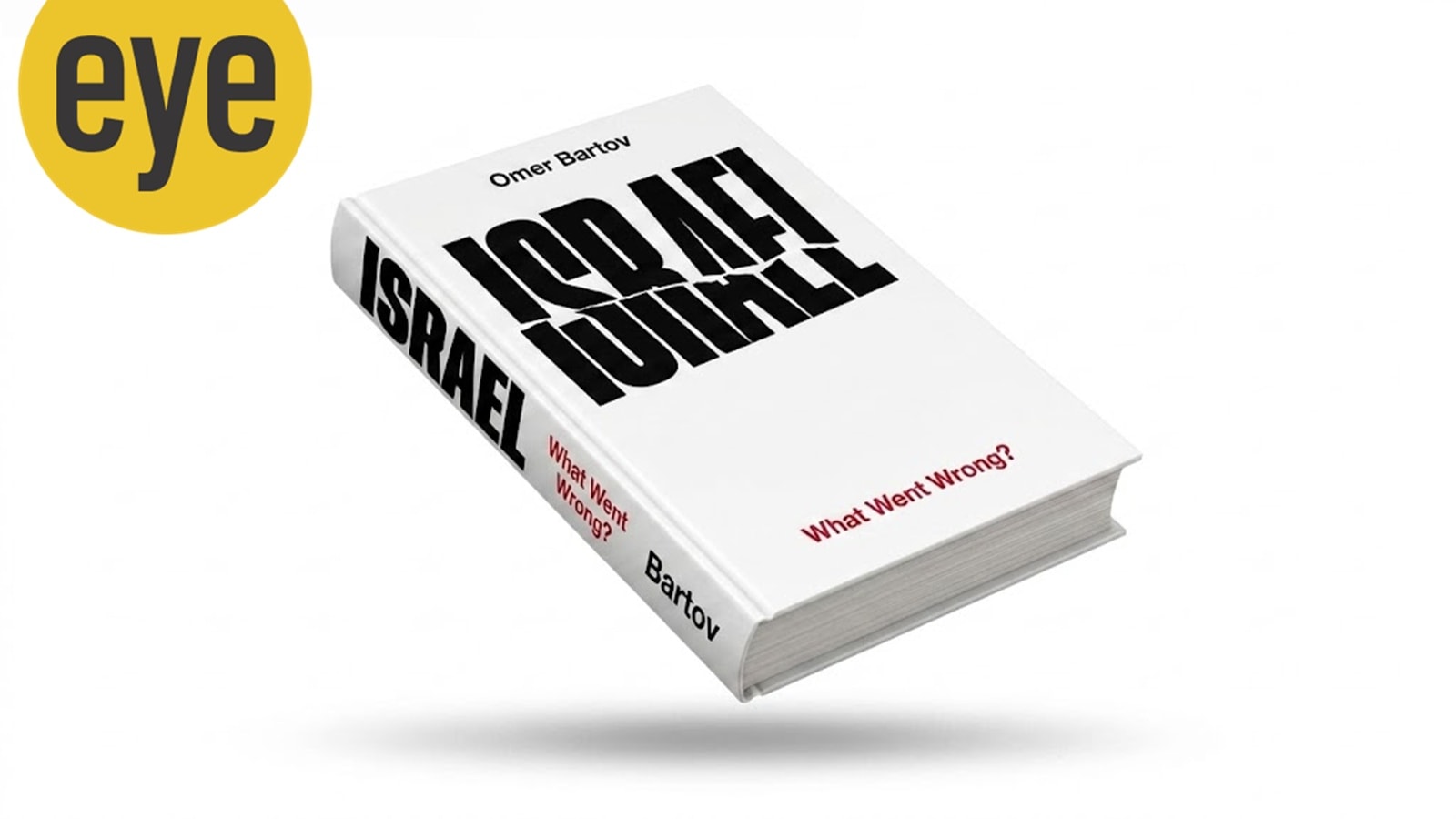
There are books that should be read because of what they say, and those that must be read because of what they say and who says it. Israeli-American historian Omer Bartov’s Israel: What Went Wrong? belongs in the latter category. Bartov is the Dean’s Professor of Holocaust and Genocide Studies at Brown University, and grew up with Zionist ideals and served in the IDF. His book serves as a reckoning, both moral and historical, for the State of Israel. It is essential reading for anyone seeking to understand how a nation founded in the shadow of the Holocaust and under the banner of “Never Again”, now finds itself confronting allegations of genocide in Gaza before the International Court of Justice.
The book traces the origins of the Israel we see today, showing how a series of critical decisions in its formative years set the country on a path of moral and political decline that has left it increasingly isolated on the world stage. Bartov’s lament is unmistakable. The book is animated by a recurring conviction: It did not have to be this way.

Of the many questions the book poses, three stand out, and it is these that distinguish Bartov’s work from much of the existing critical literature on Israel that focuses on its military adventurism or Benjamin Netanyahu’s appetite for perpetual conflict. This Bartov addresses in the first chapter but his book’s lasting significance lies in what follows. These three questions demand serious engagement not only from Israelis but from the wider Jewish public if the “race to the abyss” is to be stopped.
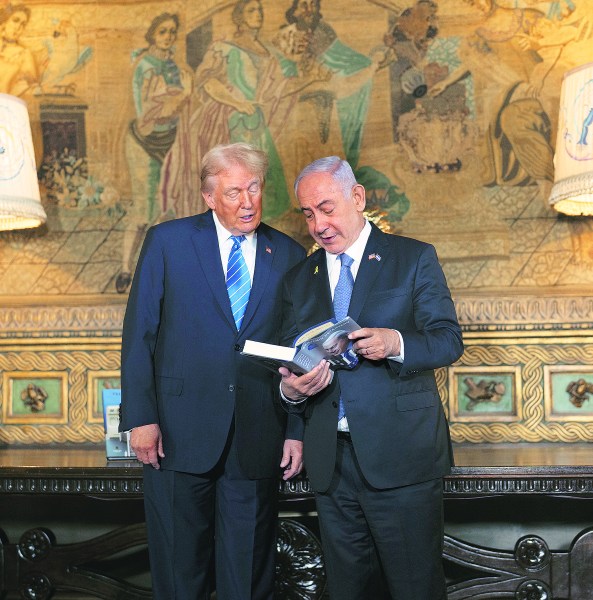 US President Donald Benjamin and Israel’s Benjamin Netanyahu. (Courtesy: NYT)
The first question concerns the distinction between antisemitism and anti-Zionism, one that has moved to the centre of political debate and policymaking in both Israel and the United States. The stakes became evident when, not too long ago, university campuses in the US witnessed arrests, suspensions, expulsions and other disciplinary measures against students protesting Israel’s bombing campaign in Gaza and continued American support for it. That many of these students were branded antisemitic is precisely the conflation Bartov seeks to untangle.
He begins by acknowledging that Judeophobia or antisemitism has a long and pernicious history, culminating in the horrors of the Holocaust. But he argues that anti-Zionism is categorically distinct. Zionism, as an ethnonationalist political project, extended beyond the goal of protecting Jews from persecution and entailed the displacement and dispossession of the existing Palestinian population in the territory that Zionist pioneers described as “a land without a people for a people without a land.” To criticise the State of Israel, whose founding ideology is Zionism, is not, in Bartov’s view, to replicate the antisemitism that Jewish communities have endured for centuries. He navigates this distinction with considerable precision, arriving at what may be the chapter’s sharpest observation: that defining criticism of Israel as antisemitic is, in his words, “the best way to help the current Israeli leadership practise unchallenged extremist, racist policies.”
The second question is about the Holocaust, and this, perhaps, is the most provocative chapter in the book. Bartov frames his inquiry plainly: “It is important to consider some fundamental questions regarding the use and abuse of the Holocaust as a historical event, a traumatic memory, and a warning to future generations.” The chapter explores the Holocaust’s historical uniqueness, its centrality in Israeli political and public life, and how it has become a justification for Israel operating as a unique entity, exempt from the rules and logic that govern other nations.
It takes considerable courage to challenge established narratives around an event as tragic as the Holocaust, and Bartov does not hold back. “The Shoah and the Nakba are inextricably entangled,” he writes. How many Western historians, let alone Israeli ones, would place the Holocaust and the mass displacement of Palestinians in 1948 in the same frame? He goes further, arguing that the catastrophe of the Holocaust became “a vast fig leaf” whose “lamentable effect” combined Israeli “self-victimisation and self-pity with self-righteousness, hubris and the euphoria of power.” Bartov’s conviction is that only by discarding the senseless competition for victimhood and by reflecting jointly on both events can Israelis and Palestinians arrive at any genuine mutual understanding. He concedes, however, that at this juncture, it is a tall order.
The third question concerns Israel’s missing constitution, a striking absence for a country that presents itself as the sole democracy in West Asia. Bartov’s central claim is that the illiberal practices of the State of Israel today — systemic discrimination against Palestinians, the concerted effort to transform the demography of occupied territories, the ongoing judicial overhaul — can all be traced back to “the unresolved question of how a multi-faith state can remain both Jewish and democratic.” Drawing on historical documents, Bartov shows how Israel’s first prime minister, David Ben-Gurion, resisted the adoption of a constitution, and how his approach to Israel’s Declaration of Independence — a progressive document that does address equal rights for all but one not enshrined in any of the country’s laws — was driven entirely by foreign policy and propaganda considerations.
Nowhere is Bartov’s sense of regret more evident than here. A constitution grounded in the Declaration, he writes, would have “served to constrain the worst impulses of Zionism.” For him, this is a missed opportunity that has exacted a high toll on Israeli politics and society, for a commitment to constitutional values and human rights might have produced a public response to Israel’s cruelty in Gaza and the West Bank very different from the “astonishing indifference” he sees today.
Finally, Bartov dedicates an entire chapter to the killing of children in Gaza, describing the silence over it within Israel as the product of a self-indulgent preoccupation with one’s own pain and suffering. At the time of writing, more than 75,000 people have been killed in Gaza, over 20,000 of them children, and more die every day as Israel pays little heed to the October ceasefire with Hamas. Will it end soon? Bartov has his doubts. His conclusion is ominous: Without being compelled to face the limits of its power by the one actor capable of doing so, the US, Israel will continue down this catastrophic path.
This is a book without a happy ending. But it is an essential one, and among the most important contributions to the literature for anyone wanting to know how Israel arrived here and where it is headed.

