

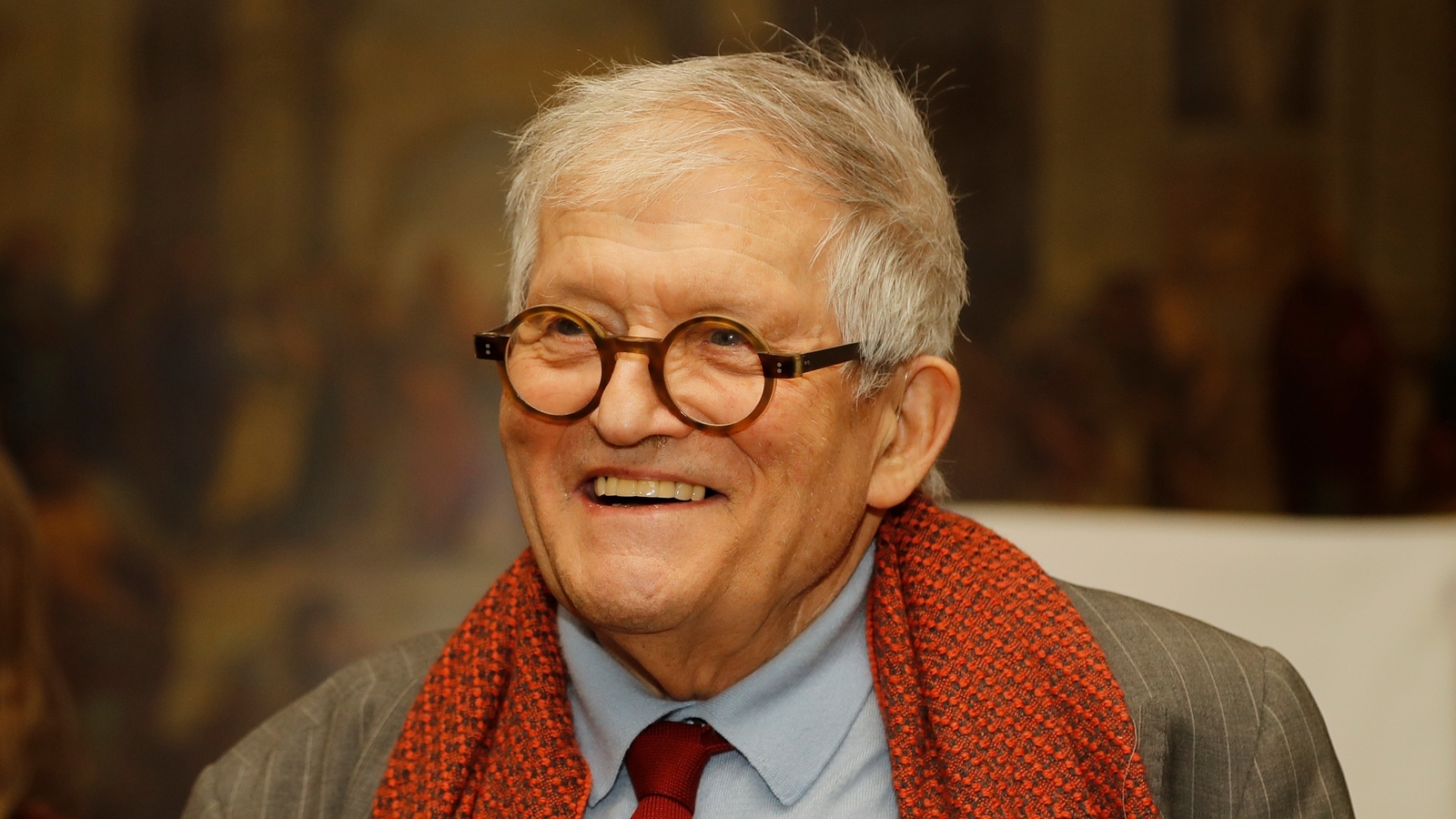
Obituaries often tend to present an inflated image of the deceased. But publications and institutions all over the world calling David Hockney (who died on June 11 at the age of 88) one of the greatest artists of the 20th and 21st centuries is not an exaggeration.
The British pop icon, best identified with his paintings of California pools, was much more. His greatness lay, contrary to what his seemingly flat renditions of the quotidian will have you believe, in his multidirectional open-minded approach towards art. Ironically, the former is very much a product of the latter.

It was his penchant for never playing by the rules that led him to completely disregard the linear perspective — with a singular vanishing point in the distance — of the Western Renaissance masters and, later, of traditional photography, and go looking for a more inclusive visual grammar.
To him, the linear perspective showed the world “from the point of view of a paralysed cyclops.” “But that’s not what it’s like to live in the world, or to convey the experience of living in the world,” he is quoted to have said in Vermeer in Bosnia by American author Lawrence Weschler. The argument was that humans don’t experience (or see) life through a single point of view but through multiple vantage points, and the prevailing mathematical approach at the time stripped art of that emotional subjectivity.
For Hockney, art was a “privilege”, one that was meant to welcome viewers to experience joy, and among the many things that allowed him to open up his art was a deep influence of the “reverse perspective” in Mughal miniatures, perpetuated by his trip to India, reportedly, in the 1970s.
Interestingly, perspective was introduced to Mughal artists in the 16th century during Akbar’s rule with the arrival of Portuguese Jesuits. But even as they adopted the technique, they also adapted it to their intended narrative. So, instead of locking the viewer outside the painting, it opened up the canvas and invited them into it to engage with it how they deemed fit.
When Hockney incorporated this technique into his work, he reinforced the core purpose of art in fostering connections, even if they were centuries apart, and established himself as an artist who was driven by a free-spirited curiosity rather than pure logic.
In his 1984 lithograph, The Perspective Lesson, from the Moving Focus series, he literally crosses out a drawing of a chair executed in the Western perspective — away from the viewer — and redraws it in reverse perspective to bring it in.
Another example is Tyler Dining Room (1984), rendered in the quintessentially bright Hockney palette. In the lithograph, featuring a dining room with a large table and several chairs around it and related paraphernalia on the walls and ceiling, the elements are stacked rather than overlapped to create an inviting lens rather than a distancing one, much like the folios in the Akbarnama, giving the impression that the viewer is part of the scene. A similar experience is evoked while viewing Hotel Acatlán: Second Day (1984), where the image offers multiple moving perspectives.
This “Hockneyed” distortion in his works is, in fact, an extension of his whimsical personality. His self-admittedly “quite serious but cheeky” nature is perhaps best encapsulated in a 1999 Vogue photograph of him wearing a blue cap and his famous round glasses covered with paint squiggles. This whimsy is also what made him an artist who created art for art’s sake, without making the distinction of fine art or otherwise.
His open-mindedness meant he never saw art as a curriculum but as a source of unbridled joy, and traditions (such as the Mughal miniature), not as a relic for the museum but as an evolving source of innovation.
The writer is associate editor, The Indian Express. trisha.mukherjee@expressindia.com

