

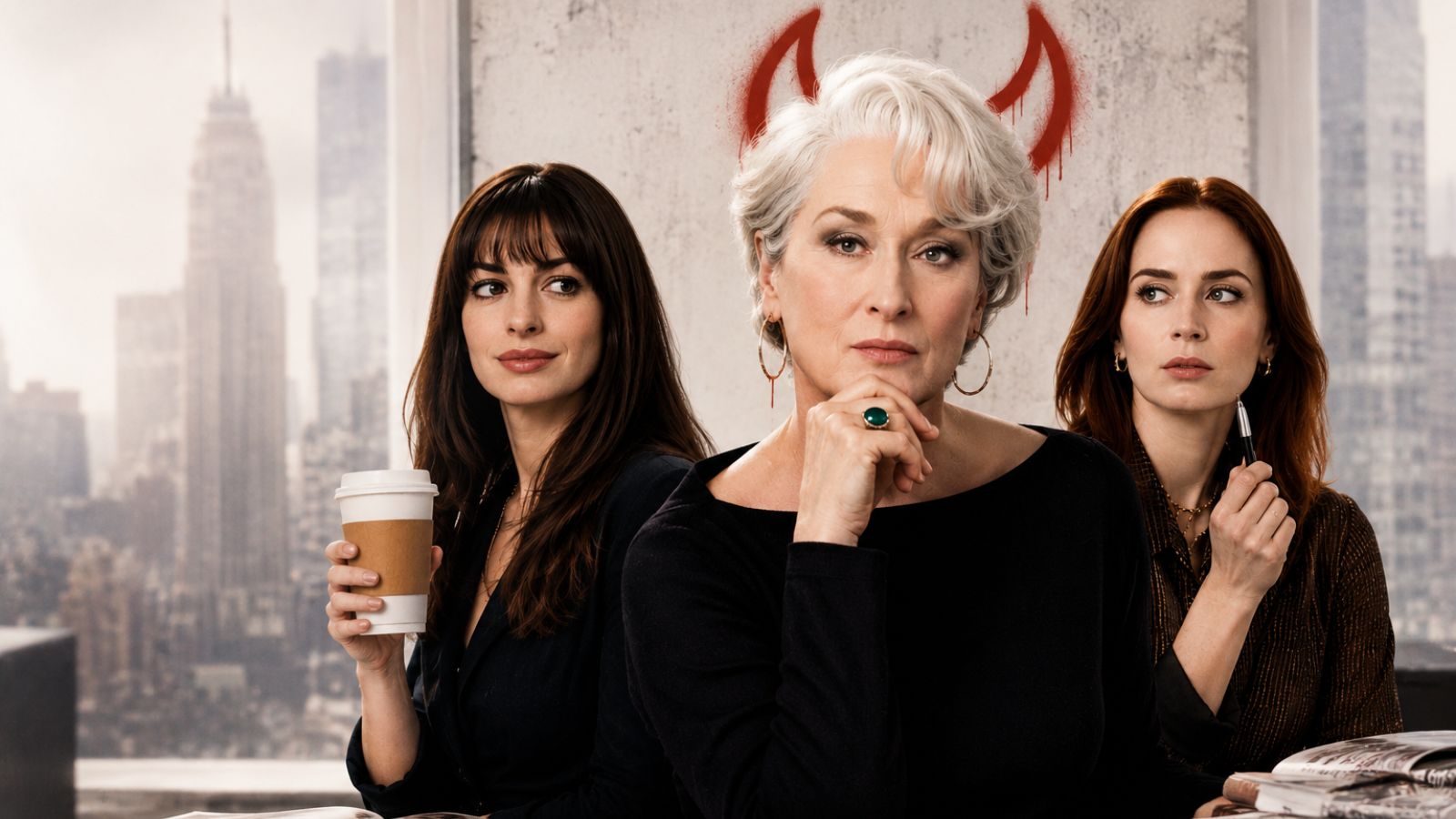
Except for their very refreshing faces, a lot has changed for Miranda Priestly, Andy Sachs and Emily Charlton – the leading women of The Devil Wears Prada’s sequel – in the 20 years since they were last seen on the big screen. You see that as soon as Andy (Anne Hathaway) is on a stage, collecting an award for her journalism work, and announcing feistily that she and her entire team at a magazine had just been sacked.
Straight off, you are thrown into the new world of journalism where print was pushed aside for digital versions, a story was as good as the number of views it scored, and hardworking journos suddenly found themselves out on the street, without a job. This world was starkly different from the one a young Andy had inhabited 20 years ago when she worked for the redoubtable Miranda (Meryl Streep) at an elite fashion magazine. Andy, of course, had the uptight Emily (Emily Blunt) for ‘company’. Unsurprisingly, all three had split ways, finding their own very varied paths.

Miranda Priestly, but softer
What has also remarkably changed is Miranda’s formidable ways. The woman who could send shivers down your spine just by looking at an intruder who walked into her world (cue: the iconic blue-sweater scene in part one), has mellowed down – almost too noticeably. This Miranda is introduced with a big blunder she made at the magazine, is shouted down by the owner, and is kept in check by Amari, her new assistant – a role she had, in her previous avatar, given to people she yelled at and made miserable. New-Miranda is not even told of the new addition to the team when an overly friendly Andy walks in and assumes the welcome she wasn’t offered.
Of course, the old Miranda surfaces all the time – insulting, belittling, condescending. Only now, she has to allow Amari to censor her when her choice of words crosses the line. The only constant, in all these years, is the sweetness of Nigel (Stanley Tucci), still letting Miranda sideline him as he stands by her through the tests of time.
There is no mistaking the nod filmmaker David Frankel and writers Aline Brosh McKenna and Lauren Weisberger are giving to the evolving work culture – of getting it politically correct and exposing toxic practices. It also seems to acknowledge that niceness at work is now a looked-down-upon quality – which is perhaps why Nigel still remains Nigel, the sidekick, notwithstanding his much-belayed five minutes in the limelight.
Lauren, the author of the novel that inspired the original The Devil Wears Prada in 2006, had based it on her brief experience of working under Anna Wintour at Vogue.
The female boss question returns
Naturally, the ever-topical question of what it is like to work under a female boss arises again. Miranda, in many ways, is the stereotypical picture of a horrible boss – the one who keeps you on your toes 24 hours a day and still can’t remember your name or face (her assistants were collectively called ‘the Emilys’).
Story continues below this ad
She is not entirely unimaginable. I have worked with several women bosses and even though a few of them could be intimidating, it was still admirable the way they commanded respect from equally senior men by their sheer will not to bend. It would not have been easy reaching that place, especially in an earlier era when even the idea of a working woman was grudgingly accepted. Over the years, theories floated about the tough face women had to show, as that was the only way they would be taken seriously.
Some were known to take the toughness to another level, crossing ethical limits. Only, toxicity — or plain old meanness — can be just as damaging wherever it comes from, and the gender of the source matters little to a suffering victim.
Scores of studies and surveys have been done over the years to understand the ease of working under a female boss. While earlier studies found employees, including women, finding it more difficult to work under a woman boss, newer reports give a different picture.
The Gallup study in 2017 found, for the first time, that a majority of employees they surveyed did not have a preference on the gender of their boss, and that women under the age of 50 actually preferred a female boss. This was also the finding of American Professor of Economics Martin Abel, who concluded that younger workers could take criticism from their female bosses much better than their older colleagues. In other cases, criticism coming from a female boss was harder to face because of the gendered expectation of female behaviour, he wrote. Women leaders were expected to give more praise while men were expected to criticise.
Story continues below this ad
A workplace that has finally changed
Another Economics Professor, Corrine Low, in her 2025 book Having It All, wrote about how working mothers struggled to keep it together in a world designed to accommodate men.
The writers of The Devil Wears Prada’s sequel have clearly taken into account the increasing tribe of women bosses smashing stereotypes and becoming able leaders who could keep a place running smoothly without having to appear intimidating. In 2026, neither Andy nor Emily seem afraid or overly keen to please Miranda. They have grown into confident women who could lead newer, younger forces on their own without breaking character. It is heartening to see Miranda herself adjust to this new reality and almost, almost seem friendly with her old Emilys.

