

At this juncture in Tamil Nadu politics, every leader is claiming to respect the people’s mandate while appearing to simultaneously search for ways around it. That is at the centre of one of the strangest post-election moments in the state in decades.
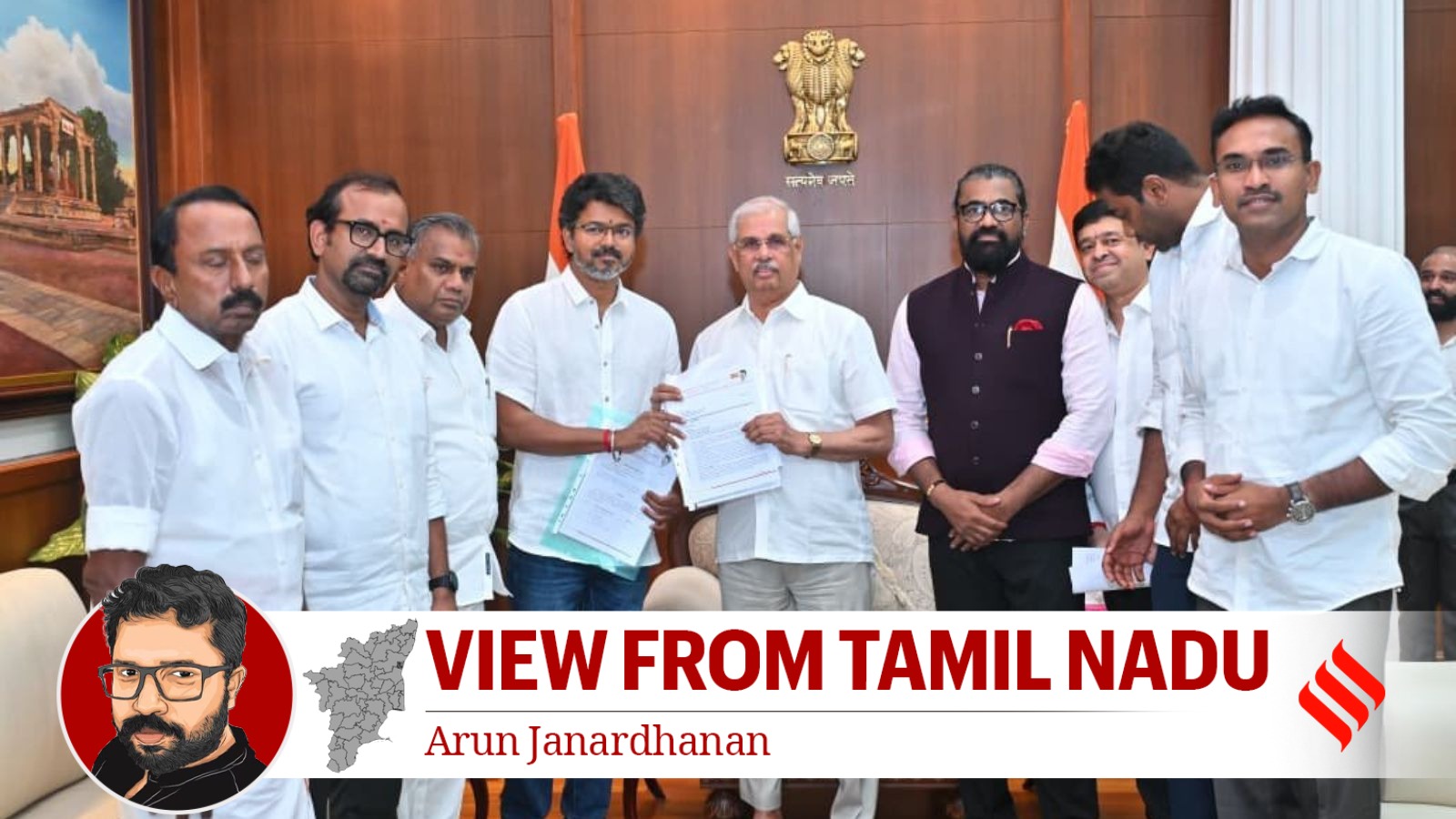
Actor Vijay’s Tamilaga Vettri Kazhagam (TVK) emerged as the single-largest party in the Assembly elections as voters pushed the DMK out of power and also refused to back the AIADMK, which had been the primary Opposition force. The message was disruptive and straightforward: people wanted something new, even if they were not fully sure of what that “new” meant.

However, the magic number is 118 — the halfway mark in the 234-member Assembly — and Vijay does not have it yet. And suddenly, parties that spent months being dismissive about a film star’s political seriousness are now spending sleepless nights calculating how to stop him from taking office.
In the last few days, politics in Chennai has been fuelled less by ideology and more by the imperatives of emergency risk management. Resorts have been filled up, WhatsApp and Signal invitations have travelled between parties, the Governor became a central character in the unfolding drama, and leaders who fought each other for decades quietly opened backchannels with the help of a real estate baron. Enemies began speaking the language of coordination, allies stopped trusting one another, and everybody started counting.
‘Casino politics’
The most revealing aspect of this crisis is not Vijay’s inexperience but the fear he has triggered. Inside sections of both the DMK and AIADMK, the fear is not merely about losing power for five years. Tamil Nadu politics remembers history too personally for that. The state still carries the memory of M G Ramachandran’s rise like an unresolved political trauma. MGR was initially dismissed as “just an actor” too. Then he ruled for a decade. Jayalalithaa inherited his legacy and extended it further.
Now, in quieter conversations across party offices, another concern has emerged: what if Vijay’s win is the start of another long political era and what if this is not a temporary wave but the beginning of a similar decades-long run?
That worry explains many otherwise bizarre developments. A senior DMK leader described the unfolding events as “casino politics”. Another spoke of becoming emotionally detached from the process itself. “Few individuals are gambling with institutions now. Everybody else is being dragged onto the table,” he said.
The gambling metaphor is apt. Tamil Nadu politics at the moment feels like a giant card game played under Constitutional lighting. As he struggles to get across the finish line, many of Vijay’s supporters ask what is sacred about the number 118. If lakhs of people voted for change, why should procedural matters prevent the largest party from governing first, they ask. The counterargument, of course, is Constitutional stability. Assemblies run on numbers and not sentiment. Both arguments are politically valid, and that is what makes this moment volatile.
The DMK and AIADMK publicly insist they are not sabotaging Vijay. Let him prove his majority; if he succeeds, he governs, but if he fails, alternative options will be in play, they say.
Behind the scenes, there are overlapping fears, calculations, and resentments. The Congress’s sudden support for the TVK deepened the crisis dramatically. What initially looked like Vijay’s breakthrough began isolating him from NDA-linked possibilities almost immediately. The BJP does not want the Congress to enter the government in Tamil Nadu through Vijay. Sections within the DMK are equally furious, though for different reasons. From their perspective, the Congress enormously benefited from their alliance for years, including Lok Sabha seats, Assembly constituencies, and organisational survival. And then shifted camps within hours of the verdict. The INDIA bloc in Tamil Nadu has effectively cracked open.
Then there was a complaint that initially sounded funny. The TVK’s outreach to other DMK allies such as the CPI, the CPI(M), and the VCK revealed a cultural clash. Some of those parties privately complained that coalition invitations arrived through WhatsApp messages instead of formal visits. Tamil Nadu’s older parties still operate through rituals of respect, hierarchy, office visits, long consultations, and symbolic seriousness. The TVK operates like a movement born in the age of reels, screenshots, and digital immediacy. One side sends emissaries while the other sends PDFs. The old guard sees this as immaturity, but the TVK sees it as efficiency.
A deeper concern
And somewhere between these two political languages sits an entire generation of younger voters who may not fully care about ideological grammar anymore. That is the deeper worry inside the establishment, one of the reasons for the proposed DMK-AIADMK alliance.
For decades, Tamil Nadu politics was built on ideological identities — Dravidianism, social justice, anti-Hindi mobilisation, caste arithmetic, welfare structures, rationalist language. Vijay has upended that, with his critics saying his party has little ideological depth. That criticism is not entirely unfair, as much of the TVK’s appeal runs on emotional familiarity, anti-corruption language, cinematic symbolism, and the promise of disruption.
Yet dismissing the support for him as “mindless voting” may itself be a misunderstanding of the present moment. Younger voters did not grow up in the emotional world of the anti-Hindi agitations or the old Dravidian movement. Their political language was shaped by the Internet culture, precarity, aspiration, memes, and a distrust of entrenched elites. To many of them, Vijay was not an ideological answer but a medium to interrupt the old establishment politics. The dilemma is that the more the established players try to stop him, the stronger the interruption begins to look.
This week produced scenes almost impossible to imagine a month ago. AIADMK legislators moved into resorts while rumours spread of DMK support from outside; Left parties debated whether supporting Vijay would destroy old alliances; the Congress tried to present itself as protector of “secular Tamil Nadu”; BJP-linked calculations shaped decisions from a distance; and the TVK itself struggled to handle negotiations without appearing chaotic.
Then came the horse-trading allegations involving an AMMK MLA, support letters, photographs sent through WhatsApp, and midnight reversals. The spectacle briefly resembled political theatre scripted by too many writers at once.
Yet beneath all this lies a serious question. What happens when voters demand change, but institutions, alliances, arithmetic, and old political bosses collectively resist the speed of that change? Tamil Nadu does not fully know the answer yet.
No matter how things eventually pan out, something larger has already changed. For nearly half a century, Tamil Nadu politics functioned like a predictable inheritance battle between two Dravidian giants. This election disrupted that certainty. The old bosses now appear less like permanent rulers and more like nervous custodians of a weakening arrangement. And that may be the real story here: not merely that Vijay won, but that the system suddenly realised it could lose. The question now is whether the old political class is willing to recognise that change and whether it still has the language to speak to people who were clearly asking for something different.

