

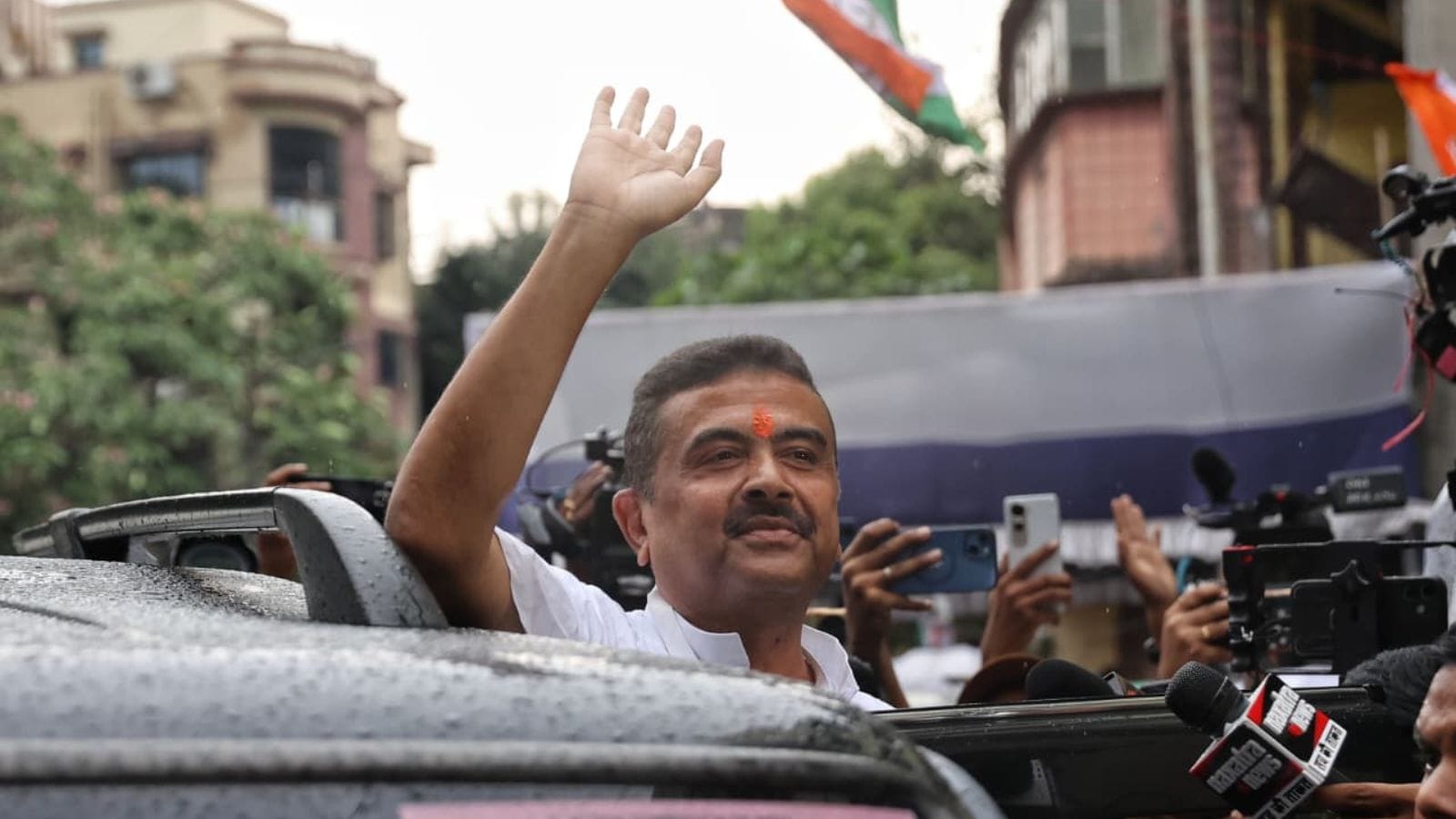
The elevation of Suvendu Adhikari to the Chief Minister’s post in the BJP’s first government in West Bengal marks the continuation of a remarkable trend — the party’s willingness to reward those who crossed over to it from other parties, especially in states where it has risen to power recently.
While the BJP generally chooses the CM from among its seasoned leaders or workers in its core states, the party has also been open to expanding and reinforcing its organisation in traditionally weak states by inducting leaders from other parties.
In states where it has been well-entrenched too, the BJP ropes in leaders from other parties, but seldom rewards them with the top post, which is generally reserved for long-time insiders – Bihar being an exception in this regard at present.
Suvendu Adhikari
Adhikari, who has taken oath as the West Bengal CM after the BJP’s first-ever victory in the large eastern state, was earlier with the Mamata Banerjee-led Trinamool Congress (TMC), where he was a close aide of Mamata, whom he has now defeated twice in direct contests. In 2007, he played a key role in Nandigram’s anti-land acquisition agitation spearheaded by Banerjee – a movement that brought her to power in 2011.
However, by 2020, Mamata’s close lieutenant drifted away from the TMC as he felt sidelined, and switched to the BJP. Adhikari went on to defeat Banerjee from Nandigram in the 2021 polls, showing that his hold there was stronger, and has repeated the feat from Bhabanipur in 2026.
In Bengal, the BJP has gone from drawing a blank in the 2011 Assembly polls to winning 207 seats out of 293 in the recent elections, indicating that the electoral surge in the state has preceded the development of a robust party organisation and leadership at the grassroots level across the state. In such a scenario, the party has chosen Adhikari, an established leader, as the CM despite the fact that he joined it just six years ago.
Himanta Biswa Sarma
Before Adhikari in Bengal, the trend was seen in Assam. The current CM and BJP leader, Himanta Biswa Sarma, had been a prominent Congress leader and minister in the state till 2014. In the 2011 Assembly polls, he defeated Prodyut Bora, a key figure of LK Advani’s campaign team for the 2009 Lok Sabha polls, from Jalukbari by a huge margin – Sarma secured 72.1 % vote share as against Bora’s 12.6 % votes.
Story continues below this ad
Sarma finally left the Congress suddenly in 2015 owing to differences with then CM and party veteran Tarun Gogoi. He had then reportedly even met Rahul Gandhi in a last bid to get a better deal for himself, but claimed to have got upset as Gandhi was apparently “feeding biscuits to a dog” rather than listening to his concerns.
After joining the BJP, he became instrumental in the rise of the party in Assam. The BJP, which was a small player in Assam earlier, came to power in the state for the first time in 2016. At that time, it made Sarbananda Sonowal, who had a background in the AGP, the CM. After its second victory in 2021, the party however appointed Sarma as the CM and shifted Sonowal to the Centre as a Union minister.
While Sonowal was ideologically never the opposite of the BJP – it was on his petition that the Supreme Court had struck down the IMDT Act that put the onus on the state to prove that someone was an illegal immigrant – and just seamlessly merged his “anti-infiltration” position with the BJP’s stand, Sarma was a quintessential Congress leader who is now one of the most strident Hindutva CMs of the party.
Pema Khandu
In Arunachal Pradesh, in 2016, 43 of the 44 Congress MLAs, led by then CM Pema Khandu, joined the People’s Party of Arunachal (PPA), an ally of the NDA’s North-East Democratic Alliance (NEDA). Two months later, Khandu split the PPA itself, walking away to the BJP with 32 MLAs. While Khandu remained the CM, he was able to switch from a diminished Congress to a formidable BJP ruling at the Centre. In Arunachal Pradesh, the BJP was traditionally a weak force.
Story continues below this ad
N Biren Singh
In Manipur, former CM N Biren Singh was a Congress leader and a minister in its government before he joined the BJP in 2016. In 2017, the BJP formed its government in the state, elevating Singh to the CM’s role. Manipur is also a state where the BJP has risen in the last few years.
Manik Saha
Tripura CM Manik Saha also has a background in the Congress. He switched to the BJP in 2016 and became president of its state unit from 2020 to 2022. After being elected as an MLA in 2022, Saha became CM the same year after party leader Biplab Kumar Deb stepped down from this post. Tripura, which had earlier seen a CPI (M) government for 25 years, saw the BJP storming to power in 2018.
Samrat Choudhary
Samrat Choudhary, the first CM of the BJP-led government in Bihar, joined the BJP only in 2017. Before that, he had a long stint in the RJD and was also with the Janata Dal (United). Thus, despite Bihar being a state where the BJP has had a strong influence for long, it has installed a relatively recent party entrant as the CM.
There are reasons for this. The BJP, traditionally an “upper caste” party in Bihar, seeks to woo the OBCs in large numbers to retain its primacy in the state. The Yadav community has been with the RJD led by Lalu Prasad and his son Tejashwi Yadav. Kurmis have been with the Nitish Kumar-led JD (U), while Upendra Kushwaha has tried to project himself as the leader of the Kushwahas with limited success.
Story continues below this ad
Samrat Chaudhary belongs to the Kushwaha/Koeri community, which has made him crucial for the BJP’s scheme of things in the state.
Given that Kurmis and Kushwahas, often called the “Luv-Kush” castes, are sometimes perceived as a larger bloc, the BJP is trying to woo these castes in particular and the OBCs in general. After the death of Sushil Kumar Modi, the BJP did not have a heavyweight OBC leader in the state.

