

4 min readPuneMay 9, 2026 05:53 PM IST
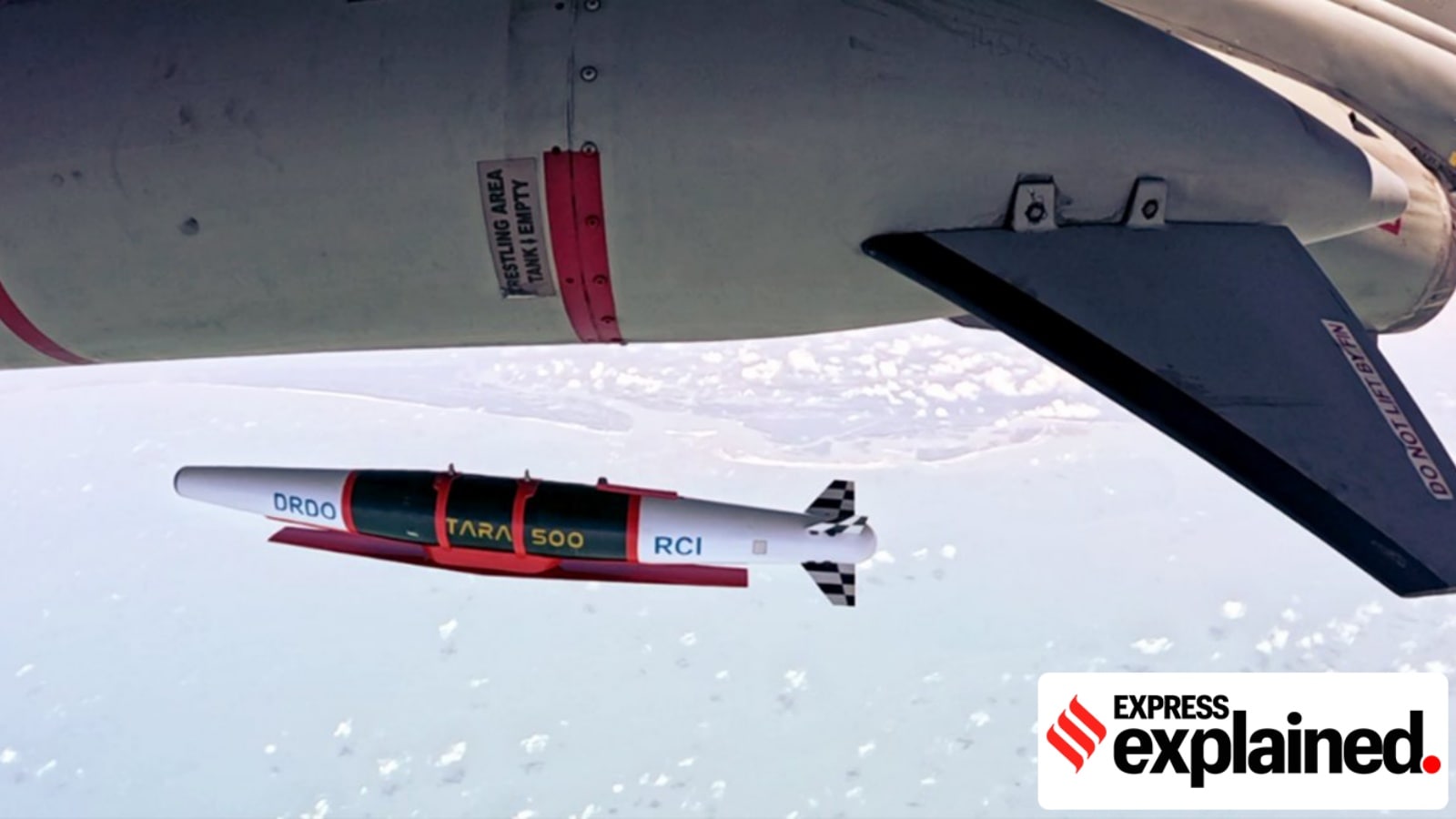
The Defence Research and Development Organisation (DRDO) and the Indian Air Force (IAF) on Thursday (May 7) successfully carried out the first flight trial of a system that can transform an unguided missile into a guided one.
The homegrown Tactical Advanced Range Augmentation (TARA) system is essentially a kit that can be attached to a conventional missile. This kit helps the missile glide over long distances, and accurately strike a target. Here’s a look at why this system is strategically important.

How does the system work?
The TARA glide weapon system is primarily a modular kit that can be attached to a conventional unguided warhead. DRDO scientists say the system can be fired from multiple fighter jets in the IAF’s service.
Once released from an aircraft at a certain altitude and speed, foldable wings and aerodynamic surfaces come into play, allowing the weapon to glide over long distances instead of falling directly onto the target. An on-board navigation and guidance system corrects the missile’s flight path to improve its accuracy.
The speed at which the aircraft is moving at the time of the launch is a key factor in this system’s operation.
The system is believed to use a combination of inertial navigation and satellite-based positioning to steer the missile towards the target.
The TARA system glides, rather than relying on a rocket motor. This makes it lightweight and cost-effective while still extending the missile’s range.
The modular design also means the kit can potentially be integrated with different classes of warheads depending on requirements.
Strategic and logistic significance
Strategically, TARA is significant because it enhances the IAF’s stand-off strike capability. This means an aircraft can hit targets from a distance that puts it out of the reach of air defence systems.
Story continues below this ad
In a battlespace, the capability to accurately strike a target from a distance can increase the chances of a fighter jet’s survival and lend it greater flexibility.
Unguided bombs, which are referred to as gravity bombs or dumb bombs, can thus be upgraded to smart bombs, or precision-guided munitions, with relatively low effort. This can reduce the need to develop entirely new missile systems.
This approach can substantially reduce costs while allowing rapid scaling of precision strike inventory.
The use of indigenous low-cost systems and its production by Indian industry partners will also reduce import dependence.
It is learnt that three TARA versions, with different weight variants, are being produced. These are to be used with warheads of different weights ranging from 250 to 500 kg.
Path to deployment
The TARA system was tested from an IAF fighter off the coast of Odisha.
Story continues below this ad
TARA has been designed and developed by the Hyderabad-based DRDO facility Research Centre Imarat (RCI) in collaboration with other DRDO laboratories and industry partners.
The successful flight trial is a critical milestone in the weapon’s development. This will pave the way for a series of developmental, validation and user trials before induction into the service.
All these trials will evaluate the system’s guidance accuracy, range, reliability, performance from different platforms, and effectiveness under varied operational conditions.
“It is the first glide weapon to utilise state-of-the-art low-cost systems. The development of the kit has been undertaken with Development cum Production Partners (DcPPs) and other Indian industries, which have already started the production activity,” the Defence Ministry said Friday.
Defence Minister Rajnath Singh has congratulated DRDO, IAF, DcPP, and the industry for the flight-trial, describing it as a significant development in advancing India’s indigenous defence capabilities.

© The Indian Express Pvt Ltd

