

The artificial intelligence (AI) race has moved beyond the realm of assistants and chatbots that unswervingly answer according to the user’s whim. Conversational chatbots have evolved into AI agents that can work on almost any tasks in an enterprise workflow, and the battleground has shifted to productivity. Perhaps this is why big tech and AI companies are shifting their focus from AI models to offering a unified experience from a single interface.
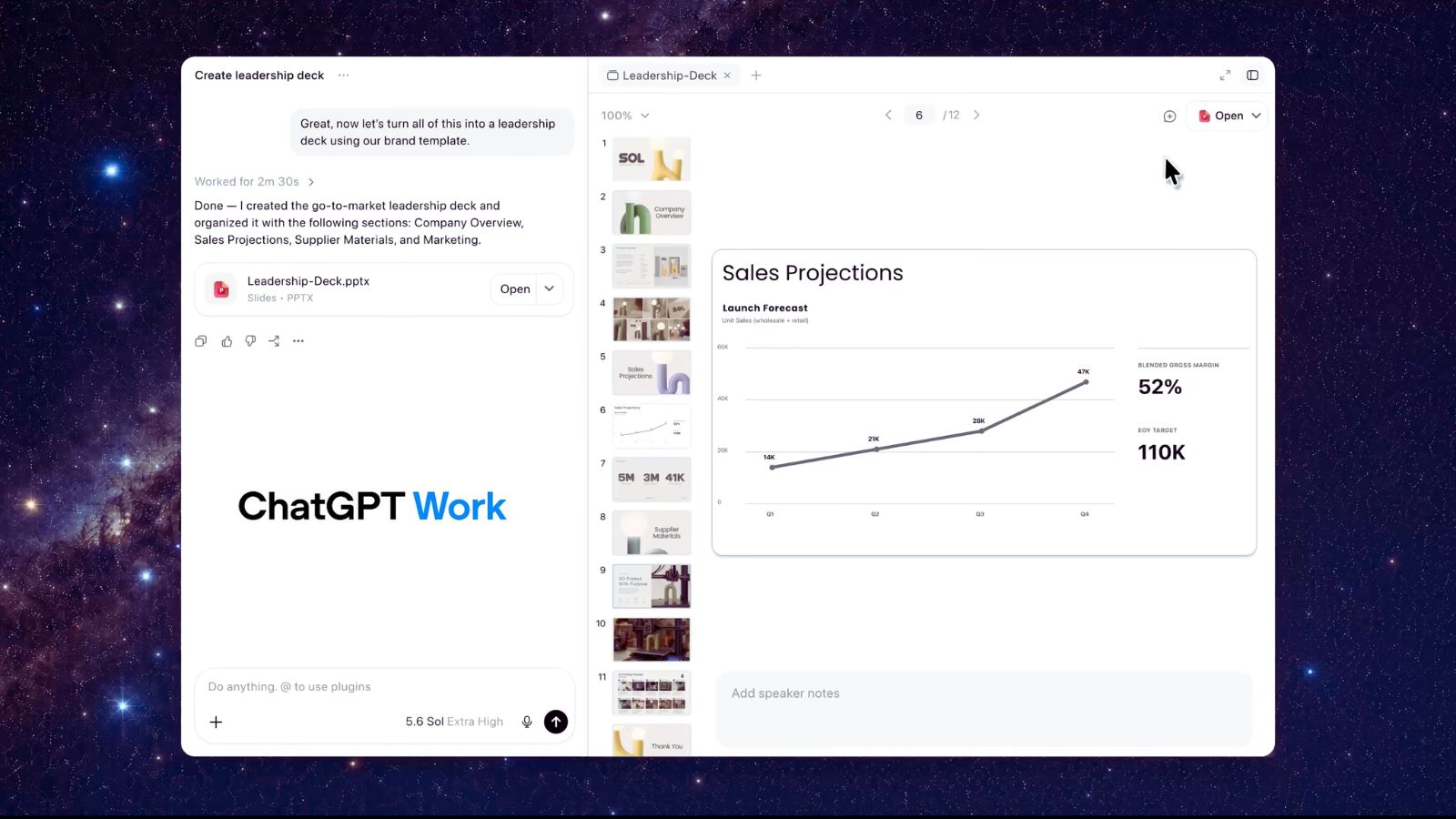
OpenAI, on July 9, launched the GPT-5.6 model family that consists of Sol, Terra, and Luna – AI models that are tailored for distinct needs with different levels of performance, speed, and cost. The announcement coincided with ChatGPT Work, an AI agent that has been designed to perform end-to-end tasks instead of plainly answering questions. ChatGPT Work has GPT-5.6 as its base operating agent. On the sidelines of the launch, indianexpress.com had an exclusive peek into the new models, demonstrated by Gabriel Chua, Developer Experience Engineer at OpenAI.

ChatGPT Work brings Codex, OpenAI’s AI software engineering agent that acts as an agentic partner, into the main interface. According to OpenAI, about a fifth (20 per cent) of the people using Codex were knowledge workers, and there has been an exponential demand for agentic AI.
Considering the massive demand, Codex is not only used as part of the main developer tool but also as part of Work mode in ChatGPT. While the regular chat mode appears on the left-hand side of the desktop, there are Work and Codex, the modes on screen now that let users explore outputs with spreadsheets, interactive dashboards, complete websites, etc. Similarly, on the desktop or in the browser, with the latest update, users will see a toggle across the top that allows them to switch between Chat and Work, and this is also available on mobile.
Productivity needs on the go
With ChatGPT Work, users can have access to all their productivity needs on the go. OpenAI is capitalising on this ease of access to bring forward a unified experience for users, essentially bringing all the tasks under one umbrella, something that has been in the offing for quite some time under the guise of a ‘super app’. This experience is also allowing users to connect with tools such as Slack, Google Workspace, Microsoft 365, etc., services that they are already familiar with and have been using in their day-to-day work.
With intensifying competition from peers, OpenAI is intending to shape ChatGPT into a single destination, and the new family of models bundled with ChatGPT Work is a step in this direction. The AI company sees this as a new dawn, essentially the first time a billion people have access to agentic AI in their pocket.
During the demo, Chua showcased three unique use cases – ChatGPT as chief of staff to help users get on top of tasks across multiple communication tools, for post-event market analysis, and as a tool to offer a recap for an event organised recently. In the first, he asked ChatGPT to scan his Gmail, Slack messages and Google Calendar and summarise what he needed to do that day, then set it up to repeat automatically each morning and to send hourly reminders to teammates. “With access to these different tools, chat is able to take action on your behalf by reading, synthesising, and fundamentally helping you get the job done,” Chua said, describing how the tool pulled scattered information such as a work email, calendar entries, and reminder notes he’d sent himself on Slack into a single plan.
Story continues below this ad
In the second demonstration, the OpenAI executive showed ChatGPT Work bringing together event photos, a spreadsheet of engagement metrics, and personal notes stored in Apple Notes to produce both a LinkedIn post and an internal summary website without being given detailed instructions on formatting. “Chat built this from scratch without any prompting. It took some of my notes about good photos and interesting moments of the event and got all of this together,” he said.
Meanwhile, the third demo involved reconciling conflicting information spread across a spreadsheet, emails and Slack messages from a multi-city hackathon, which the tool used to generate a spreadsheet, a slide deck and an internal dashboard. OpenAI said its newest model family is designed to be cheaper and faster to run than its predecessors, positioning this as being as important to customers as raw performance.
When asked how OpenAI’s approach differed from rivals such as Google, Microsoft, Anthropic and Alibaba, all of which are building their own AI agents, the response centred on cost per completed task rather than cost per unit of output. OpenAI also said its models were now outperforming rival model Claude Fable 5 while using fewer computing resources, a claim that is yet to be independently verified.
Data privacy and personalisation
ChatGPT now leaning more towards offering a unified experience would also mean gaining more access to personal and workplace data. When asked how OpenAI plans to strike a balance between personalisation and privacy, especially around what data is stored, what is used to improve the model and how much control users have, Chua asserted, “To be clear, we do not train on user data.”
Story continues below this ad
“Where personalisation comes in is through the model’s memory function, which helps it better understand context over time. Going back to an earlier example – telling ChatGPT to check my Slack, Gmail, and calendar – initially I had to spell out each system in detail. Over time, it learns which systems are relevant to me, so I don’t have to keep re-explaining myself. It’s a bit like onboarding a new team member: their questions start very detailed and become less so over time,” Chua told indianexpress.com.
According to Chua, this memory and personalisation function is configurable. Users will be able to choose what gets remembered and what doesn’t, and OpenAI will keep iterating on that. “Overall, the privacy of our nearly one billion users is extremely important to us, especially for enterprises putting sensitive data into their systems through ChatGPT. Our first-party plugins are built to handle that securely,” Chua said.
OpenAI’s Codex-in-ChatGPT rollout is ongoing, with the company describing further changes to usage limits and controls as still in progress.

