


The theatre of the West Asia conflict, earlier limited to the Strait of Hormuz from the perspective of India’s crude oil imports, has now widened. Last week, the Yemen-based Houthi militia announced that it will target Saudi Arabian tankers attempting to cross the Bab al-Mandab, and indeed attacked a few ships. Like the Strait of Hormuz, the Bab al-Mandab — which connects the Red Sea to the Gulf of Aden and the Arabian Sea — is another critical chokepoint for global trade, and energy supplies in particular.
The impact is already visible, with vessel crossings through the Bab al-Mandab slumping to an average 31 per day over the past three days from 43 per day in the first half of July, as per S&P Global data. Moreover, energy volumes transiting the Strait of Hormuz continue to be paltry.

Saudi Arabia was using the route, which is independent of the Strait of Hormuz, to export its oil, including to India as maritime traffic through the Strait of Hormuz reduced to a trickle. The immediate impact of a Houthi blockade on Saudi Arabia-linked shipping and energy supplies would be delays in oil shipments to Asia, as tankers would be forced to sail westward instead, through the Suez Canal, and then taking the circuitous route around Africa.
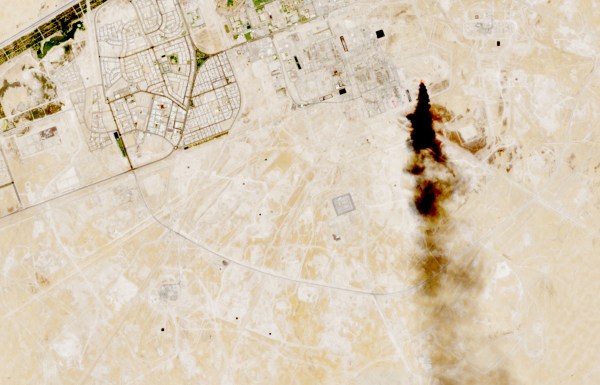 A satellite image shows smoke coming out of an oil facility after a strike by the Houthis in Abqaiq, eastern Saudi Arabia on July 27, 2026. (Reuters)
This would add up to four weeks to the journey, and make supplies expensive due to higher freight and insurance costs. Moreover, the anti-Saudi blockade could keep oil prices elevated, which is another concern for India as the country depends on imports to meet over 88% of its oil requirement. According to industry insiders, experts, and analysts, while the current risks for India are a matter of concern, they appear manageable.
The first and the most obvious fall-back for the country is Russian crude, the mainstay of its oil imports. So far, Russian oil appears to be safe from Houthi attacks as it was in earlier Bab al-Mandab blockades by the Iran-backed militia.
Russian oil exports are also under pressure, with Ukrainian strikes against Moscow’s energy infrastructure. But the expectation by and large is that while this may lead to some tightness in availability of Moscow’s crude, any material impact on India would be limited from a supply security perspective, even though Indian refiners may get battered by higher oil, freight, and insurance costs.
India’s options if Saudi oil supplies are hit
“See as per the predictions, if Russian oil (coming through the Red Sea route) is not affected and the blockade is targeted only against Saudi Arabia, we don’t see a very big challenge. We expect the movement of Russian to increase, which would compensate for any loss in Saudi volumes and cover the requirement. But many ifs and buts are still there, so maybe in another week or 10 days’ time, there would be more clarity,” state-owned Bharat Petroleum’s Chairman and Managing Director Sanjay Khanna told The Indian Express on Thursday. The Suez Canal-Red Sea route is the primary route for Russian oil to reach Indian ports.
Story continues below this ad
Industry analysts said that if Saudi Arabian oil supplies to India are disrupted, Indian refiners are likely to further increase purchases of Russian oil barrels, while also drawing on commercial crude inventories to bridge temporary supply gaps. Moreover, India’s increasingly diversified crude slate — which includes dozens of suppliers from across the world — provides greater flexibility than in previous years, reducing the risk of a severe supply disruption.
“If Red Sea transit remains uninterrupted, Indian refiners retain an important supply buffer through Saudi Arabia’s East-West (Yanbu) pipeline, which has recently supplied roughly 300,000–500,000 bpd (barrels per day) of crude. However, if the security situation deteriorates and Red Sea imports become unavailable during August, refiners will need to replace those barrels from alternative sources. Indian refiners are likely to increase purchases of Russian spot barrels where available, while also drawing on commercial crude inventories to bridge any temporary supply gaps,” said Sumit Ritolia, manager, refining and modelling at commodity market analytics firm Kpler.
Amid the Strait of Hormuz crisis, as supplies from West Asia faltered, India’s Russian crude imports have increased sharply from around 1 million bpd in February, to record highs of about 2.6 million bpd in June, accounting for over 50% of India’s overall oil imports. July oil imports from Russia are also tracking at similar levels, as per ship-tracking data. Before the war, over 40% of India’s oil imports came from West Asia via the Strait of Hormuz.
According to Ritolia, Russian crude remains India’s strongest supply hedge, and imports could potentially rise toward or even above 3 million bpd if market conditions and Russian export availability permit. He added that the situation would become tighter if Red Sea flows are disrupted, but it is unlikely to become critical.
Story continues below this ad
“Russian oil will provide some relief for India and China. Urals was offered at around $7/barrel discount to Dubai (crude grade) before the latest escalation; those discounts have now disappeared, and Russian barrels are now moving at premiums as Indian refiners compete for supply. However, as India will try to absorb as much Urals (Russia’s flagship crude grade) as possible, its incremental availability is limited as China and Turkey are competing for the same barrels,” Abu Dhabi-based energy analyst Natalia Katona told The Indian Express.
Apart from further increasing oil imports from Russia, West Asian crude that can bypass both the Strait of Hormuz and the Bab al-Mandab — such as the UAE’s Murban — are also practical emergency barrels for Indian refiners. Murban can be loaded from Fujairah, which lies outside the Strait of Hormuz, and reach the Indian coast in roughly five to six days. There are also options to increase purchases of American and South American oil, but the long voyage times mean that they cannot be considered as emergency replacement barrels for any supply lost due to the Houthi blockade against Riyadh.
The risks to Russia’s oil exports
According to industry experts and analysts, a key uncertainty from India’s point of view is whether Russia can sustain higher export availability, given the impact of continued Ukrainian attacks on parts of its upstream and downstream oil infrastructure.
“While the Strait of Hormuz and Red Sea remain strategically important, the uninterrupted operation of Russian export infrastructure — particularly Black Sea terminals such as Novorossiysk — has become equally, if not more, critical for India’s crude supply…any disruption to Saudi exports via the Red Sea would have a relatively smaller impact on India’s overall crude availability than a sustained disruption to Russian Black Sea exports,” said Ritolia.
Story continues below this ad
Unlike the Red Sea, where some cargoes can be rerouted through Africa, export alternatives for oil exported from Black Sea ports are limited. Any prolonged disruption there could tighten global crude availability, disrupt trade flows, and directly affect India’s largest source of imported crude. “In short, as Russia has become the dominant supplier to India, developments around the Black Sea have become one of the most important geopolitical risks for Indian refiners—arguably carrying greater near-term significance than disruptions to Saudi Red Sea exports,” he said.
According to Katona, the larger immediate concern is Novorossiysk’s Sheskharis terminal, which halted operations last week following Ukrainian attacks on regional oil infrastructure. The terminal is particularly important for India, as of the 1.1 million bpd crude loaded there in June, around 840,000 bpd went to India. Overall, the Novorossiysk complex supplied about 28% of India’s Russian crude imports in June.
“Satellite tracking suggests that Sheskharis loadings paused on June 20, although the data may understate actual activity. Some Russian-linked tankers are reportedly switching off their transponders to reduce exposure to further attacks, while terminal data indicates that at least two vessels have loaded since June 20. The port infrastructure itself appears undamaged, and current delays may also reflect severe weather in the region. I therefore expect the disruption to be temporary,” she said, adding that Russian operators have become more accustomed to working under drone-attack risk and can rely on the shadow fleet.
Russia had recently increased crude exports as Ukrainian attacks sent several refineries offline for repairs, which freed additional barrels for the export market — predominantly China and India. In the medium term, the return of the affected Russian refining capacity is also a risk as far as Moscow’s oil supplies to India are concerned, particularly of the Strait of Hormuz closure and any associated supply risk don’t abate.
Story continues below this ad
“As more refineries return, fewer barrels will be available for export. Given Russia’s recent domestic fuel shortages, Moscow is likely to reduce the record 4.5 million bpd of crude exported in June, of which about 55% went to India. If all major refineries resume normal operations, Russian crude exports could fall by as much as 1 million bpd,” said Katona.
“So far, Ukrainian strikes haven’t created a major risk for Russian oil exports…But India should watch closely what happens once Russian refineries start coming back online. At that point, Moscow will almost certainly prioritise restoring its own refining sector, especially after being forced to import fuel from abroad,” she added.

