

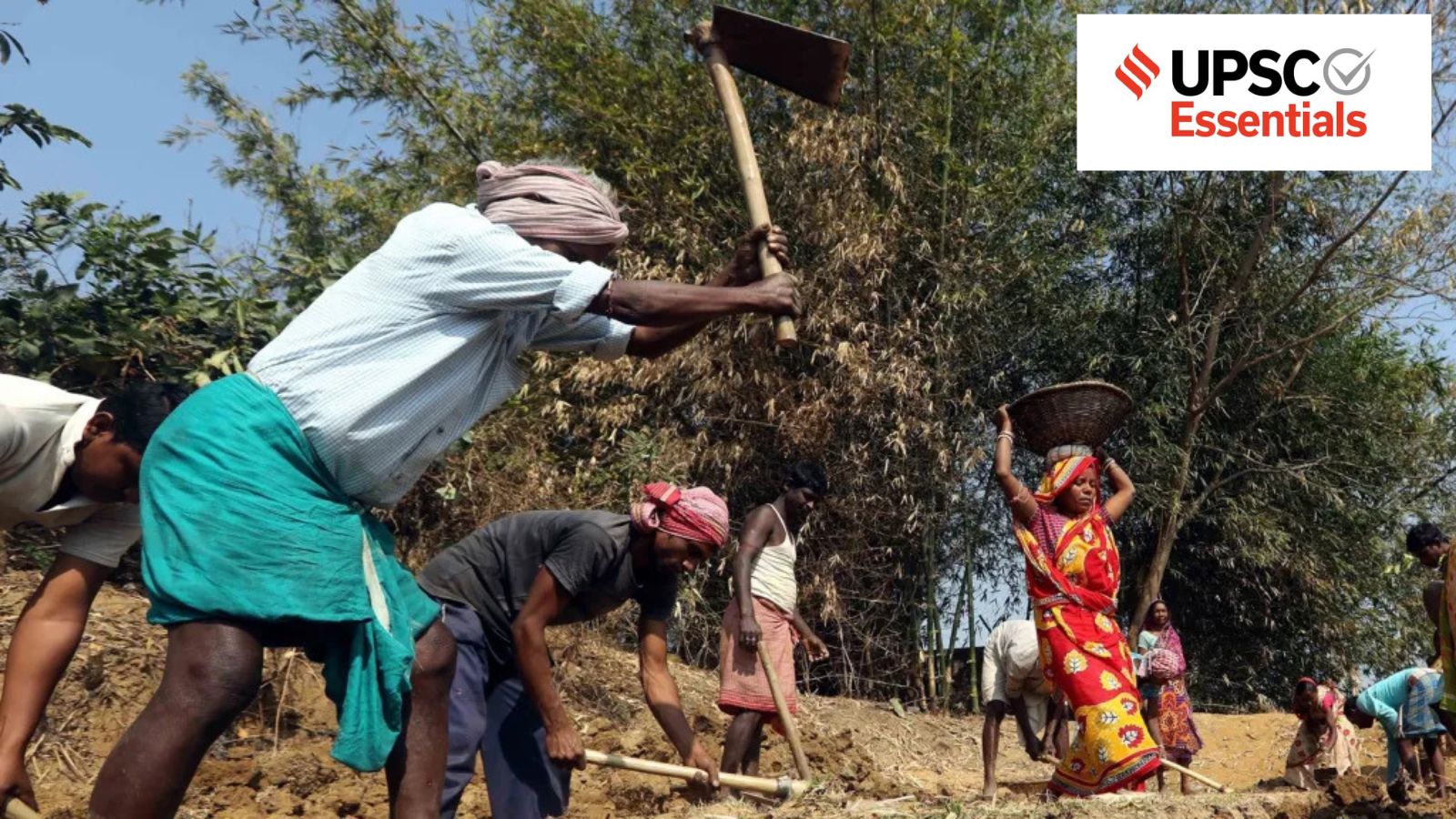
According to the United Nations, two out of every three people will live in cities or urban areas by 2050. Urban planning has become an important component of recent development models. Yet, the rural areas remain highly significant, especially in the Global South.
While 42% of the world’s population continues to live in rural areas, the share of people living in rural areas in India is 65% of its population. Notably, 47% of the Indian population is dependent on agriculture and allied activities (the Economic Survey 2022-23). Scholars increasingly argue that the boundaries between the rural and the urban have become blurred, with rural households engaging in a wide range of farm and non-farm activities.
The Situation Assessment Survey (SAS) data suggests that between 2012-13 and 2018-19, the average real monthly income from crop production in India has declined from Rs 3,081 to Rs 2,760, while the income from wages has increased from Rs 2,071 to Rs 2953 in the same time period. This is true for all rural households across various size-class of land possession. Meanwhile, income from animal husbandry has increased from Rs 763 to Rs 1,150 during this time period.
Why rural India is working off the farm
THE MONEY TREND
Crop income down, wage income up
Situation Assessment Survey data shows rural India’s average real monthly income from crop production fell between 2012-13 and 2018-19, even as wage income and animal husbandry income rose — a pattern seen across land-holding sizes.
₹3,081→₹2,760
Monthly crop production income (2012-13 to 2018-19)
₹2,071→₹2,953
Monthly wage income (2012-13 to 2018-19)
₹763→₹1,150
Monthly animal husbandry income (2012-13 to 2018-19)
33.3M
Workers who left agriculture, 2004-05 to 2011-12
48M
Workers who entered non-farm employment in the same period
~50%
Of new non-farm entrants absorbed by low-wage construction
2004-05
Non-farm work makes up 27.3% of rural employment.
2011-12
Share rises to 35.9% — the most rapid phase of structural transformation.
2018-19
Peaks at 42.2% — the highest recorded share of rural non-farm employment.
2020-21
Dips slightly to 39.2%, indicating a slowdown in labour movement out of agriculture.
COMPETING EXPLANATIONS
Why is non-farm work growing?
Two theoretical perspectives explain the rise of rural non-farm work in India — one rooted in agricultural prosperity, the other in agrarian distress.
PROSPERITY-LED
Green Revolution tech raised productivity and income, creating demand for non-farm goods and services. Example: Punjab, Haryana.
DISTRESS-DRIVEN
Falling crop income pushes households into precarious, low-quality casual wage work. Example: Bihar.
◆
Land access matters
Access to agricultural land helps households diversify into well-remunerated non-farm work; lack of access drives distress migration to cities.
STATE RESPONSE
Seven decades of rural policy
From community development to guaranteed wage employment, India’s rural policy has evolved alongside its changing employment patterns.
1952
Community Development Programme (CDP) launched, influenced by Gandhian ideals of participatory development.
1953
National Extension Service (NES) introduced to extend agricultural and technical support to villages.
1966
Ford Foundation-funded report, India’s Food Crisis and Steps to Meet It, recommends the first norms of Integrated Rural Development amid a major food crisis.
1970s
Focus shifts to “regional development” amid dissatisfaction over uneven spatial growth and spreading rural poverty.
1978-79
Integrated Rural Development Programme (IRDP) officially launched, covering all blocks in the country by 1980.
2005
MGNREGA launched — now renamed the Viksit Bharat Guarantee for Rozgar and Aajeevika Mission-Gramin (VB G-RAM-G). Later served as fallback employment during crises like the Covid-19 pandemic.
Sources: Situation Assessment Survey (SAS) · National Sample Survey Office (NSSO) · Economic Survey 2022-23
What explains the rise of rural non-farm employment
The changing composition of rural household income has given rise to two broad interpretations in the literature. First, the increase in the share of wage income among rural households has come as a result of decline in income from crop production. Thus, the rising share of wage income reflects that rural households are pushed out of agriculture and into casual wage work as agriculture has become non-remunerative.
Second, the decline in income from crop production reveals the persistence of the agrarian crisis in rural India, as growth of agricultural output has remained stagnant. As income from agriculture has declined, the importance of the rural non-farm sector needs to be highlighted. The growing importance of the rural non-farm sector is not unique to India. Across Asia, around 55% of rural household income is derived from non-farm activities.
Rural households engage in a range of activities like crop production, animal rearing, migration, casual agricultural wage labour, casual non-agricultural wage labour, and businesses and trade. These households are termed “pluri-active” or “mixed” households as they engage in both farm as well as non-farm work. Additionally, there is also evidence of how individual workers in rural areas engage in “multi-tasking” of both farm and non-farm work.
Story continues below this ad
Data show that India’s rural non-farm sector evolved unevenly over the past three decades. The economic reforms of the 1990s did not result in its substantial expansion. However, the period 2004–05 to 2011–12 marked the most rapid phase of structural transformation. According to the National Sample Survey Office (2004–05 and 2011–12), 33.3 million workers left agriculture and 48 million entered non-farm employment, nearly half of whom were absorbed by the low-wage construction sector.
| Q1. With reference to Integrated Rural Development (IRD) programmes, consider the following statements:
1. They are primarily distribution- and equity-oriented programmes. 2. Their objective includes increasing agricultural income and improving the quality of rural life. 3. They exclusively focus on increasing agricultural production without addressing rural poverty. Which of the statements given above is/are correct? (a) 1 and 2 only (b) 2 only (c) 1 and 3 only Story continues below this ad (d) 1, 2 and 3 |
Consequently, the share of non-farm work in rural employment increased from 27.3% in 2004-05 to 35.9% by 2011–12. During the following decade, rural non-farm employment continued to expand, peaking at 42.2% in 2018–19, before declining slightly to 39.2% in 2020–21. It indicates a slowdown in labour movement out of agriculture.
Two contrasting perspectives
There are at least two theoretical perspectives on the emergence of rural non-farm work. One view of the emergence of the rural non-farm sector looks at the role of agriculture in driving non-farm work. According to this view, growth in agriculture creates linkages that lead to the growth in non-farm employment.
In the case of India, this is the “prosperity-led argument”, which contends that the adoption of Green Revolution technologies increased agricultural productivity and rural incomes. Rising income generated demand for goods and services and created new non-farm employment opportunities. The states of Punjab and Haryana can be seen as examples of such transformation.
The second view explains the emergence of non-farm work as largely distress-driven. According to this view, declining income from agriculture pushed rural households towards non-farm work like casual wage labour and petty non-farm self-employment. As income from crop production has declined in India, rural households are pushed towards casual wage work, which is highly precarious, uncertain, generates low income, and is of low quality. The example of the Indian state of Bihar can be noted here.
Story continues below this ad
With growing land pressure and jobless growth, rural populations are often compelled to rely on distress-driven non-farm self-employment. In addition, rural households engage in seasonal or temporary migration during the agricultural off-season. These structural challenges made rural employment a central concern of policymaking. Since independence, India pursued a range of rural development programmes to address agricultural productivity, employment, and poverty.
| Q2. Match List I with List II:
List I List II A. 1966 1. Official launch of IRDP B. 1978–79 2. Green Revolution pathway through IADP C. 1980 3. All blocks covered under IRDP D. 2005 4. Launch of MGNREGA Select the correct answer: (a) A–2, B–1, C–3, D–4 (b) A–1, B–2, C–4, D–3 (c) A–2, B–3, C–1, D–4 (d) A–4, B–1, C–2, D–3 |
Community development programmes
The 1950s and early 1960s saw a focus on “community development” programmes across the developing world. In India, the First Five-Year Plan recognised development as socio-economic transformation of rural life. Influenced by Gandhian ideals of participatory development, the Community Development Programme (CDP) was initiated in 1952.
The CDP aimed to improve agricultural production as well as rural infrastructure and laid the foundation for democratic decentralisation. It was agreed that rural development could be pursued through the active participation of rural communities through self-governance. To strengthen the implementation of CDP, the National Extension Service (NES) was introduced in 1953, extending agricultural extension services and technical support to villages across the country.
However, in the 1970s, the concept of “regional development” became popular amid growing concerns and dissatisfaction over the uneven spatial growth and the subsequent spread of rural poverty. Proponents of regional development argued that the dispersion of basic services to everyone is essential to equitable growth. Along with agriculture, rural infrastructure, marketing, credit, processing, and linkages are important for growth. This gave rise to the idea of Integrated Rural Development (IRD) programmes.
Story continues below this ad
Intensive Agricultural Development Programme
These IRD programmes are often distribution- and equity-oriented by increasing agricultural income and the overall quality of rural life. As India witnessed a major food crisis in the 1960s, a Ford Foundation-funded research team in 1966 recommended the first norms of IRD in its report titled India’s Food Crisis and Steps to Meet It.
The Indian government implemented the Intensive Agricultural Development Programme, which eventually led to the Green Revolution. The government officially launched IRDP in 1978-79 in selected blocks and covered all blocks in the country by 1980. The programme was aimed at alleviating rural poverty by providing income-generating assets to the poor.
The IRDP eventually paved the way for other rural development programmes. In 2005, the Mahatma Gandhi National Rural Employment Guarantee Act (MGNREGA), now renamed the Viksit Bharat Guarantee for Rozgar and Aajeevika Mission-Gramin (VB G-RAM-G), was launched. Studies have indicated that MGNREGA has been effective in including women, Scheduled Caste, as well as Scheduled Tribe workers in providing gainful employment.
It had a positive effect on economic efficiency and aggregate output. The programme also acted as a fallback employment for disadvantaged groups, especially in times of crisis like during the Covid-19 pandemic.
Story continues below this ad
Other major policies for rural employment
There are also two important policies pursued by the Indian government that played a role in rural employment. First, land reforms, including abolition of intermediaries, tenancy reforms, and land ceilings, have been an important policy measure. Second, the Green Revolution also played a significant role in shaping rural employment. Thus, the role of land in determining rural employment has been historically crucial in India.
Empirical evidence suggests that access to agricultural land may help rural households diversify into well-remunerated non-farm work. Further, lack of access to land can lead to distress-led migration away from rural areas to cities, leading to migrant workers getting absorbed in informal work.
The history of rural employment in India suggests that the state plays an important role through rural development programmes as well as through new technologies. India’s rural employment is shaped by important rural policies, impacting both agriculture as well as regional development. While development programmes have been historically important, access to land also plays a central role in rural employment.
The biggest concern for rural employment in India remains the declining agricultural income. While the rural non-farm sector deserves policy attention, its important linkages with agriculture cannot be overlooked.
Story continues below this ad
Post read questions
1. Critically examine the factors explaining the emergence of the rural non-farm sector in India.
2. The emergence of rural non-farm employment in India reflects both agricultural prosperity and agrarian distress. Evaluate.
3. Does the expansion of rural non-farm employment necessarily indicate successful rural development? Discuss.
4. Evaluate the contribution of rural development programmes in addressing employment and poverty in rural India. How does programmes like Viksit Bharat Guarantee for Rozgar and Aajeevika Mission-Gramin (VB G-RAM-G) Act mark a shift in rural employment?
Story continues below this ad
5. How does access to agricultural land influence rural livelihood diversification in India? Discuss.
(Ritwika Patgiri is a doctoral candidate at the Faculty of Economics, South Asian University.)
Share your thoughts and ideas on UPSC Special articles withashiya.parveen@indianexpress.com.
Click Here to read the UPSC Essentials magazine for July 2026.Subscribeto ourUPSC newsletterand stay updated with the news cues from the past week.
Stay updatedwith the latestUPSC articlesby joining ourTelegram channel–IndianExpressUPSC Hub, and follow us onInstagramandX.

