

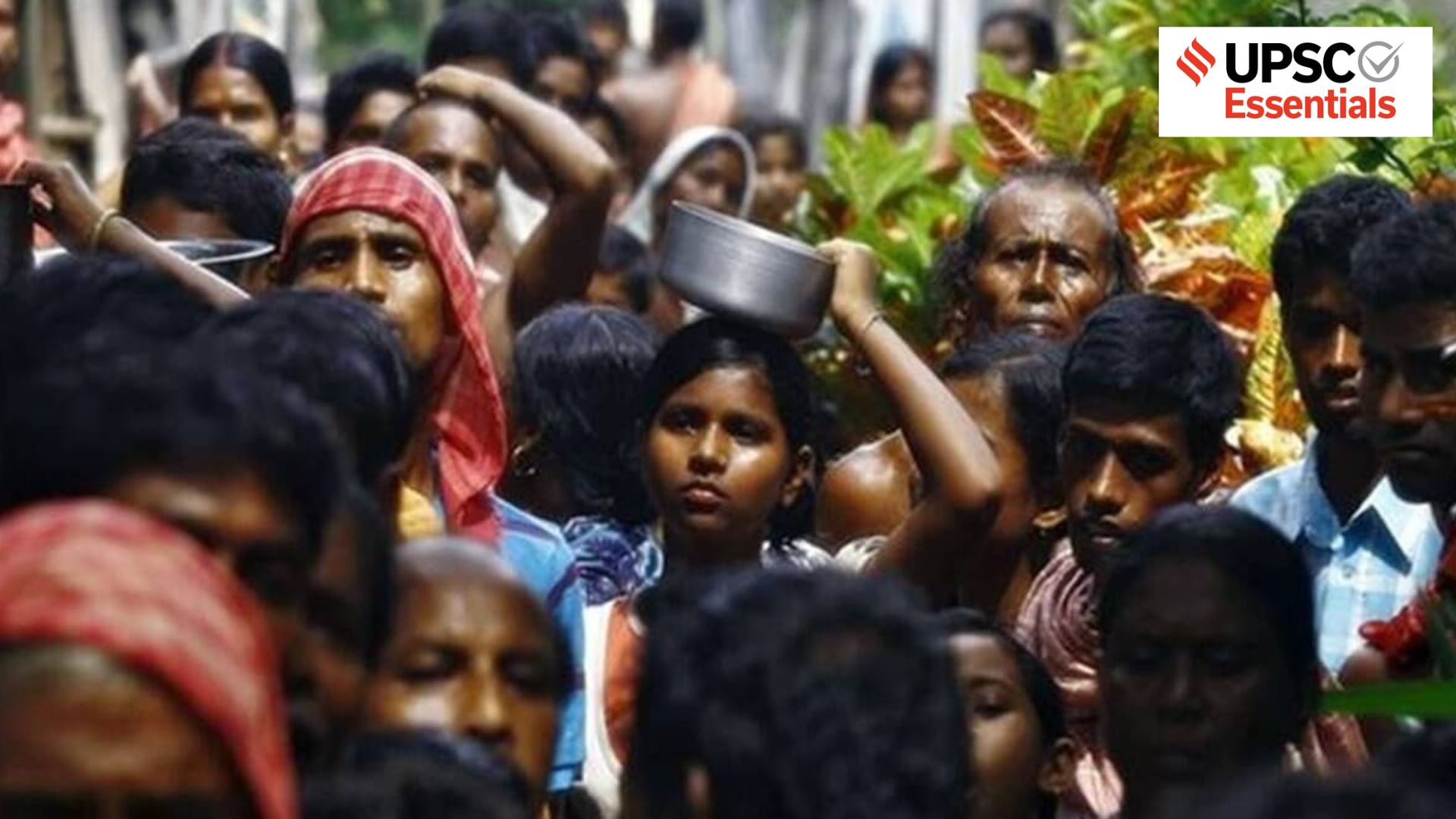
Global income and wealth have reached historic highs, but inequality remains enormous, with the richest 10 per cent of the global population owning close to three-quarters of all wealth and the poorest half barely 2 per cent, says the 2026 World Inequality Report.
Notably, inequality in India remains amongst the highest in the world and has shown little movement in recent years. The top 10 per cent of earners capture about 58 per cent of national income, while the bottom 50 per cent receive only 15 per cent, says the report.
What are the key factors behind the persisting inequality? Beyond wealth, how does inequality manifest in gender, opportunity, and climate?
World Inequality Report 2026: Who Gets What?
SINCE 1820
Two centuries of skewed distribution
Since 1820, the top 10% of the world’s population have never captured less than 50% of global income. The bottom 50% have never received more than 15%. Despite rising overall prosperity, this structural imbalance has barely shifted.
Who gets what — global income today
37%
Global wealth owned by top 1%
2%
Global wealth held by bottom 50%
“The top 0.1% earn as much as the entire bottom half of the global population.”
— World Inequality Report 2026
INDIA IN FOCUS
Among the world’s most unequal nations
India’s inequality ranks among the highest globally, with little evidence of meaningful reduction in recent years. Post-liberalisation growth, financialisation of wealth, and limited access to quality education and healthcare are key drivers.
India: income and wealth distribution
22.6%
Top 1% income share in 2022 — all-time high
13%
Top 1% income share in 1922
LAND INEQUALITY
46% of rural households are landless
The top 10% own 44% of India’s rural land. Villages with higher shares of Scheduled Castes and Tribes show higher rates of landlessness. Kerala and West Bengal are cited as exceptions where land reforms reduced inequality.
THE PATRIMONIAL MIDDLE CLASS
The middle 40% — a century of gains, then stagnation
Economist Thomas Piketty calls the middle 40% the “patrimonial middle class.” Their income share rose between 1920 and 1980, declined through 2000, and has only partially recovered since. Historic reductions in inequality have mostly benefited this group — not the poorest.
Middle 40% income share — trajectory
▲
1920–1980: The rise
State-led welfare expansion, public services, and progressive taxation in advanced economies boosted the middle 40%’s share of income and wealth.
▼
1980–2000: The decline
Liberalisation, financialisation, and disproportionate income growth for the top 0.1% squeezed the middle class’s share globally.
◆
2000–present: Partial recovery
A modest rebound, but the middle 40% have not returned to their 1980 peak. The bottom 50% have seen no meaningful benefit from any of these shifts.
85%
Wealth held by top 10% in early 1900s
50–60%
Top 10% wealth share today — still alarming
THE REPORT’S PRESCRIPTION
Four interventions to reduce inequality
The World Inequality Report 2026 argues that inequality is not inevitable — meaningful policy interventions can reverse it. Without radical steps, extreme inequality is likely to persist for generations.
①
Public investment in education and health
Expanding quality access to education and healthcare is foundational — these are among the key factors cited behind India’s persistent inequality.
②
Redistributive programmes
Cash transfers, pensions, and unemployment benefits directly support the bottom 50% and help stabilise middle-income groups against economic shocks.
③
Dismantling structural barriers
Unequal access to land, labour markets, and opportunity — including for women and marginalised communities — must be addressed through targeted structural reform.
④
A fairer tax system
Progressive taxation — where those at the top pay higher rates — can fund education, health, and climate adaptation. Piketty argues that without redistribution of inheritance, extreme inequality will persist.
Sources: World Inequality Report 2026 · Thomas Piketty, A Brief History of Equality (2022) · Sajith Pai & Amal Vats study (2023)
What the report reveals about claims of decline in inequality
The World Inequality Report 2026 highlights two important findings. First, global income and wealth have reached historic highs. Since the beginning of the 19th century, income per person has increased more rapidly than population growth.
While population increased at an average annual rate of 0.9 per cent between 1800 and 2025, per capita income grew at an annual rate of 1.2 per cent. In theory, this suggests that the world today has become richer and can provide every person with Rs 1.32 lakh (or €1,200) per month. However, the reality is far from this.
The second important finding of the report is that economic resources continue to be highly unevenly distributed. This is manifested in numerous ways. For instance, the top 10 per cent of the world population (around 56 crore people) receive 53 per cent of the total global income, while the bottom 50 per cent (around 280 crore people) receive only 8 per cent.
Story continues below this ad
More alarmingly, the top 1 per cent earn 2.5 times more than the bottom 50 per cent, while the top 0.1 per cent earn as much as the entire bottom half of the global population.
Although global income has grown at an annual rate of 1.1 per cent since 1980, data reveal that the richest 0.1% have seen disproportionately higher income growth rates, challenging claims of decline in inequality. At the same time, the middle 40 per cent experienced stagnation in income growth.
Why middle-income groups demand closer attention
A similar pattern is observed in wealth distribution. The top 1 per cent owns 37 per cent of the total global wealth, while the bottom 50 per cent have access to only 2 per cent.
It is important to distinguish between income inequality and wealth inequality. While income inequality measures the difference in the distribution of household or individual income (earnings, wages, investments) among the population of a country, wealth inequality measures the difference in the distribution of accumulated assets (net worth, property, savings). Both reflect economic inequality.
Story continues below this ad
However, high income and wealth inequality are not a recent phenomena. The report highlights that since 1820, the top 10 per cent of the world population have consistently captured more than 50 per cent of global income, while the bottom 50 per cent have never received more than 15 per cent.
But the changing position of middle-income groups demands closer attention. The middle 40 per cent saw a rise in their income share between 1920 and 1980, followed by a decline in the share until 2000, and then witnessed a partial recovery thereafter. The historic decline in income inequality that data often mention has mostly benefited the middle class and not the bottom 10 per cent.
Why rich countries tend to be more equal than poor ones
The French economist Thomas Piketty uses the term “patrimonial middle class” in his book, A Brief History of Equality (2022), to refer to the middle 40 per cent. One way to understand how this group benefited from reductions in inequality is by examining wealth distribution before the First World War.
In the early 1900s, the top 10 per cent owned 85 per cent of the global wealth. Although the share has now reduced to 50-60 per cent – still alarmingly high – it represents a substantial reduction. This has, in turn, benefitted the middle 40 per cent or the “upper middle”, whose share of wealth has increased over time.
Story continues below this ad
Both Piketty and the World Inequality Report have highlighted that rich countries tend to be more equal than the poor countries. However, this was not always the case. Relative equality among advanced economies became notable by the 20th century through state-led policies like the development and expansion of welfare systems, public services, and progressive taxation.
Piketty’s core argument is that while redistributive policies helped reduce inequality, the progress has been very limited for the bottom 50 per cent.
Factors behind India’s striking inequality
In the case of India, the report indicates that the top 1 per cent of the population holds 40 per cent of the wealth while the top 10 per cent hold 65 per cent. This places India among the most unequal countries in the world, with little evidence of a notable reduction in inequality. In terms of income inequality, the top 10 per cent earn around 58 per cent of the total income, and the bottom 50 per cent earn only 15 per cent.
Researchers and scholars attribute India’s striking inequality to various factors, including the lack of quality access to education and healthcare, and the service-dominated nature of economic growth that emerged after the economic liberalisation.
Story continues below this ad
The “financialisation of wealth”, or the growing importance of activities like trading and investments have increased the wealth share of the top 1 per cent. Historical data show that the income share of the top 1 per cent in India was around 13 per cent in 1922. This share declined between the 1950s and early 1980s, but increased again after the economic reforms, reaching an all-time high of 22.6 per cent in 2022.
Land, gender, and climate
Another striking feature of the Indian economy is land inequality and land fragmentation. Around 46 per cent of rural households in India are landless, while the top 10 per cent own 44 per cent of the total rural land.
The 2026 inequality report also notes that villages with higher shares of Scheduled Castes and Scheduled Tribes tend to exhibit higher rates of landlessness. However, states like Kerala and West Bengal are seen as exceptions, where, it may be argued, land reforms played an important role in reducing inequalities.
Contrary to popular assumptions, greater market accessibility does not necessarily reduce inequality; proximity to towns, roads, and cities has often been insufficient in reversing historically rooted inequalities.
Story continues below this ad
Inequality also has gender and social dimensions. For instance, women in India continue to facelow female labour force participation rates, historical inequality in labour income, wealth, and land ownership, and a disproportionate burden of domestic and care work. Similarly, other marginal and vulnerable groups are more likely to have unequal access to resources and income as compared to dominant groups.
Moreover, climate change further intensifies these inequalities. While the poorest often account for low carbon emissions, they are more likely to be exposed to climate-related shocks like water crisis, heat stress, and extreme weather events.
How to reduce inequality
The report argues that inequality can be reduced through meaningful interventions, including:
1) Increase in public investment in education and health.
2) Redistributive programmes like cash transfers, pensions, and unemployment benefits.
3) The dismantling of structural barriers that shape unequal distribution of work and opportunities.
4) The creation of a fairer tax system.
Story continues below this ad
Progressive taxation, where those at the top contribute taxes at higher rates, could help bring about transformative changes in education, health, and climate adaptation. However, debates around “taxing the wealthy” are often reduced to concerns that such measures may slow economic growth and trigger capital outflows.
Therefore, it is often argued that poverty alleviation through inclusive growth is more crucial than mere inequality reduction. However, facts demonstrate the extent of inequality in India. For instance, a 2023 study by Sajith Pai and Amal Vats notes, “1% of Indians take 45% of flights, 2.6% of Indians invest in mutual funds, 6.5% of users are responsible for 44% of digital transactions on Unified Payment Interface (UPI).”
Therefore, Piketty has argued that without a radical step like “redistribution of inheritance”, extreme inequality is likely to persist for a long time.
Post read questions
Economic growth has not necessarily translated into reduction in inequality. Discuss in the context of the World Inequality Report 2026.
Story continues below this ad
Examine the major dimensions of inequality in India. How do wealth, income, gender, and land inequalities reinforce one another?
Distinguish between income inequality and wealth inequality. Why is wealth inequality often considered more persistent and structural?
Examine the argument that India’s post-liberalisation growth model has intensified economic inequality.
To what extent can progressive taxation reduce inequality in developing countries like India? Discuss the challenges involved.
(Ritwika Patgiri is a doctoral candidate at the Faculty of Economics, South Asian University.)
Share your thoughts and ideas on UPSC Special articles withashiya.parveen@indianexpress.com.
Gear up forUPSC Prelims 2026—Practice smarter, revise faster, and succeed with ourSpecial Quiz Magazine. (Click Here)
Click Hereto read the UPSC Essentials magazine for April2026.Subscribeto ourUPSC newsletterand stay updated with the news cues from the past week.
Stay updatedwith the latestUPSC articlesby joining ourTelegram channel–IndianExpressUPSC Hub, and follow us onInstagramandX.

