

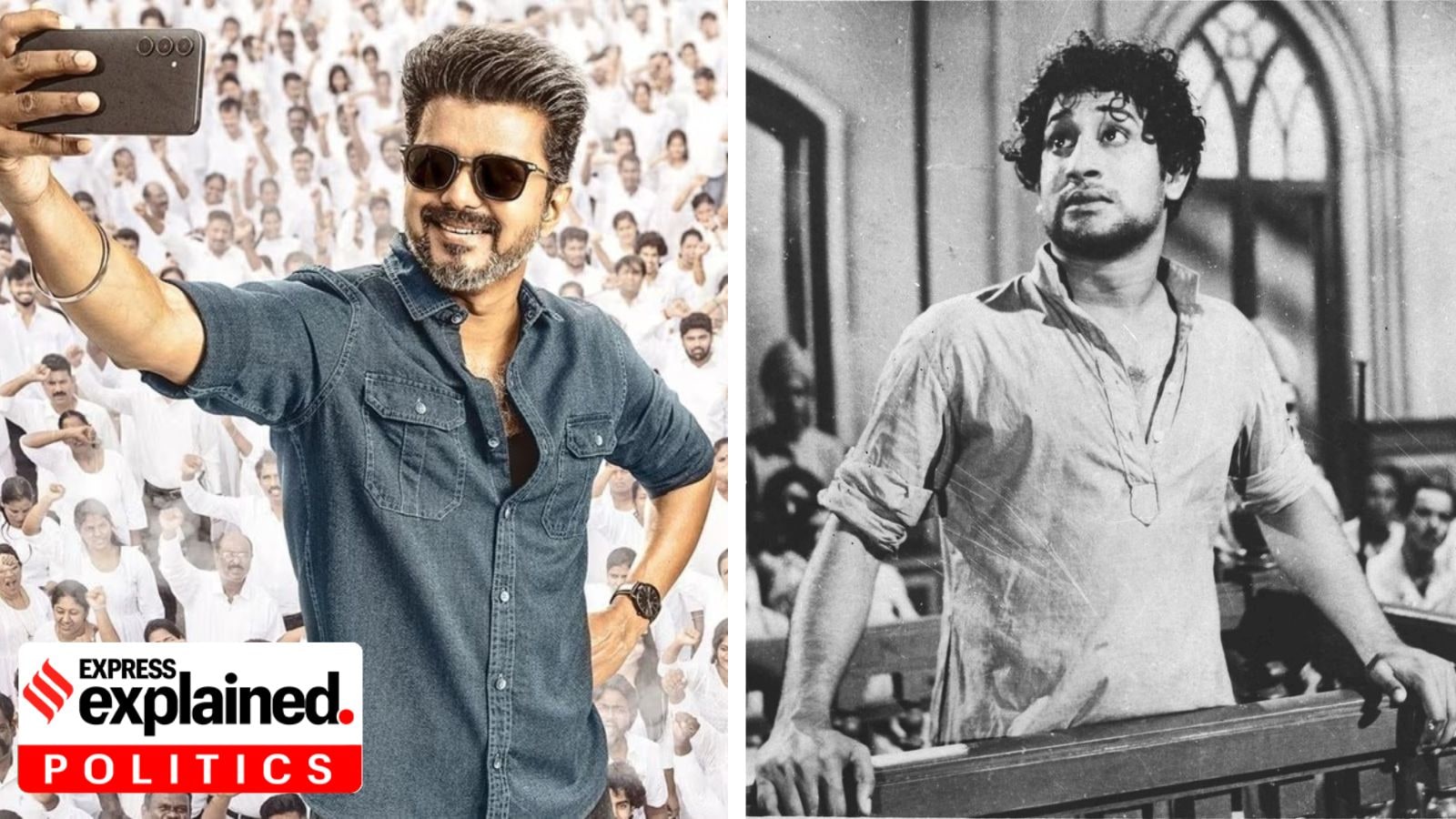
May 4 saw the declaration of results for four State Assembly elections. Perhaps none was as much of a surprise to observers as Tamil Nadu, where actor-turned-politician Vijay’s Tamilaga Vettri Kazhagam (TVK) emerged as the largest party, despite being founded about two years ago. The victory has raised questions about how a political novice made his mark so prominently, even in a state with a history of actors successfully transitioning to politics.
This article is an edited transcript of Picturebaazi, a cinema podcast by The Indian Express. The episode centred on politicians in Indian cinema. Host Nishant Shekhar moderated the discussion with The Indian Express’s Shubhra Gupta and Deeptiman Tiwary.

Nishant Shekhar: How did Vijay manage to pull off this incredible feat?
Deeptiman Tiwary: I think there are many reasons for it, but the simplest one is that Tamil Nadu has been oscillating between the deeply entrenched Dravidian politics of the DMK and AIADMK for four decades. People were tired of old wine being served in new bottles. The state was yearning for change; Vijay came and delivered.
Shubhra Gupta: What was the role of Gen Z in this victory?
Deeptiman Tiwary: Vijay’s entire messaging is youth-oriented. As a film star, he already has a massive following among the young. Through his films, he talks about jobs, unemployment, corruption, and education — themes that appeal directly to the youth.
This new generation didn’t grow up in the era of Periyar or MGR, and they have no memory of the social inequality struggles those leaders fought. All they see now is dynastic politics — Karunanidhi’s son Stalin, then his son, and so on. They want a way out of corruption and lack of opportunities.
Story continues below this ad
Nishant Shekhar: How have Tamil cinema actors managed to use films as a political tool so successfully, whereas the same modus operandi has failed in many other states?
Deeptiman Tiwary: Tamil Nadu politics and cinema have been deeply intertwined since the 1940s. Dravidian political figures like CN Annadurai and Karunanidhi were professional scriptwriters. They wrote hit films like Parasakthi (1952) that were deeply political, critiquing caste discrimination and Brahmanism, central to the pre-Independence era Self-Respect Movement, led by Periyar. They had theatrical dialogues that immediately connected with the audience emotionally. In this setting, cinema becomes a political rally, and the audience isn’t just watching a story but also absorbing a political message.
Back then, they realised that while pamphlets take time to distribute, a film reaches millions within three hours. MGR became the vehicle for this — his charismatic screen presence as an actor delivered the message, and later he formed the AIADMK. J Jayalalithaa followed him, based on a similar template.
Vijay has registered a victory despite the fact that his party manifesto doesn’t offer anything new when compared with the two Dravidian parties. This is also because the state has a firmly rooted political ideology, which is one reason why the BJP has failed to register electoral success there.
Nishant Shekhar: But why did Kamal Haasan and Rajinikanth fail to fill this vacuum?
Story continues below this ad
Deeptiman Tiwary: Kamal Haasan’s campaign felt very half-hearted, at least in terms of the lack of energy it displayed.
Shubhra Gupta: He was also never a “mass-y” star; he was always considered cerebral or intellectual. In the South, the definition of “mass” means actors like Yash or Vijay, whose films can evoke a sense of mass hysteria. Rajinikanth was undoubtedly a massive star, but his timing for a political pivot was off.
Deeptiman Tiwary: Vijay, however, uses a “Messiah” template in his films — fighting corrupt doctors or advocating for electoral reforms. In one film, he plays an NRI CEO who returns home, finds out that his vote has been cast fraudulently, and enters politics to fight for reform. Voters connect with this “everyman” hero who fights their real-world battles on screen.
Such films might be melodramatic, but they also act as a release for the public that enters a theatre for entertainment.
Story continues below this ad
It’s like what Bollywood’s Salim-Javed did by taking the core of the Dilip Kumar-starrer Ganga Jamuna (1961) and turning it into Deewar (1975). Vijay is essentially regurgitating the same Dravidian ideology with punchy dialogues and a new message, and the public has lapped it up.
Shubhra Gupta: This is also what the Shah Rukh Khan-led Jawaan (2023) did, directed by the frequent Vijay collaborator Atlee, where one man challenges the system. It was quite similar to mass-y Tamil films in its storyline and themes.
Nishant Shekhar: Why doesn’t this work in Kerala or Karnataka, or in the North?
Deeptiman Tiwary: In Kerala, the electorate is very politically aware and highly literate. They can differentiate between a cinematic persona and real-world political capability; they treat entertainment as entertainment. In Karnataka, politics is caste-entrenched — largely involving the dominant Vokkaligas and Lingayats. If you don’t set the political narrative into that caste ecosystem, it’s difficult to succeed.
Story continues below this ad
And in the North, I believe, cinema has never been that politically conscious, to the point that it became a vehicle of political mobilisation. In the South, those who made such films offered political parties as the solutions to the angst depicted on screen.
Shubhra Gupta: There is also the question of censorship, like what the Gulzar film Aandhi (1975) had to face. The Congress-led establishment was against it for alluding to Indira Gandhi.
Deeptiman Tiwary: In Bollywood, we’ve had Amitabh Bachchan, Sunil Dutt, and Shatrughan Sinha enter politics, but they became MPs for established parties. They didn’t start new political movements or parties using their screen popularity.
Nishant Shekhar: Speaking of launching political movements, Prashant Kishore worked very hard in Bihar, and yet he didn’t win a single seat in last year’s Assembly polls. Where did he fail?
Deeptiman Tiwary: Prashant Kishore tried to sell technocratic politics in a society like Bihar, where people value familiarity and proximity. In Bihar, a voter wants to know if their leader can “call the collector”, as is colloquially said, to get their work done, which also speaks to institutional and governance weaknesses. While Kishore had a great blueprint and identified the youth’s desire for jobs, he didn’t root his narrative in the identity politics that governs Bihar.
Story continues below this ad
What has also changed, broadly, is that the modern youth have capitalist aspirations — they want a house and a car by age 35 — and their social consciousness has dimmed compared to older generations. So many anti-establishment ideas of the past, which were also seen in films, no longer have that resonance among this demographic.
Nishant Shekhar: To wrap up, what films would you recommend to our audience on politics?
Shubhra Gupta: Sudhir Mishra’s Hazaaron Khwaishein Aisi (2003) and Hollywood’s All the President’s Men (1976).
Deeptiman Tiwary: Watch Ganga Jamuna and Deewar to understand what has happened in Tamil Nadu politics!
Nishant Shekhar: I would recommend Azaad (1978).

