

Gear up forUPSC Prelims 2026—Practice smarter, revise faster, and succeed with ourSpecial Quiz Magazine.Click Here
Preliminary Examination: Current events of national and international importance.
Mains Examination: General Studies-III: Role of external state and non-state actors in creating challenges to internal security
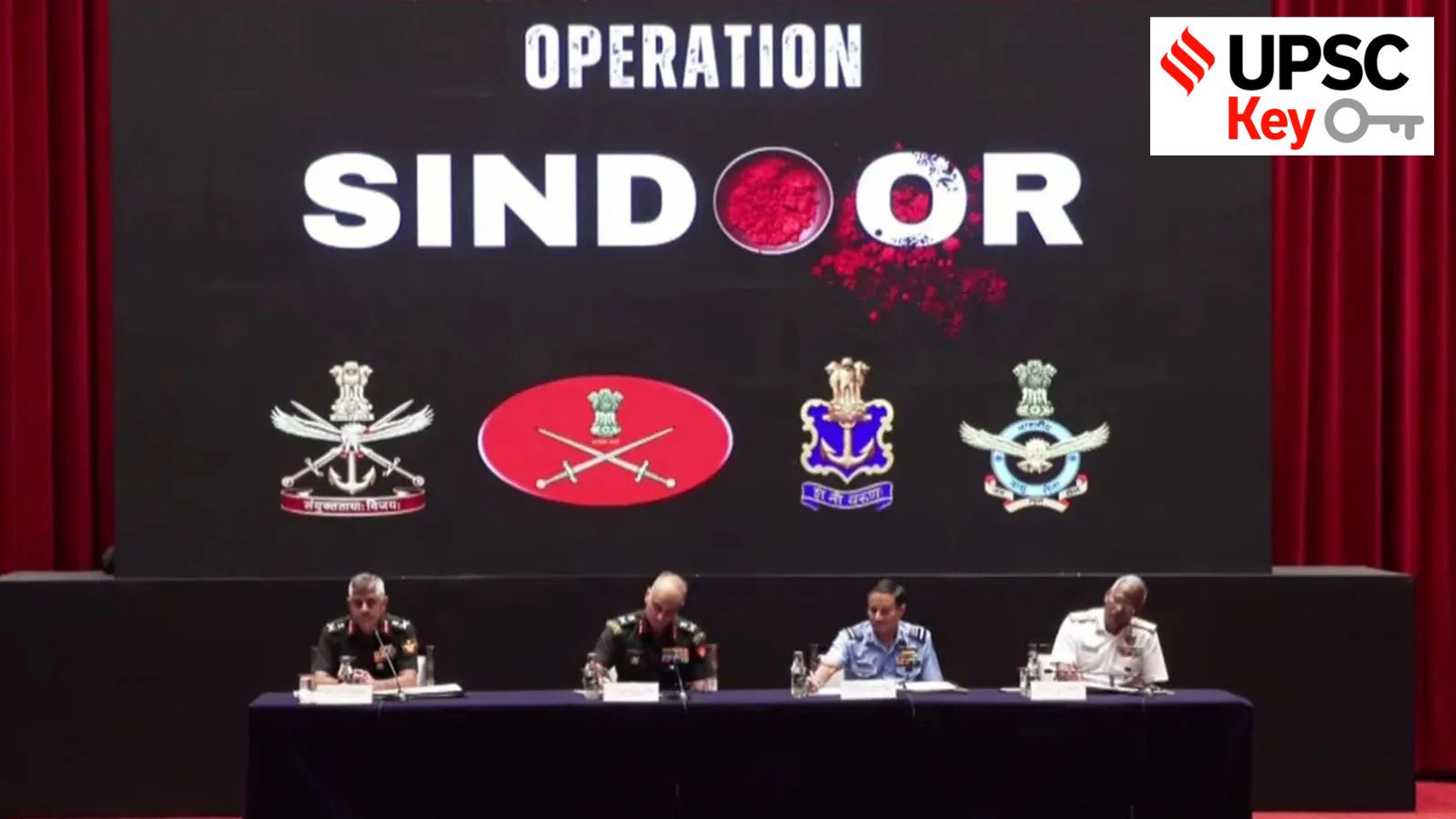
What’s the ongoing story: The early hours of May 7 will mark one year of Operation Sindoor, a strike by the Indian armed forces on terror targets in Pakistan-occupied Kashmir and Pakistan followed by hostilities between the two countries over four days.
Key Points to Ponder:
— Operation Sindoor 2025: Know about it.
— What is the strategic significance of Operation Sindoor in the context of India’s counter-terrorism policy and regional security dynamics?
— India’s past military operations against Pakistan—know in detail
Story continues below this ad
— Know the evolution of India’s military response mechanisms to cross-border terrorism since the Kargil War.
— How has technological advancement played a key role in Operation Sindoor?
— What is a Sudarshan Chakra mission?
Key Takeaways:
— A year since, the Indian military has focused on two significant aspects: large-scale construction of underground infrastructure and the establishment of a strong air defence system.
— Learning from Operation Sindoor and ongoing global conflicts, several changes are being considered, covering deployment of troops and equipment, acquisition of new technology and weapons, among them a range of drones and counter-drone systems, and newer ways of fighting wars.
Story continues below this ad
— Multiple officials across the defence establishment told The Indian Express that the construction of large-scale underground infrastructure has been a major focus of the military, alongside the implementation of other passive measures such as dispersal of assets and formations, increased concealment and camouflage, and force preservation efforts.
— According to officials, work on the construction of underground command and control centres, starting with the Army’s Command and Corps Headquarters level and later at divisional and lower levels, has been underway.
— These underground command centres will be equipped with C4I2SR (Command, Control, Communications, Computers, Intelligence, Information, Surveillance and Reconnaissance), which can be shared among all services on a secure network.
— Officials said that construction of 3D-printed bunkers, which are quick to make, resilient and can easily be relocated, will also form part of the country’s underground infrastructure.
Story continues below this ad
— It is also learnt that the focus is also on the creation of additional underground infrastructure along the western borders, so as to make daily routine operations resilient to wars or disasters, a key element of which is the hardened bunker.
— Aside from the construction of underground military infrastructure, the creation of dual-use infrastructure such as airfields, highways and roads connecting strategic areas closer to borders has also emerged as a key priority.
— While there are moves to establish a comprehensive air defence shield across the country under the Sudarshan Chakra mission – a panel under the Defence Research and Development Organisation (DRDO) recently submitted a pre-feasibility report on the project – work has also begun on enhancing the existing Akashteer cover of the Army.
— An indigenous, automated Air Defence Control and Reporting System of the Army, Akashteer can be easily integrated with the IACCS (Indian Air Force) and TRIGUN (Indian Navy), creating a clear and real-time picture of the battlefield.
Story continues below this ad
— There has also been large-scale procurement of counter-UAS systems – many of these will be integrated with legacy weapon systems of the armed forces – which are cheaper to operate, yet accurate and will help optimise the use of ammunition.
— India has also been planning to procure more S-400 surface-to-air missile systems. The DRDO has been developing Project Kusha, an indigenous long-range surface-to-air missile system to protect strategic military and civilian assets and infrastructure from a range of aerial threats.
From The Editorial Page- “Operation Sindoor’s key lesson: Future conflicts will not resemble the past”
— Syed Ata Hasnain writes- “A year after Operation Sindoor, it is possible to move beyond the immediacy of events and assess its deeper strategic meaning. Op Sindoor was more than a successful response to provocation. It marked the maturing of India’s ability to employ calibrated force under a nuclear overhang, while retaining control over escalation. In doing so, it offered” a template for the management of sub-conventional conflict in a complex, multi-domain environment.”
Story continues below this ad
— “The most striking feature of Sindoor was not the scale of force employed, but the discipline with which it was applied. India chose not to be drawn into a wider conventional conflict, despite having both the capability and the provocation to do so. Instead, it demonstrated a doctrine of aggression blended with restraint — precise, time-bound, and politically directed.”
— “This was not a restraint born of hesitation, but of strategic confidence. The message was clear: India could escalate, but chose not to. Yet. Credible retribution against the perpetrators, rather than territorial ambition, defined the operation. This was a carefully chosen strategy from a spectrum of available options.”
— “Operation Sindoor also underscores a broader lesson: Future conflicts will not resemble the past. They will be shorter, sharper, and fought across domains that blur the line between war and peace. Urban centres, digital infrastructure, and societal cohesion may become as significant as traditional battlefields. The ability to absorb shocks, maintain normalcy, and control narratives will be as critical as military success.”
— “For India, the challenge now is one of sustainability. Sindoor has set a benchmark, but its lessons must be institutionalised. Jointness must be deepened, technologies continuously integrated, and decision-making processes further streamlined. Above all, the delicate balance between aggression and restraint must be preserved — not as a slogan, but as a practised doctrine.”
Story continues below this ad
From the Front Page- “India’s new sports policy for Pakistan: no to bilateral ties, yes to global events”
— A year after the Pahalgam terror attacks and Operation Sindoor, India has formally opened the door for Pakistani athletes and teams to compete on its soil in international events, spelling out a clear policy that separates bilateral ties from global sporting commitments.
— In an Office Memorandum issued on May 5, the Sports Ministry stated that ‘Pakistani players and teams will be able to participate in multilateral events hosted by India,’ while also signalling a more supportive visa regime for athletes, officials and international federation representatives. The policy draws a firm line between bilateral and multilateral sport.
Do You Know:
Here’s a look at some of the past military operations by India against Pakistan:
— Operation Riddle (1965 Indo-Pak War): Operation Riddle was the Indian military’s response to the offensive launched by Pakistan under the code names of Operation Gibraltar and Grand Slam in 1965. As Pakistan violated the Line of Control (LoC) and entered Jammu and Kashmir, India launched this operation, targeting Lahore and Kasur on September 6, 1965. The operation had a crippling effect on the Pakistan military.
Story continues below this ad
— Operation Ablaze (1965 Indo-Pak War): Operation Ablaze, too, was in the context of the 1965 Indo-Pak war. Launched as a defensive strategy on the western border, Operation Ablaze was the Indian Army’s pre-emptive mobilisation plan in April 1965, following rising tensions and skirmishes along the India-Pakistan border, particularly in the Rann of Kutch area.
—Although it did not immediately result in direct combat, this large-scale mobilisation demonstrated India’s readiness. The operation set the stage for heightened military preparedness before the full-fledged war broke out in August 1965.
— Operation Cactus Lily (1971 Indo-Pak War): Operation Cactus Lily, also known as The Meghna Heli Bridge or the Crossing of the Meghna, was an air assault operation conducted in December 1971 during the Bangladesh Liberation War. It was conducted by the Indian Army and Indian Air Force to cross the Meghna River, bypass a Pakistani stronghold at Ashuganj/Bhairab Bazar and reach Dhaka.
— Operations Trident and Python (1971 Indo-Pak War): Both were offensive operations launched by the Indian Navy on Pakistan’s port city of Karachi during the Indo-Pak War of 1971. Operation Trident saw the first use of anti-ship missiles in combat in the region. The operation was conducted on the night of December 4-5, 1971 and inflicted heavy damage on Pakistani vessels and facilities.
— Operation Meghdoot (Siachen conflict): By 1984, Pakistan’s cartographic aggression in the uncharted territory of Ladakh, allowing foreign mountaineering expeditions in Siachen, was becoming a cause of concern. Having received intelligence inputs about an impending Pakistani military action in the area, India decided to thwart Pakistan’s efforts to legitimise its claim on Siachen.
—The Indian Army launched Operation Meghdoot in April 1984 to secure strategic heights on Siachen with the deployment of troops. The IAF transported stores and troops and air-dropped supplies to high-altitude airfields, from where Mi-17, Mi-8, Chetak, and Cheetah helicopters ferried men and material to dizzying heights on the glacier.
— Operation Vijay (1999 Kargil conflict): Operation Vijay was the codename for the Indian military operation launched in May 1999 to reclaim areas occupied by Pakistani forces during the Kargil War. The operation successfully forced Pakistani troops to withdraw and recapture critical positions, leading to India’s victory.
— Operation Safed Sagar (1999 Kargil conflict): Operation Safed Sagar was the codename for the Indian Air Force’s role in the 1999 Kargil War. It involved a series of airstrikes to flush out Pakistani troops from Indian positions in the Kargil sector along the Line of Control. This was the first large-scale use of air power in the region since the 1971 Indo-Pakistani War.
— Unnamed operation (2016 surgical strikes): This operation, conducted by Indian special forces in response to the Uri attack, was not given any specific name other than surgical strikes. It targeted terrorist launch pads across the LoC in Pakistan-administered Kashmir.
— Operation Bandar (2019 Balakot air strikes): This was in response to the February 2019 attack by operatives of the Jaish-e-Mohammed on a CRPF convoy in Jammu and Kashmir that killed 40 soldiers. Under Operation Bandar, the Indian Air Force carried out air strikes on a Jaish-e-Mohammed training camp in Balakot, Pakistan, where it claimed to have killed several terrorists.
Other Important Articles Covering the same topic:
📍Operation Sindoor signals: Three takeaways from India’s action against Pak terror
Previous year UPSC Prelims Question Covering similar theme:
1. Operations undertaken by the Army towards upliftment of the local population in remote areas to include addressing of their basic needs is called: (UPSC CSE 2024)
(a) Operation Sankalp
(b) Operation Maitri
(c) Operation Sadbhavana
(d) Operation Madad
Previous year UPSC Mains Question Covering similar theme:
The terms ‘Hot Pursuit’ and ‘Surgical Strikes’ are often used in connection with armed action against terrorist attacks. Discuss the strategic impact of such actions. (UPSC CSE 2016)
EXPLAINED
How hantavirus is deadlier than Covid, but slower
Syllabus:
Preliminary Examination: Current events of national and international importance
Mains Examination: General Studies-II: Issues relating to development and management of Social Sector/Services relating to Health, Education, Human Resources.
What’s the ongoing story: A group of people on a Dutch cruise ship which was travelling from Argentina towards Spain have been found to be infected by the deadly hantavirus earlier this week. At least seven cases — two laboratory confirmed and five suspected — have been identified among the 147 passenger and crew. Three of them have died while one is seriously ill. Three others are reporting mild symptoms, according to the World Health Organisation (WHO).
Key Points to Ponder:
— What is hantavirus? Why is it a cause of concern?
— How does hantavirus spread? Why are Hantavirus outbreaks often linked to poorly ventilated spaces?
— Why is Hantavirus termed a “silent risk”?
— What are the types of hantavirus?
— How is hantavirus different from coronavirus ?
— What are zoonotic diseases?
— Know about the other viral diseases.
— Is there a cure for a hantavirus infection?
Key Takeaways:
— The hantavirus cases on the ship created a global concern, though the WHO said that at this stage the “overall public health risk remains low”.
— Named after the Hantan River in South Korea, hantavirus is a family of rodent-borne viruses that can cause serious illness and death in humans. However, the virus-carrying rats and other rodents do not fall ill to the virus.
— Human infection primarily occurs through contact with the urine, faeces, or saliva of infected rodents or by touching contaminated surfaces. It is also possible to get the infection by breathing air that contains viral particles stirred up from these droppings, according to the US Centers for Disease Control and Prevention (CDC).
— These viruses are generally not known to spread between people. However, some human transmission was recorded for the Andes strain, found in Argentina and Chile. The people on the ship are suspected to have been infected by the Andes hantavirus.
— The type of virus varies depending on the region, and each hantavirus is specific to a different rodent host.
— Hantavirus pulmonary syndrome (HPS) is endemic to the Western Hemisphere and caused by New World hantaviruses. These are the deadlier of the two variants, killing a third of those who develop respiratory symptoms.
— Haemorrhagic fever with renal syndrome (HFRS) is another group of illnesses caused by so-called Old World hantaviruses, found primarily in Europe, Africa and Asia.
— Hantavirus and coronavirus are both zoonotic, meaning they are transferred from animals to humans, the mode of transmission, and subsequent spread, is different. Hantavirus rarely transmits from one person to another, which means in most cases infected persons have individually come in contact with the urine, faeces, or saliva of infected rodents or by touching contaminated surfaces. This is different from the coronaviruses which, after having jumped from bats to humans, freely and efficiently spread between human beings.
— Both hantaviruses and the coronavirus that caused Covid19 result in serious respiratory illnesses. In the case of hantavirus, the spread is relatively slow and limited, but the fatality is high. Covid had spread at a much faster rate and had infected hundreds of millions of people worldwide. Covid primarily affects the respiratory system, progressing to multi-organ failures in extreme cases.
— In the case of HPS, flu-like symptoms present within one to eight weeks after exposure, and may include fatigue, fever, and muscle aches early on. As the disease advances, the affected person may experience respiratory difficulties such as shortness of breath and chest tightness as the lungs fill with fluid.
— Symptoms of HFRS appear within one to six weeks of exposure to infected rodents, progressing from sudden fever with intense headaches and nausea. The disease progresses in phases, with low blood pressure, renal failure and internal bleeding becoming increasingly likely.
— There is no known cure or treatment for HPS, and early detection and treatment are crucial, but some antivirals have helped manage the symptoms. Patients with severe breathing difficulties may need respiratory support like a breathing tube, while dialysis may become necessary as the disease advances.
Do You Know:
— Sporadic hantavirus cases have been reported from India since the early 2000s. There were at least 28 cases reported in a multi-institutional study from 2008 among patients with chronic kidney disease, warehouse workers, and those from the Irula tribe in Tamil Nadu known for catching snakes and rats.
Other Important Articles Covering the same topic:
📍Knowledge Nugget | From Hantavirus to COVID-19: Understanding viral diseases in news
UPSC Prelims Previous Year and Practice Question Covering similar theme:
2. Consider the following statements: (UPSC CSE, 2025)
1. No virus can survive in ocean water.
2. No virus can infect bacteria.
3. No virus can change the cellular transcriptional activity in host cells.
How many of the statements given above are correct?
(a) Only one
(b) Only two
(c) All the three
(d) None
3. With reference to the hantavirus, which of the statements given below are correct
1. It is named after the river in South Korea.
2. It is a family of rodent-borne viruses that can cause serious illness and death in humans.
3. It can occur by touching contaminated surfaces.
4. It can easily spread between people.
Select the correct answer using the codes given below:
(a) 1 and 2 only
(b) 2, 3 and 4 only
(c) 1, 2 and 4 only
(d) 1, 2 and 3 only
Why SC expanded definition of ‘acid attack victim’
Syllabus:
Preliminary Examination: Indian Polity and Governance—Constitution, Judiciary, Rights Issues, Government Policies and Interventions, etc.
Mains Examination: General Studies-II: Government policies and interventions for development in various sectors and issues arising out of their design and implementation; Mechanisms, laws, institutions and Bodies constituted for the protection and betterment of vulnerable sections; Separation of powers between various organs dispute redressal mechanisms and institutions.
What’s the ongoing story: The Supreme Court on Monday (May 4) held that survivors of acid attacks, who were forced to consume acid and suffered internal injuries without any visible scarring, will be considered acid attack victims under the Rights of Persons with Disabilities (RPwD) Act, 2016. The bench of CJI Surya Kant and Joymalya Bagchi said that the clarification would apply retrospectively from the day the Act came into force and also informed the government that existing punishment for acid attack had failed as a deterrent, suggested reversing the burden of proof onto the accused and said acid sellers should be made co-accused in such cases.
Key Points to Ponder:
— What are India’s Legal and Policy Framework for Disability Rights?
— What does NCRB data on acid attacks say?
— What are 21 categories of disability according toRPwD Act?
Key Takeaways:
— The RPwD Act includes acid attack survivors in its list of specified disabilities. But the definition it settled on was narrow. Under Schedule 2(zc) of the Act, an “acid attack victim” is a person “disfigured due to violent assaults by throwing of acid or similar corrosive substance.” Survivors who had acid forcefully ingested fell outside it.
— The court noted the problem was that “the use of term “disfigured” appears to confine the scope of external disfigurement of the body, thereby excluding cases involving internal injuries or scarring caused by the administration of acid.”
— The consequences of falling outside the purview of the RPwD Act are significant. A disability certificate under the Act is the gateway to financial assistance, rehabilitation schemes, medical support, etc. Without it, a survivor cannot access any of it. The petition called it a “textbook example of under-classification, where a law purports to treat a class of persons but arbitrarily excludes a sub-group that is identically situated for the purposes of the law.”
— The only difference between the two groups, it argued, is the method of the attack—throwing vs administering acid, rather than the nature and extent of harm.
— At the centre of the challenge is Article 14 of the Constitution. The petition argues that the law creates an “arbitrary and unreasonable classification” by distinguishing victims based on the method of assault, throwing acid versus administering it, rather than the consequence of the attack. This distinction has no rational nexus to the object of the law, which is to support persons living with disabilities.
— It describes the omission as a “textbook example of under classification, where a law purports to treat a class of persons but arbitrarily excludes a subgroup that is identically situated for the purposes of the law.”
— The petition also points to what it calls a legal inconsistency between criminal law and welfare law. Section 124 of the Bharatiya Nyaya Sanhita, 2024, treats throwing acid and administering acid as the same offence, carrying identical punishment. “The harm, intent, and societal danger are identical regardless of the method of acid assault,” the petition argues, making it “legally incoherent and arbitrary” for a remedial welfare statute to draw a distinction that penal law has consciously rejected.
— The Article 21 argument flows from the consequences of exclusion. Since victims of forceful ingestion do not fall within the statutory definition, they are unable to obtain disability certificates required to access state compensation, rehabilitation schemes, and medical support. The petition argues that this denial of statutory recognition effectively infringes their right to live with dignity.
Do You Know:
— The Supreme Court noted an “alarming increase” in the number of acid attack cases since 2013, itself a serious issue of consideration.
— The compliance affidavits that were filed in the Supreme Court mapped a clear picture of pendency across states, with a few jurisdictions accounting for a significant share. Uttar Pradesh reported the highest backlog at 198 cases, followed by West Bengal with 160 cases and Gujarat with 114. Bihar reported 68 pending cases.
— Among other states, Maharashtra had 58 cases, while Assam recorded 27 cases. Jharkhand had 26 cases; Odisha reported 23 cases in subordinate courts and 8 before the High Court.Delhilower courts had 21 pending cases as of December last year. At the lower end, Uttarakhand had three pending cases, whereasJammuand Kashmir and Ladakh had five.
— The Rights of Persons with Disabilities Act, 2016: Itwas enacted in 2016 and came into effect on April 19, 2017, replacing the Persons with Disabilities Act of 1995. It recognises 21 categories of disability, mandates reservation in education and employment and places a legal duty on governments to ensure accessibility, non-discrimination and full participation for persons with disabilities. It also introduces a centralised certification regime and strengthens rights to inclusive education, employment and community living.
— According to Census 2011,there are 2.68 crore persons with disabilities in India which constitute 2.21 percent of the total population. Out of these, approximately 1.50 crore are male and 1.18 crore, are female.According to The Rights of Persons with Disabilities Act, 2016, a“person with disability” is someone who has a long-term physical, mental, intellectual or sensory impairment which, in interaction with barriers, hinders their full and effective participation in society equally with others.
— The Sugamya Bharat App is a government-launched mobile application designed to enhance accessibility for disabled (Divyangjan) and elderly citizens in India. It enables users to report accessibility barriers in public infrastructure, transportation, and ICT by uploading geo-tagged photos. The app is available on both Android and iOS platforms.
Other Important Articles Covering the same topic:
📍 Why a PIL wants victims of forceful acid ingestion recognised under the disability law
UPSC Prelims Practice Question Covering similar theme:
4. India is home to lakhs of persons with disabilities. What are the benefits available to them under the law?
1. Free schooling till the age of 18 years in government-run schools.
2. Preferential allotment of land for getting up business.
3. Ramps in public buildings.
Which of the statements given above is/are correct?(2011)
a) 1 only
b) 2 and 3 only
c) 1 and 3 only
d) 1, 2 and 3
Previous year UPSC Mains Question Covering similar theme:
The Rights of Persons with Disabilities Act, 2016 remains only a legal document without intense sensitisation of government functionaries and citizens regarding disability. Comment. (UPSC CSE 2022)
Persons with disabilities are an integral part of our pluralistic society, yet they continue to face multifaceted challenges in various domains and spheres of life. Discuss. (UPSC CSE 2022)
12 semiconductor plants approved: Where India’s chip manufacturing mission stands
Syllabus:
Key Points to Ponder:
— Why have semiconductors become strategically important for both economic growth and national security?
— How can the India Semiconductor Mission help India become part of the global chip supply chain?
— What are the major challenges India may face in becoming a semiconductor manufacturing hub?
— Why is India focusing not only on chip fabrication but also on packaging, testing, and display manufacturing?
— How can semiconductor development support sectors like AI, telecom, defence, and electric vehicles in India?
— What is Vikram 3201?
Key Takeaways:
— Launched in 2021, ISM 1.0 was conceived as a state-backed push to build a full-stack chip ecosystem, from fabrication and packaging to design and display manufacturing. Under the scheme, cumulative investments of around Rs 1.64 lakh crore have been committed. In this year’sUnion Budget, Finance Minister Nirmala Sitharaman announced the India Semiconductor Mission 2.0 to produce equipment and materials, design full-stack Indian IP and fortify supply chains.
— The 12 chip plants that have received approvals under the ISM are being constructed in states like Gujarat, Assam, Andhra Pradesh, Uttar Pradesh, and Odisha. They include one full-fledged commercial semiconductor fabrication facility, and assembly and testing plants
Do You Know:
— The government is working on the next iteration of the plan, and could approve a scheme with an outlay of around $11 billion,The Indian Express had earlier reported. However, under the revised scheme, the government’s priorities might change. While ISM 1.0 focused on attracting chipmaking infrastructure to India, ISM 2.0 is likely to offer greater support to ancillary industries such as gases, chemicals and capital goods, among others.
— Under ISM 2.0, the government could reduce the capex subsidy for assembly and testing plants (ATMP/OSAT) from the current 50%. Under the new scheme, the government could also offer capital equipment and ecosystem support such as gases, chemicals, and raw materials needed at assembly and testing plants. ISM 2.0 could also see a much more significant design-side push, and tie incentives to the amount of market capital companies are able to raise.
— Odisha CM Mohan Charan Majhi and Union IT Minister Ashwini Vaishnaw laid the foundation stone for India’sfirst advanced 3D chip packaging unit in Bhubaneswar, in a big boost to India’s growing semiconductor ambitions.
— Most modern-day semiconductors are integrated circuits, also referred to as semiconductor ‘chips’ — essentially a set of minute electronic circuits comprising transistors, diodes, capacitors, and resistors, and the myriad interconnections between them, layered on a wafer sheet of silicon.
— Semiconductors occupy a unique position between conductors and insulators. While conductors like copper allow electric current to flow and insulators like glass block it, semiconductors exhibit controlled conductivity.
— Semiconductors in their natural state are weak conductors of electricity. When certain materials are added to them and an electric field is applied, current can start to flow. Adding phosphorus to semiconducting materials, such as silicon and germanium, for example, allows the flow of a negative current.
— Semiconductors are an essential component of electronic devices, enabling advances in communications, computing, healthcare, military systems, transportation, clean energy, and countless other applications. They are highly complex products to design and manufacture, that provide the essential functionality for electronic devices to process, store and transmit data.
— 3D glass semiconductor technology was recently in news. It is an advanced chip process that utilises specialised glass substrates to enable high-performance, three-dimensional integration of electrical components.
Other Important Articles Covering the same topic:
📍‘India’s semiconductor ecosystem expanding rapidly, talent pipeline to drive growth’: Union Minister Ashwini Vaishnaw
📍Knowledge Nugget: India’s First 3D Chip Packaging Plant — Technology and Semiconductors Explained
Previous year UPSC Mains Question Covering similar theme:
India aims to become a semiconductor manufacturing hub. What are the challenges faced by the semiconductor industry in India? Mention the salient features of the India Semiconductor Mission. (UPSC CSE 2025)
THE EDITORIAL PAGE
In war-torn world, India needs autonomy, consensus at home
Syllabus:
Preliminary Examination: Current events of national and international importance; General issues on security and international relations.
Main Examination: General Studies-II, IV: Effect of policies and politics of developed and developing countries on India’s interests; India and its neighbourhood- relations; Bilateral, regional and global groupings and agreements involving India and/or affecting India’s interests; Important International institutions, agencies and fora, Ethics in international relations and governance; Human values—lessons from the lives and teachings of great leaders and philosophers.
Key Points to Ponder:
— How do ongoing wars in regions like West Asia and Ukraine impact developing countries such as India?
— Why is West Asia strategically important for India’s economy and foreign policy?
— What is meant by “strategic autonomy” in India’s foreign policy?
— How do global conflicts affect India’s energy security and inflation?
— How is multi-alignment different from non-alignment?
— Why are social cohesion and national consensus important for India’s global credibility?
— “Whereof one cannot speak (clearly), thereof one must be silent.” What does this quote mean?
What’s the ongoing story: Subrata Mitra writes, “As the war in the Gulf enters its third month, the daily bombardment is on pause, though the ceasefire looks fragile. Iran seems to be holding its ground; its talks with the US sputter amid President Donald Trump’s threats and reports of a rift within the Tehran regime. Yet to blame the caprices of a single individual for a global catastrophe is to trivialise the deeper, structural forces that underpin it.
Our first thought must go to the suffering of ordinary people across all conflict zones: Iran, Gaza, Lebanon, the Gulf, Russia, and Ukraine. Beyond that, one must ask: What lessons does this moment hold for the citizens and states of the Global South?”
Key Takeaways:
— “… the tsunami unleashed by the Middle East war is spreading worldwide. The consequences for India are already visible: The Indian diaspora in the Gulf lives under daily uncertainty; oil prices remain elevated; queues for gas cylinders lengthen; small eateries shutter; and growth projections are revised downward.
This should serve as an incentive to introspect, decolonise our mindset, and reach toward a genuine, endogenous modernity. China’s synthesis of Confucian values with modern technology, however different its political dispensation, offers an instructive model for how civilisational roots and contemporary ambition need not be mutually exclusive. Yet one must not lose sight of the world’s interconnectedness. Global challenges do not respect the boundaries of the nation-state.”
— “According to Kautilya’s Arthashastra, the primary responsibility of the king (swami) is the protection, security, and welfare of his subjects (praja-palana). Legitimacy, therefore, flows from the contentment and prosperity of the people — not from grandstanding on the world stage. New Delhi would do well to set its foreign policy case by case, protect the diaspora, and secure access to vital supply chains through pragmatic bilateral arrangements. The wisest course remains strategic autonomy.
Domestically, the imperatives are equally pressing. The government must prepare Indian society to shoulder greater responsibility for its own security, revive manufacturing to generate employment, transcend partisan divisions in the pursuit of structural reform and, most urgently, foster social cohesion rather than polarisation.”
Do You Know:
— The “Global South” refers to developing nations in Asia, Africa, Latin America, and Oceania, typically characterized by colonial histories, developing economies, and higher income inequality, comprising 88% of the world’s population. It is a geopolitical, rather than purely geographical, term highlighting shared developmental challenges and a push for a multipolar world.
— India’s G20 Presidency (2023) theme,“Vasudhaiva Kutumbakam”or“One Earth · One Family · One Future”, draws from the ancient Sanskrit text of the Maha Upanishad, emphasizing interconnectedness and sustainable growth. It advocates for pro-planet approaches to life and equitable global collaboration, focusing on healing the planet, harmony within the human family, and creating a greener future
Other Important Articles Covering the same topic:
📍Beyond Trending: What is just war?
📍India’s defence strategy in the time of rising global conflicts
📍How India’s economy deals with West Asia war
Previous year UPSC Prelims Question Covering similar theme:
5. The term ‘Regional Comprehensive Economic Partnership’ often appears in the news in the’ context of the affairs of a group of countries known as (UPSC CSE 2016)
(a) G2O
(b) ASEAN
(c) SCO
(d) SAARC
Previous year UPSC Mains Question Covering similar theme:
The long sustained image of India as a leader of the oppressed and marginalised nations has disappeared on account of its new found role in the emerging global order.’ Elaborate (UPSC CSE 2019)

