


Preliminary Examination: Current events of national and international importance
Mains Examination: General Studies-II: Government policies and interventions for development in various sectors and issues arising out of their design and implementation.
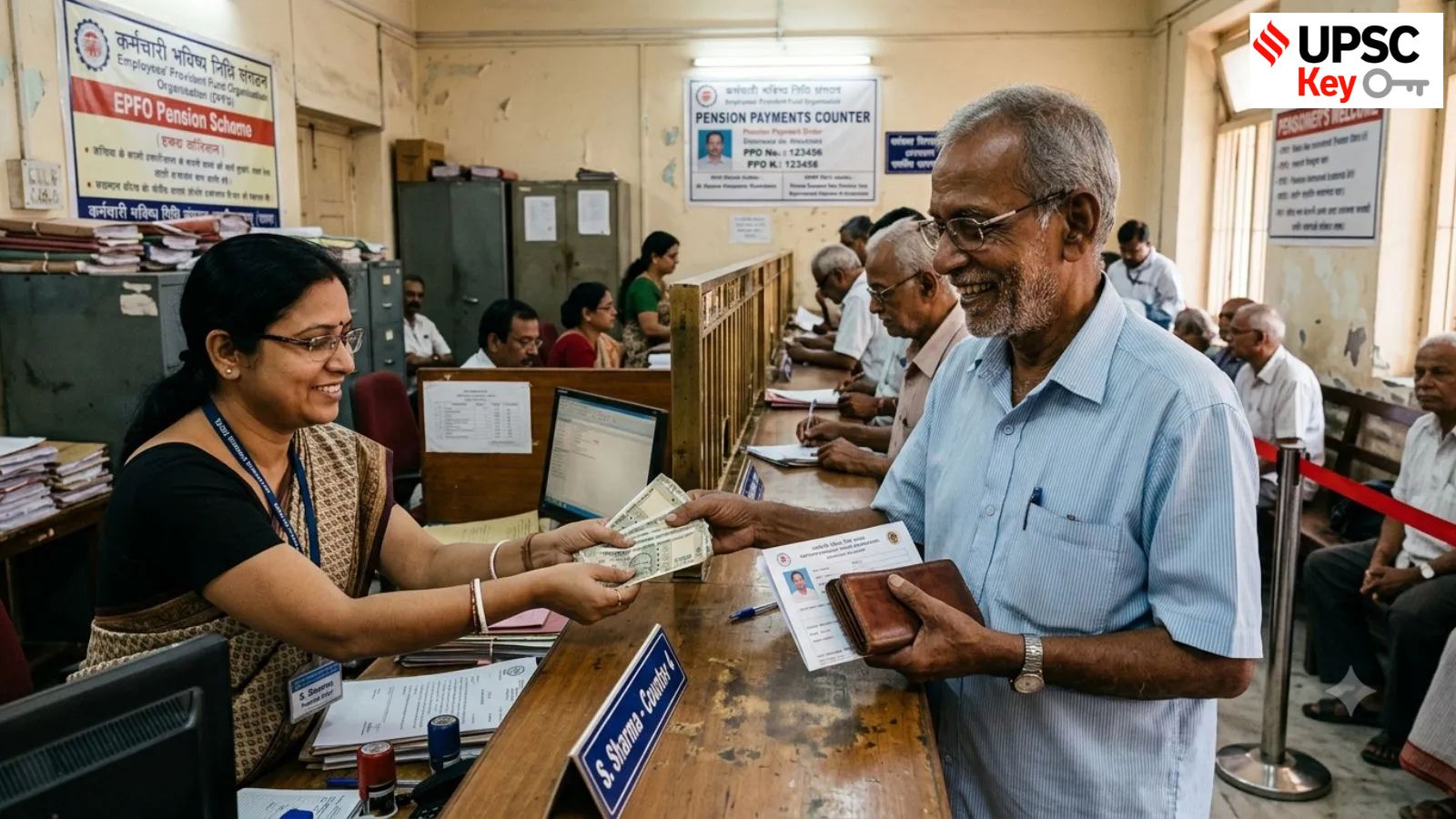
What’s the ongoing story: The government is working on a new contributory pension scheme for unorganised and formal sector workers that would accumulate contributions over time, and be invested in long-term government-backed securities, with annual crediting of interest.
Key Points to Ponder:
— What is the role and function of EPFO?
— Know about the new EPFO portal.
— What are the pension schemes of the government?
— What is the National Pension Scheme?
— How is it different from the Unified Pension Scheme?
— What is the importance of pension schemes?
— Compare the retirement fund schemes of India with other countries.
Key Takeaways:
— At the age of 60 years, the scheme may allow the proposed “Target Retirement Sum (TRS)” to be converted into pension, based on prevailing annuity and interest rates, a senior government official told The Indian Express.
— The scheme, part of the 3.0 reforms phase of the retirement fund body Employees’ Provident Fund Organisation (EPFO), will cover existing members and those excluded from the Employees’ Pension Scheme (EPS).
— It is likely to adopt a defined contribution framework and allow contributions from multiple sources: workers themselves, employers, government co-contributions for workers in the lower wage segment, aggregators in the case of gig and platform workers, and corporate social responsibility (CSR) or third-party funds, the officials said.
— The EPFO proposes to give the flexibility to the worker at the age of 55 years to decide the purpose for his or her retirement savings.Under the proposed pension plan, each member will have an individual pension account.
— When asked if this would be along the lines of the National Pension System (NPS), one of the officials cited above said the NPS is “purely annuity based, while the proposed pension scheme will be more flexible, risk free and based on real and not notional returns”.
— The scheme also proposes family and survivor pensions for spouse, children, and orphans funded through a pooled “Family Benefit Fund”, managed on actuarial principles, the official said.
— The EPFO 3.0 reforms will bring new tech features and an upgradation to the core banking solution (CBS), and pave the way for PF contributions for all unorganised sector workers and gig workers, in line with the Code on Social Security that brings gig and platform workers into the social security net for the first time.
— The retirement fund models of other countries such as Singapore are being studied to incorporate the best practices, the official said. Singapore’s social security scheme, Central Provident Fund (CPF), a deferred annuity scheme, sets aside savings not just for retirement but also for housing and healthcare.
— As the EPFO expects around 2.5 crore gig workers and building and other construction workers (BOCW) over the next five years, the scheme is also being designed keeping in mind their inclusion into social security coverage for the first time
Do You Know:
— The National Pension Scheme (NPS) replaced the Old Pension Scheme (OPS) on January 1, 2004. However, there have been persistent demands for a return to the OPS because for government employees, the NPS not only gave lower assured returns, it also implied employee contributions — which was not the case with the OPS.
— The main problem was that the pension liability remained unfunded — that is, there was no corpus specifically for pension, which would grow continuously and could be dipped into for payments.
— The Government of India budget provided for pensions every year; there was no clear plan on how to pay year after year in the future. The ‘pay-as-you-go’ scheme created inter-generational equity issues — meaning the present generation had to bear the continuously rising burden of pensioners.
— One of the most important features of the Centralised IT Enabled Services (CITES) project under the EPFO 2.01 initiative is the move towards a centralised database. It follows the merger of information from all regional centres, which will allow members to resolve their issues at any regional EPF office and not necessarily in their city of employment, where Provident Fund deductions may have happened.
Other Important Articles Covering the same topic:
📍Unified Pension Scheme: All that matters for UPSC Exam
Previous year UPSC Prelims Question Covering similar theme:
(1) Who among the following can join the National Pension System (NPS)? (UPSC CSE 2017)
(a) Resident Indian citizens only
(b) Persons of age from 21 to 55 only
(c) All State Government employees joining the services after the state of notification by the respective State Governments
(d) All Central Government employees including those of Armed Forces joining the services on or after 1st April, 2004
EXPLAINED
The case for updating the Indus Waters Treaty
Syllabus:
Preliminary Examination: Current events of national and international importance.
Mains Examination: General Studies-II: Bilateral, regional and global groupings and agreements involving India and/or affecting India’s interests.
What’s the ongoing story: Several rhetorical statements have emerged from Pakistan in the last couple of weeks over India’s decision to keep the Indus Waters Treaty “in abeyance” following the terrorist strikes in Pahalgam last year.
Key Points to Ponder:
— What is the Indus Water Treaty (IWT)?
— Why is there a need to renegotiate the IWT?
— What were the reasons for the suspension of IWT?
— What is the Indus Water river system?
— What is the significance of the Indus River for India?
— What is Permanent Indus Commission (PIC)?
— How is river water sharing determined in bilateral relationships?
— What are the other river water sharing agreements of India with other countries?
— Know the significance of the Indus Waters Treaty in the context of India-Pakistan relations.
— The Indus originates in Tibet. Should India be concerned about China’s interference while it resolves the river issue with Pakistan?
Key Takeaways:
— Incidentally, Pakistan has still not responded to India’s two notices to modify and renegotiate the Treaty.
— While the decision to hold the Treaty in abeyance is an exceptional measure to deal with an extraordinary security situation arising from Pakistan’s continued support for cross-border terrorism, there is nothing unusual in India’s request to amend or renegotiate the Treaty.
— The need for reviewing and updating the Indus Waters Treaty has been articulated, even by Pakistani experts and scholars, for several years now, much before the present stand-off, which actually began in 2016 following the terror attack in Uri. However, India’s request for modification or renegotiation of the Treaty is the first such official move from either side.
— River systems are dynamic entities. As river flows and water use change, the populations dependent on these waters increase or decrease, new water management technologies and practices emerge, and better data and scientific knowledge develop. The management of these river waters, therefore, cannot be a static arrangement.
— There are at least 250 separate transboundary riverwater-sharing treaties worldwide, covering 113 transboundary river systems, according to a 2013 study.
 Indus Basin
— India’s other major transboundary river agreement, the 1996 agreement with Bangladesh on the Ganga River, has a 30-year validity, after which it must be renewed. This agreement is due for renewal this year.
— While the Indus Waters Treaty is often seen as a static agreement in perpetuity, it is not. Two provisions of the Treaty allow it to be adapted to newer situations.
— Article VII allows the Permanent Indus Commissions of the two countries to undertake new drainage or other engineering works through mutual agreement and cooperation. This provision has never been made use of.
— Additionally, Article XII provides for modification of the provisions of the Treaty “from time to time” but only through another government-level treaty. India has invoked this provision to serve Pakistan notices, seeking its modification or a complete renegotiation.
— Many modern riverwater-sharing arrangements, like the one over the Mekong River in Southeast Asia, finalised in 1995, have much more flexible institutional structures and easier processes for making changes.
— While the Permanent Indus Commission (PIC), established by the Indus Treaty, functions merely as its implementing agency, the Mekong River Commission also acts as a joint river water-management system.
— Even before the present stand-off, it was widely recognised that the Indus Waters Treaty, the result of a unique situation between the two countries in the 1950s, was not adequate to address contemporary water management challenges.
— But several other important elements of modern integrated water management practices are also missing from the Treaty.
— It also has no provisions for water quality or maintaining environmental flows in the rivers.
— The case for modifying or renegotiating the treaty is both common-sensical and compelling. A recent study by Indian researchers Vimal Mishra and Urmin Vegad of IIT Gandhinagar showed how climate change was having differential impacts on water availability in the Indus basin.
Do You Know:
— India and Pakistan signed the Indus Water Treaty on September 19, 1960 to ensure the distribution of waters of the Indus and its tributaries. It was signed in Karachi by then Prime Minister Jawaharlal Nehru and then Pakistan President Ayub Khan.
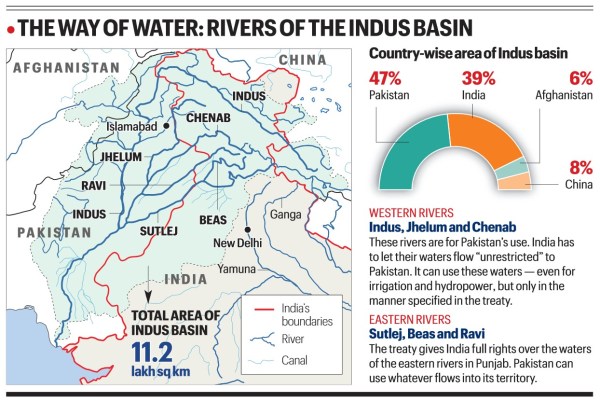
— A river, along with its tributaries, is called a river system. The Indus River system comprises six rivers: Indus, Jhelum, Chenab, Ravi, Beas, and Sutlej. The Indus and Sutlej are antecedent rivers, meaning they existed even before the formation of the Himalayas and cut deep gorges after originating in the Tibet region. The other four rivers – Jhelum, Chenab, Ravi and Beas – originate in India.
Other Important Articles Covering the same topic:
📍Knowledge Nugget | Indus Waters Treaty in Focus: What aspects need to be revisited?
📍Indus River system and the debate on Indus Water Treaty
Previous year UPSC Prelims Question Covering similar theme:
(2) With reference to the Indus river system, of the following four rivers, three of them pour into one of them which joins the Indus directly. Among the following, which one is such a river that joins the Indus direct? (UPSC CSE 2021)
(a) Chenab
(b) Jhelum
(c) Ravi
(d) Sutlej
UPSC Mains Practice Question Covering similar theme:
Why is the Indus River system significant for India and its neighbouring countries?
Can courts stop release of a film cleared by CBFC?
Syllabus:
Preliminary Examination: Current events of national and international importance
Mains Examination: General Studies-II: Government policies and interventions for development in various sectors and issues arising out of their design and implementation.
What’s the ongoing story: The Supreme Court on Friday (July 17) declined to permit the release of the animated film Mahaprabhu Jagannath on its scheduled release date today but directed the producer to postpone the release until after July 27, when the annual Rath Yatra in Puri concludes.
Key Points to Ponder:
— Know about the Jagannath Rath Yatra
— What is CBFC?
— How are films rated?
— Is there regulation for theater release and OTT release same?
— What is the Cinematography Act?
— What are the important Court rulings in this regard?
— How is it linked to Article 19?
— Know about the issue related to Sutluj movie OTT release
Key Takeaways:
— The order, by a bench of Justices B V Nagarathna and R Mahadevan, came after the Orissa High Court, on July 15, restrained the film’s release over concerns regarding the depiction of Lord Jagannath and the possible impact of its screening during the Rath Yatra.
— The High Court had held that the film’s depiction of Lord Jagannath’s childhood and adventures was “not in tune with the religious texts of the Skandha Purana and the Brahma Purana”. It said that releasing it during the Rath Yatra would be “counterproductive”.
— The film held three separate ‘U’ (universal) certificates from the Central Board of Film Certification (CBFC) for its Hindi, Telugu and Odia versions, dated May, June and July, respectively. The stay stalled the certified Hindi and Telugu versions in states “where no cause of action existed and no relief was ever sought”.
— The plea states that once “an expert statutory body… examines a film and certifies it for unrestricted public exhibition, there is a strong legal presumption of validity”, and courts should not substitute and follow “its view over the expert wisdom of the CBFC based on unverified apprehensions”.
— The SC has generally treated CBFC as carrying significant weight. In Union of India v K.M. Shankarappa (2000), it struck down a provision letting the government revise a tribunal’s decision. It said that once an expert statutory body certifies a film, that decision cannot be revisited by the executive merely because of objections or apprehensions about public reaction.
— Certification itself, however, is not entirely immune from judicial scrutiny. Courts retain the power to examine whether certification was granted in accordance to the law — such as if the CBFC relied on statutory grounds, issued reasons or followed fair procedure. Where the CBFC acts within the framework of the Act, courts usually defer.
— Under the Cinematography Act, the government may suspend or revoke a certification after approval. It may, in some cases, temporarily restrict screening without prior hearing. The Act allows criminal liability for violations and authorities can enter theatres and seize materials.
— The HC order says that even if the movie enjoys the guarantee of freedom of expression and speech, a balance has to be created when such a creation impacts “the thoughts and the actions of the common people… it should ensure a high degree of attention and retention.”
Do You Know:
— Theatre releases are governed by the Cinematograph Act, 1952. Under Section 4 of the Act, any person wishing to exhibit a film publicly must apply to the CBFC, a statutory body under the Ministry of Information and Broadcasting. Screening uncertified films in a cinema is a criminal offence.
— The CBFC certifies films into categories: U (unrestricted); UA (unrestricted with parental guidance); A (adults only), and S (restricted to specialised audiences).
— The Cinematograph (Amendment) Act, 2023, further split the UA category into age-based sub-categories and made certificates perpetually valid, removing the earlier 10-year limit.
Other Important Articles Covering the same topic:
📍Behind ‘Satluj’ takedown, India’s parallel regimes to regulate theatrical and OTT releases
Previous year UPSC Prelims Question Covering similar theme:
(3) According to the Constitution of India, which of the following are fundamental for the governance of the country? (UPSc CSE 2013)
(a) Fundamental Rights
(b) Fundamental Duties
(c) Directive Principles of State Policy
(d) Fundamental Rights and Fundamental Duties
Previous year UPSC Mains Question Covering similar theme:
“Right of movement and residence throughout the territory of India are freely available to the Indian citizens, but these rights are not absolute. “ Comment. (UPSC CSE 2022)
Behind US ‘explosive diarrhoea’ outbreak, hard-to-kill parasite that clings to green
Syllabus:
Preliminary Examination: Current events of national and international importance.
Mains Examination: General Studies-II: Issues relating to development and management of Social Sector/Services relating to Health, Education, Human Resources.
What’s the ongoing story: A woman in the US reportedly had to rush to the bathroom around 30 times a day after becoming infected with Cyclospora, a microscopic parasite that causes explosive diarrhoea, dehydration and hospitalisation.
Key Points to Ponder:
— What is the difference between parasites, bacteria, and viruses?
— What is cyclospore?
— What are the prominent parasite related diseases?
— What are the symptoms and cure of cyclospore?
Key Takeaways:
— The latest cyclospora outbreak is one of the largest ever recorded in the US, with case numbers already exceeding the previous record set in 2019.
— Bacterial food poisoning burns itself out in one to three days and viral gastroenteritis in two or three, whereas cyclosporiasis runs for weeks. If left untreated, the illness may last from a few days to a month or longer and may relapse.
— That rhythm, in which the patient improves, believes it is over, and then crashes again, is close to a signature. The incubation too is wrong for food poisoning: it averages about a week and ranges from two days to a fortnight or more. If the patient is blaming last night’s biryani, it’s not cyclospora.
— Point to note is that Cyclospora is a protozoan, a single-celled microscopic organism that multiplies inside you, while worms are large, multi-celled creatures that cannot directly multiply inside the human body (they lay eggs instead).
— The feature of the illness also differs. The diarrhoea is watery and sometimes explosive, but what dominates is loss of appetite, weight loss, abdominal cramping and bloating, increased flatulence, and a prolonged fatigue extremely out of proportion to the bowel symptoms.
— Empirical use of antibiotics such as metronidazole, azithromycin or a fluoroquinolone (ciprofloxacin, norfloxacin) will fail, and then co-trimoxazole will produce a dramatic response, which in hindsight is itself a diagnostic.
— Cyclospora cannot be grown in a laboratory culture dish like bacteria, so scientists have to rely heavily on advanced genomic tools to study it. As for why the illness lasts, cyclospora is a tough parasite that hides and multiplies inside the lining of the small intestine, attacking neighbouring cells in waves that cause the illness to return just when doctors think the patient is recovering.
— It damages the gut’s ability to absorb nutrients, which is why extreme fatigue and weight loss can drag on for weeks even after the diarrhoea has stopped. Furthermore, our body does not develop permanent immunity, meaning a person can catch it again.
— The parasite is especially dangerous because its “eggs” have a rugged shell that survive for weeks in soil and water and completely resist chlorine, allowing it to easily hitch a ride onto fresh produce.
— Cyclospora infections are frequently underdiagnosed because the parasite is invisible on standard tests and requires specific staining or ultraviolet fluorescence techniques.
— Cyclospora requires one to two weeks to mature in the environment, making direct person-to-person transmission unlikely. Identifying the parasite on food serves as a “fossil record,” indicating contamination happened well before the food was harvested, shipped, or eaten.
— Cyclospora is exceptionally skilful at evading food safety systems because it favours raw produce like leafy greens and berries, lacks an effective chemical kill step, and clings tenaciously to complex plant surfaces.
Do You Know:
— Parasites are organisms that depend on another organism, known as the host, for their nutrition and survival.
— There are three main classes of parasites that can cause disease in humans: protozoa, helminths, and ectoparasites.
Other Important Articles Covering the same topic:
📍38 parasites found in a British woman’s brain after years of no symptoms
Previous year UPSC Prelims Question Covering similar theme:
(4) Widespread resistance of malarial parasites to drugs like chloroquine has prompted attempts to develop a malaria vaccine to combat malaria. Why is it difficult to develope an effective malaria vaccine? (UPSC CSE 2010)
(a) Malaria is caused by several species of Plasmodium.
(b) Man does not develop immunity to malaria during natural infection.
(c) Vaccines can be developed only against bacteria.
(d) Man is only an intermediate host and not the definitive host.
THE EDITORIAL PAGE
India now has the funds, the talent and the opening for a research leap
Syllabus:
Preliminary Examination: Current events of national and international importance
Mains Examination: General Studies-II: Government policies and interventions for development in various sectors and issues arising out of their design and implementation
What’s the ongoing story: Shivkumar Kalyanaraman and V Anantha Nageswaran wrote: For three months this spring, the most consequential number in the Indian economy was the distance between a tanker and the Strait of Hormuz… The lesson was salutary, but incomplete. In the end, oil can be rerouted. A nation that is aspiring to be self-reliant in critical technologies enjoys no such latitude.
Key Points to Ponder:
— What is the status of Research and Development in India?
— What is the role of the private sector in this?
— What are the reasons for low R&D investment in India?
— What is the significance of R&D for a nation like India?
— What is the Anusandhan National Research Foundation?
Key Takeaways:
— India knows where it stands, because it has taken its own measure without flinching. As of 2023, it spends 0.64 per cent of GDP on research and development — against a global average more than twice that — and barely two-fifths of even that is financed by private enterprise, whereas in China, Korea and America the share is three-quarters or more. However, the state has, for the first time, put real weight behind the proposition.
— The Anusandhan National Research Foundation, notified in 2024 — a statutory body chaired by the Prime Minister, convening academia, industry, start-ups, philanthropy and the diaspora — exists to change the arithmetic of risk.
— The design is catalytic: For every rupee companies invest in pre-commercial research in partnership with the foundation, they are likely to commit five to 10 of their own to commercialise and scale up these research outputs.
— But the argument must move on from what is offered to what is required, for a catalyst is not a substitute, or a crutch. The foundation can lower the risk of the climb; it cannot make it. Three acts remain the industry’s own.
— The first is to mobilise one’s own capital behind the public catalyst. The second is to choose, with strategic seriousness, the arenas that matter — the technologies in which dependence is most dangerous and capability most valuable — over the incremental gains a captive market rewards.
— The third, least glamorous and most important, is institutional: To build inside the firm the machinery long-horizon goals demand — dedicated research units, corporate venture arms, planning functions insulated from the tyranny of the next quarter.
— India can be the world’s research and development partner. All of us have to build it together: The foundation’s logic is partnership with academia and deep-technology start-ups that outpace incumbents.
— When India accepted the World Trade Organisation’s intellectual property regime in the mid-1990s, agreeing to honour product patents in pharmaceuticals, the expectation was that the domestic drug industry, built on reverse-engineering molecules others had discovered, would be overrun by the very multinationals whose patents it had worked around.
— That is not what happened. Indian firms chose to build rather than retreat: They mastered process chemistry and the world’s strictest regulatory requirements, and made themselves the pharmacy for much of the world. The inflection now before Indian enterprise is broader; its logic is identical.
— The climb, moreover, can be swifter than it was for those who went before. India faces the task with the pieces in place at once — a demographic dividend available now, not forever; unmatched digital public infrastructure; funds and architecture now in place; and a global moment that rewards any economy offering an alternative to a single dominant supplier.
— These are the conditions under which a country does not merely catch up but leaps — from the consumer of intellectual property it has too long been, to the generator its aspirations demand.
Other Important Articles Covering the same topic:
Previous year UPSC Prelims Question Covering similar theme:
(5) Which of the following statements is/are correct regarding National Innovation Foundation-India (NIF)? (UPSC CSE 2015)
1. NIF is an autonomous body of the Department of Science and Technology under the Central Government.
2. NIF is an initiative to strengthen the highly advanced scientific research in India’s premier scientific institutions in collaboration with highly advanced foreign scientific institutions.Select the correct answer using the code given below:
(a) 1 only
(b) 2 only
(c) Both 1 and 2
(d) Neither 1 nor 2
Previous year UPSC Mains Question Covering similar theme:
Scientific research in Indian universities is declining, because a career in science is not as attractive as are business professions, engineering or administration, and the universities are becoming consumer-oriented. Critically comment. (UPSC CSE 2014)
ECONOMY
SEBI cautions firms against rising ‘Boss Scam’
Syllabus:
Preliminary Examination: Current events of national and international importance
Mains Examination: General Studies-III: Challenges to internal security through communication networks, role of media and social networking sites in internal security challenges, basics of cyber security
What’s the ongoing story: The Securities and Exchange Board of India (SEBI) has cautioned regulated entities and listed companies against a rapidly emerging cyber fraud known as the ‘Boss Scam’, in which fraudsters impersonate CEO or managing director to carry out the crime.
Key Points to Ponder:
— What is ‘Boss scam’?
— What is the role and function of the Indian Cyber Crime Coordination Centre (I4C)?
— What is the function of SEBI?
— what is cyber security?
— What are the various cyber threats?
— How are AI and deepfake technology impacting cyber security?
Key Takeaways:
— Acting on inputs from the Indian Cyber Crime Coordination Centre (I4C), the market regulator has urged organisations to strengthen internal verification procedures as fraudsters increasingly exploit artificial intelligence, deepfake technology and malicious software to deceive finance officials into transferring funds.
— In a press statement issued on Friday, SEBI said cybercriminals are targeting chief executive officers, managing directors and other senior officials by impersonating them through email, WhatsApp, Microsoft Teams and other social media platforms.
— The fraudsters send convincing messages or place fake calls to employees, particularly those handling financial transactions, instructing them to make urgent payments to bank accounts controlled by criminals.
— According to SEBI, the scam typically follows two distinct methods. In the first, fraudsters use advanced deepfake technology, including AI-generated voice cloning and manipulated video calls, to convincingly imitate senior executives.
— The second method involves the distribution of malicious compressed (.zip) files containing executable (.exe) and Dynamic Link Library (.dll) files. These files, once downloaded and opened on Windows computers, install malware capable of compromising the victim’s device. The malware functions as a Trojan dropper, enabling attackers to hijack active WhatsApp Web session tokens and gain unauthorised access to the finance officer’s messaging account, SEBI said.
— Once access is obtained, fraudsters use the compromised account to contact other finance or accounts personnel, directing them to transfer money to designated mule bank accounts.
— In more sophisticated attacks, cybercriminals who gain complete control of a device reportedly alter the victim’s contact list by saving the fraudster’s number under the name of the company’s CEO or Managing Director.
— This makes fraudulent payment instructions appear to originate from a trusted senior executive, increasing the likelihood of successful deception.
— In the event of any suspected cyber fraud or attempted scam, SEBI advised companies and individuals to immediately report the incident by dialling the national cybercrime helpline, 1930, or by lodging a complaint through the government’s cybercrime reporting portal.
Do You Know:
— India has a comprehensive legal framework to address cybercrimes. The Information Technology Act, 2000 covers offences related to phishing, smishing, and vishing, prescribing fines and imprisonment.
— In 2018, the Ministry of Home Affairs approved the Indian Cyber Crime Coordination Centre (I4C) as a national-level coordination centre to address cybercrime-related issues. In September 2024, four I4C platforms — Cyber Fraud Mitigation Centre (CFMC), the ‘Samanvaya’ platform, a Cyber Commandos programme and a Suspect Registry — were inaugurated by Home Minister.
— Under the provisions of section 70B of the Information Technology (IT) Act, 2000, the CERT-In is designated as the national agency for responding to cyber security incidents. The CERT-In plays a vital role in controlling cybersecurity incidents and coordinating incident response activities. It acts as the central agency for incident response, vulnerability handling, and security management in India’s cyberspace.
Other Important Articles Covering the same topic:
📍UPSC Issue at a Glance | India’s Cybercrime Challenge : Rise and Response
📍What Digital Threat Report tells about cybersecurity and how is it relevant for UPSC exam
Previous year UPSC Prelims Question Covering similar theme:
(6) In India, it is legally mandatory for which of the following to report on cyber security incidents? (UPSC CSE 2017)
1. Service providers
2. Data centres
3. Body corporate
Select the correct answer using the code given below:
(a) 1 only
(b) 1 and 2 only
(c) 3 only
(d) 1, 2 and 3
Previous year UPSC Mains Question Covering similar theme:
What are the different elements of cyber security? Keeping in view the challenges in cyber security, examine the extent to which India has successfully developed a comprehensive National Cyber Security Strategy. (UPSC CSE 2022)
ALSO IN NEWS
PM flags off India’s first hydrogen train: 2-hour Jind-Sonipat travel, 14 halts and zero emission
India joined a select group of nations on Friday as Prime Minister Narendra Modi flagged off the country’s first hydrogen-powered train connecting Jind and Sonipat in Haryana — a significant achievement for the Indian Railways in the use of zero emission, clean fuel technology.
RBI moves closer to polymer notes, subsidiary floats tender
The Reserve Bank of India (RBI) is set to trial polymer currency notes, with the Bharatiya Reserve Bank Note Mudran Private Limited (BRBNMPL) on Friday floating a global tender for polymer sheets that will be used to print currency notes at its own presses and that of Security Printing and Minting Corporation of India (SPMCIL).
PRELIMS ANSWER KEY
1. (c) 2. (d) 3. (c) 4. (a) 5. (a) 6. (d)
Subscribe to our UPSC newsletter. Stay updated with the latest UPSC articles by joining our Telegram channel – IndianExpress UPSC Hub, and follow us on Instagram and X.
🚨 Click Here to read the UPSC Essentials magazine for July 2026. Share your views and suggestions in the comment box or at manas.srivastava@indianexpress.com🚨

