

UPSC Essentialsbrings to you its initiative of subject-wise quizzes. These quizzes are designed to help you revise some of the most important topics from the static part of the syllabus. Attempt today’s subject quiz on theEconomyto check your progress.
Gear up forUPSC Prelims 2026—Practice smarter, revise faster, and succeed with ourSpecial Quiz Magazine. (Click Here)
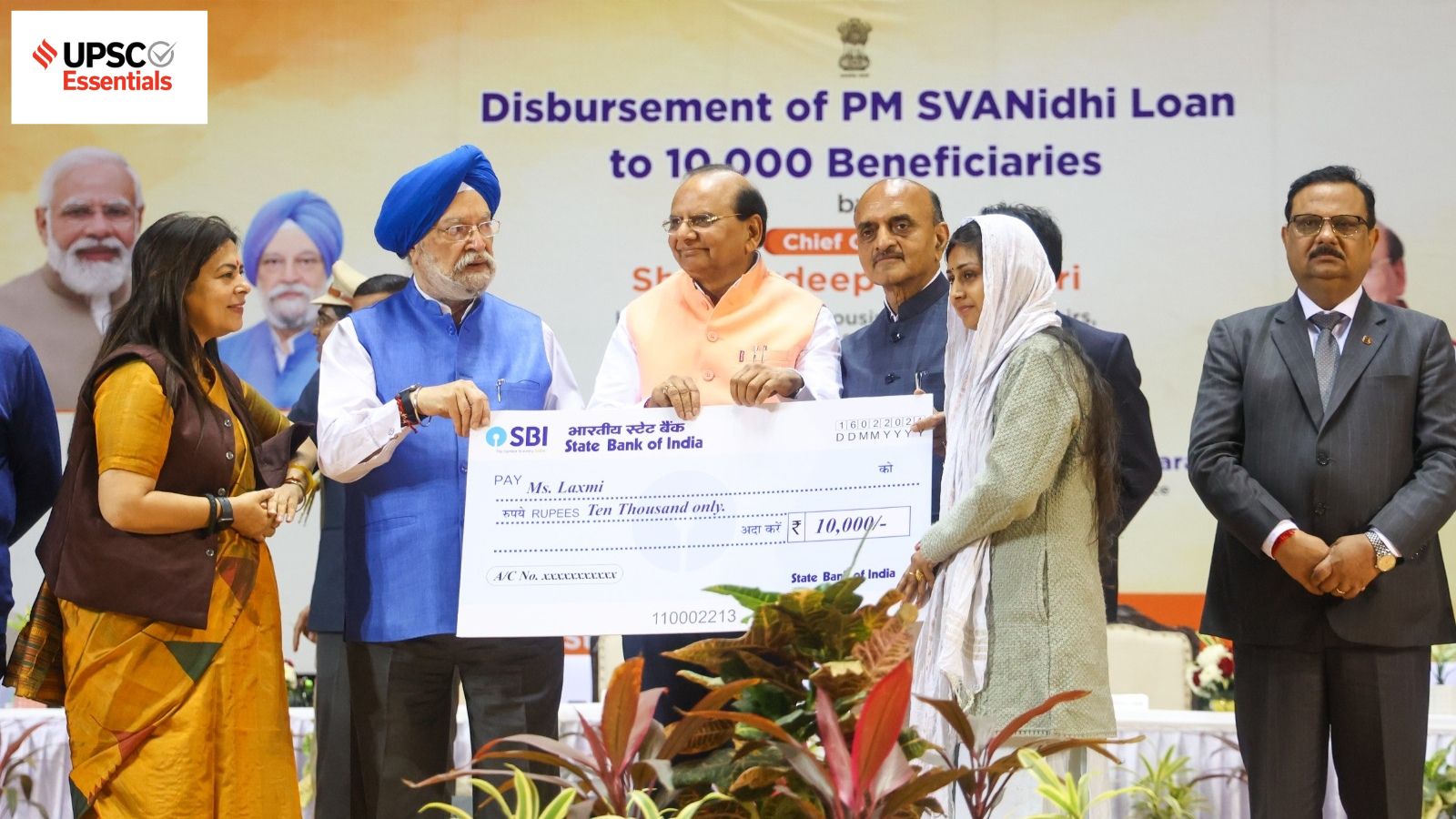
1. The scheme was launched in 2020 as a part of the government’s economic package during the Covid-19 pandemic and lockdown.
2. The scheme has the provision of a UPI-linked RuPay Credit Card for beneficiaries.
3. The scheme is implemented by the Ministry of Housing and Urban Affairs.
How many of the statements given above are correct?
(a) Only one
(b) Only two
(c) All three
(d) None
Relevance: Urban livelihood schemes like PM SVANidhi Scheme are important for prelims. Aspirants should be aware of the schemes in news.
Explanation
Story continues below this ad
— The Union Cabinet approved the restructuring of the PM SVANidhi loan scheme for street vendors, extending it till March 31, 2030 and enhancing the loan amount.
— The scheme was launched in 2020 as a part of the government’s economic package during the Covid-19 pandemic and lockdown. Hence, statement 1 is correct.
— The government has extended the lending period from December 31, 2024 to March 31, 2030, which is expected to benefit 1.15 crore beneficiaries, including 50 lakh new ones.
— The scheme is implemented by the Ministry of Housing and Urban Affairs and the Department of Financial Services. Hence, statement 3 is correct.
Therefore, option (c) is the correct answer.
QUESTION 2
With reference to the repo rate, which of the statements is/are correct?
1. When the RBI wants to encourage economic activity in the economy, it increases the repo rates.
2. When the RBI wants to control inflation, it decreases the repo rate.
Select the correct answer using the codes given below:
(a) 1 only
(b) 2 only
(c) Both 1 and 2
(d) Neither 1 nor 2
Story continues below this ad
Relevance: Repo rate is a core tool of monetary policy used by the Reserve Bank of India to manage liquidity and interest rates in the economy. UPSC can frame a question to test the understanding of inflation control vs growth stimulation mechanisms.
Explanation
— When the RBI wishes to boost economic activity, it lowers repo rates. This allows commercial banks to reduce both the interest rates they charge (on loans) and the interest rates they pay on deposits. This, in turn, encourages people to spend money because keeping their savings in the bank now pays back a bit less, while businesses are encouraged to take out new loans for new investments because new loans now cost a little less. Hence, statement 1 is not correct.
— When the RBI seeks to limit inflation, it raises the repo rate. Banks must thus pay more interest to borrow from the RBI, resulting in higher interest rates for their borrowers. Hence, statement 2 is not correct.
Therefore, option (d) is the correct answer.
QUESTION 3
Which of the following shall not levy any pre-payment charges on loans with sanctioned amount/limit up to Rs 50 lakh?
1. Small finance bank
2. Regional rural bank
3. Commercial Banks
4. NBFC-ML( medium layer)
Select the correct answer using the codes given below:
(a) 1 and 2 only
(b) 1, 2, 3 and 4
(c) 2, 3 and 4 only
(d) 1, 2 and 4 only
Story continues below this ad
Relevance: Questions test regulatory nuances of loan policies issued by the Reserve Bank of India, especially differences across financial institutions. It is relevant for prelims due to focus on consumer protection norms. Aspirants must read about the difference in RRB, Commercial Banks, Cooperative Banks, and NBFCs.
Explanation
Therefore, option (b) is the correct answer.
QUESTION 4
The Repatriation of Foreign Direct Investment (FDI) refers to:
Story continues below this ad
(a) foreign investors taking back money they had previously invested in India.
(b) reinvestment of profits earned by foreign companies within India.
(c) transfer of funds from domestic investors to foreign countries for investment purposes.
(d) conversion of domestic savings into equity for foreign companies operating in India.
Story continues below this ad
Relevance: FDI concepts are frequently asked in prelims, especially definitions like repatriation, inflows, and outflows in the external sector. Aspirants should also read about Balance of Payment, capital account transactions, and investment flows.
Explanation
— Repatriation of FDI refers to foreign investors taking back money they had previously invested in India. This repatriation can be in the form of profits, dividend, or sale of assets. Net FDI is calculated after adjusting for gross FDI for investments that are repatriated by foreign companies and overseas investments made by Indian companies.
Therefore, option (a) is the correct answer.
QUESTION 5
With reference to the Coffee, consider the following statements:
1. India is the largest producer and the exporter of arabica beans.
2. In India, Karnataka is the largest coffee-producing state.
Which of the statements given above is/are correct?
(a) 1 only
(b) 2 only
(c) Both 1 and 2
(d) Neither 1 nor 2
Story continues below this ad
Relevance: Coffee cultivation is a key plantation crop topic linked to India’s agricultural economy. UPSC can frame questions testing global vs Indian production patterns. Aspirants should read about both Arabica and Robusta varieties of coffee.
Explanation
— Indian coffee exporters have benefitted from global ending stocks for 2024-25 depleting to their lowest since 1999-2000, mainly courtesy of subpar crops in Brazil and Vietnam, the world’s biggest producers of arabica and robusta varieties respectively. India mostly exports robusta beans and powder used in instant coffee and espresso blends. Tobacco exports have similarly got a boost from output shortfalls in Brazil and Zimbabwe. Hence, statement 1 is not correct.
— Karnataka leads in production followed by Kerala and Tamil Nadu. Hence, statement 2 is correct.
Therefore, option (b) is the correct answer.
🚨Click Hereto read the UPSC Essentials magazine forApril 2026.Share your views and suggestions in the comment box or at manas.srivastava@indianexpress.com🚨
Previous Daily Subject-Wise-Quiz
Daily Subject-wise quiz — History, Culture, and Social Issues (Week 154)
Daily subject-wise quiz — Polity and Governance (Week 159)
Daily subject-wise quiz — Science and Technology (Week 159)
Daily subject-wise quiz — Economy (Week 158)
Daily subject-wise quiz — Environment and Geography (Week 158)
Daily subject-wise quiz – International Relations (Week 158)
Subscribeto ourUPSC newsletterand stay updated with the news cues from the past week.
Stay updatedwith the latestUPSC articlesby joining ourTelegram channel–IndianExpressUPSC Hub, and follow us onInstagramandX.

