

When the Union Budget was presented in February, a popular notion was that the Indian economy was witnessing a “rare goldilocks period”, as RBI Governor Sanjay Malhotra put it. A cultural reference, goldilocks refers to an economy being exactly where policymakers would like it to be — sustained growth, low inflation, and low unemployment.
Since then, the news has turned negative.
First, India revised (with a new base year of 2022-23) how it calculates its gross domestic product (GDP) — the measure used to assess the size of any economy — and found that the old series (with 2011-12 as base year) was overestimating GDP.
Then came the US’s war in Iran, and the further fall in the rupee’s exchange rate with the US dollar. Last week, Japan and the UK overtook India in terms of GDP.
With the hostilities in Iran still on, more observers are pencilling in a slower growth and high inflation for India, especially given India’s overwhelming reliance on energy imports via the Strait of Hormuz.
So, was India really witnessing a goldilocks moment? Was India growing fast enough before the war? And if so, how fast?
A sobering truth
If one looks at the data from the old GDP series (as it provides data for past years), it becomes clear that — contrary to popular notion that India’s economy was doing very well — the truth is far more sobering.
The table gives the nominal GDP (in current day prices) and the real GDP (without the effect of inflation) of some key years.
Story continues below this ad
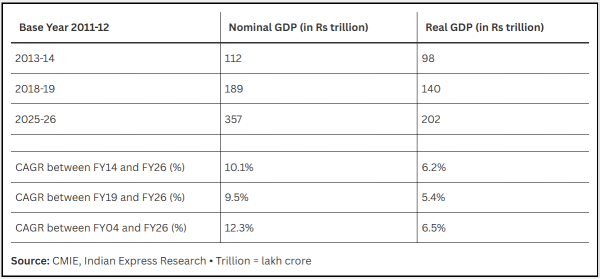 Data from the old GDP series shows that contrary to popular notion — that India’s economy was doing very well — the truth is far more sobering.
Whereas the chart provides the GDP’s compounded annual growth rate (CAGR) for the past 12 years (since 2014) and the past 7 years (since 2019) as well as over the past 22 years (since 2004).
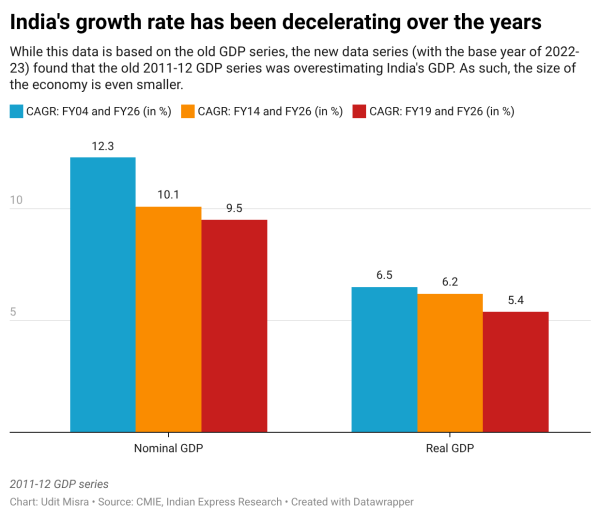 Chart 2 provides the GDP’s compounded annual growth rate (CAGR) for the past 12 years (since 2014) and the past 7 years (since 2019) as well as over the past 22 years (since 2004).
The two main takeaways are:
One, CAGR of nominal GDP over the past 12 years (April 2014-March 2026) has been just above 10% each year. For perspective, CAGR over the past 22 years has been around 12.3%. So, India’s growth rate is decelerating over time — and this deceleration is getting worse. In the past 7 years, nominal GDP growth rate clocked just 9.5% annually.
Two, in terms of real GDP — the variable that is more commonly talked about when one refers to India’s growth rate — India clocks a modest growth rate of just 6.2% per annum over the past 12 years. Again, CAGR over the past 22 years is higher than that over the past 12 years, suggesting that the growth momentum had weakened in the past 12 years. Also, CAGR of real GDP over the past 7 years has been less than 5.5%.
Story continues below this ad
In short, just above 6% real GDP growth rate over the past 12 years and less than 5.5% growth rate over the past 7 years is nowhere near the kind of growth rate required to become a developed country in the next two decades.
A hard look needed
Also, it is important not to cherry-pick only the years after the Covid-19-led growth contraction in 2020, since the high growth rates in those years would again overstate the growth without realising that those rates were owing to the low base created by the contraction.
So, it matters to look at slightly longer-term growth rates, because not doing so can mislead both the public and policymakers. For instance, the high growth rate of the past 2-3 years could present a goldilocks scenario when perhaps none exists.
If the real GDP has not even grown at 5.5% over the past 7 years, it should force policymakers to take a hard look at the domestic economy and the reforms needed to genuinely boost economic growth. For example, if India is not even growing at 6% in a sustainable manner, it is hardly surprising that corporate earnings have been modest and global investors have been shying away even as net foreign direct investment turned negative.
Story continues below this ad
Lack of foreign capital flows has been a big reason why the Indian rupee has weakened. This data also explains why the Indian rupee has been weakening against the dollar even when the dollar has been weakening against all the other currencies.
What makes this data from the old GDP series even more relevant is that the new GDP series has actually rolled back the size of India’s GDP. In other words, India is today a smaller economy than what was previously imagined.

