

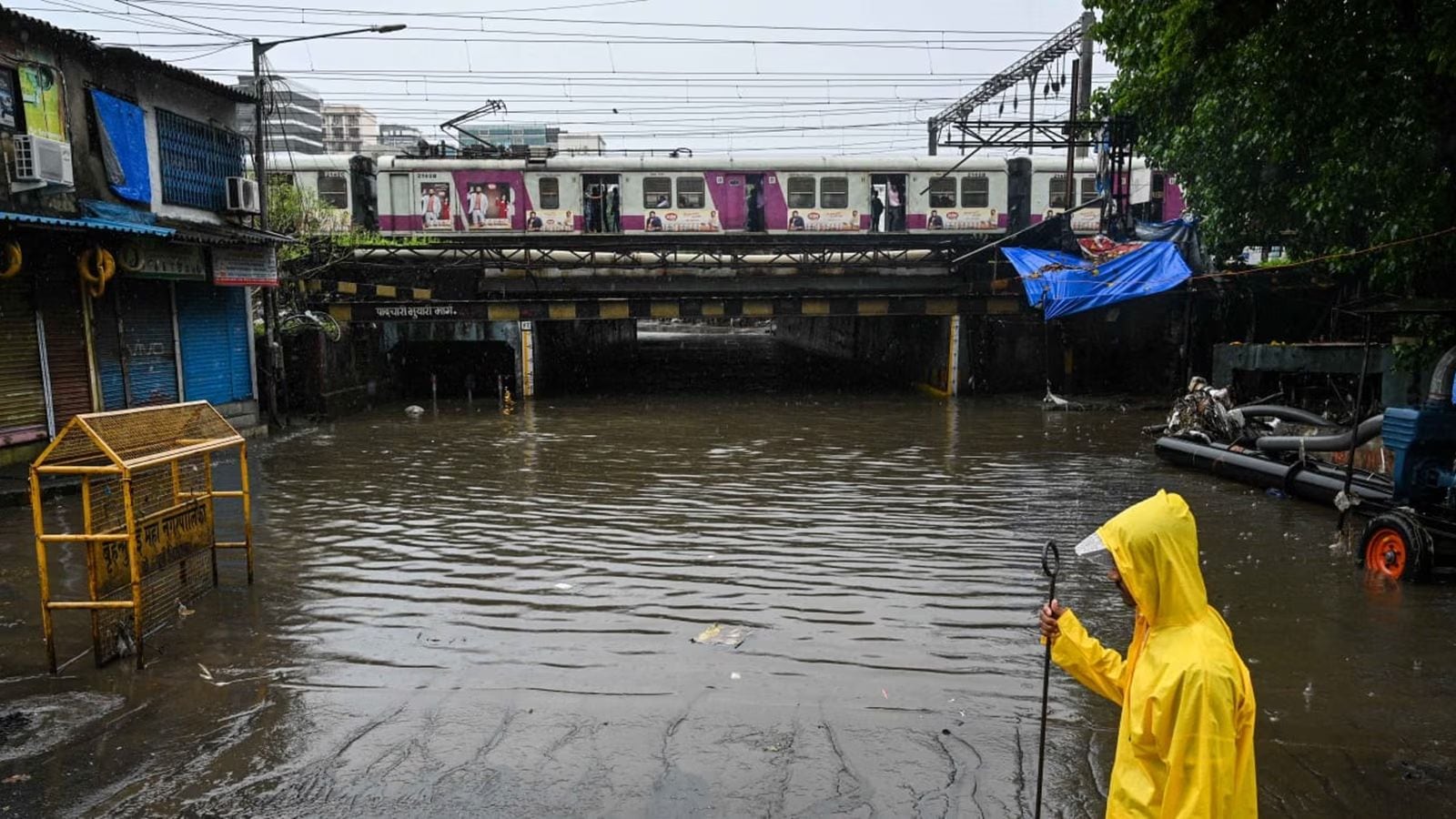
The Andheri subway, which is shut several times after getting inundated every monsoon, may continue to remain so in the upcoming season also, with the Brihanmumbai Municipal Corporation (BMC) not being able to find a solution till now. Civic officials said that a measure will be adopted soon, and the crisis will be mitigated from next year.
Located almost one kilometre from the Andheri railway station, the Andheri subway is a key east-west link in the western suburbs. However, during the monsoon, the subway is kept shut due to waterlogging. In 2025, the subway was shut 33 times between June and October, while in 2024, it was shut 35 times during this period, and in 2023, the subway was shut 21 times.

Speaking to The Indian Express, Abhijit Bangar, additional municipal commissioner (Projects), said the authorities are looking at two probable options — diversion of the existing drainage network and construction of a holding tank. “The process of diverting the drains is going to be challenging since the drains have sharp turns, which cause disruption to the flow and lead to clogs and reduced lifespan of pipelines,” Bangar said.
Therefore, according to officials, a holding tank is likely to be the probable solution to counter flooding in Andheri. A holding pond is like a detention basin that temporarily stores water during heavy rainfall. The water from a flood-prone area is routed to a nearby pond through pumps and pipelines, where the water is either kept in storage temporarily or channelled elsewhere using dewatering pumps. Holding ponds also act as a buffer between an area and its nearby waterbody.
In Mumbai, a holding pond was constructed in Hindmata Junction, which was a key flood-prone area. Following this, the issue of waterlogging in that area decreased considerably.
The BMC has roped in IIT Bombay to chalk out a solution for Andheri. Bangar said that the BMC has set a June 15 target to finalise the plan of implementation, following which tenders will be floated, with the construction work set to begin by October this year.
‘Ambitious’ proposal
In 2024, the BMC had proposed a Rs 200-crore proposal to mitigate the flooding issue at the Andheri subway. The civic body’s objective was to augment the existing drainage system to ensure that the water-carrying capacity increases. The civic authorities had also planned to create an additional drainage line that would divert the flow of water towards the western side, eventually discharging the water to the nearby creek.
Story continues below this ad
The two-phase project was supposed to begin in October 2025 and be completed by May 2026. However, the project didn’t take off.
“During a feasibility study, we found that the carrying capacity of the drains could be increased to tackle an average rainfall of 55 mm. At present, the carrying capacity is just 20 mm, and after the implementation of the proposed works, we would get only an additional cover of 35 mm of rainfall, which is not a wide range. Therefore, spending Rs 200 crore just to tackle 35 mm of rainfall will not be worth it, and we had to cancel this project to chalk out a more feasible project with a good cost-benefit ratio,” an official said.
Why does the subway and its adjoining areas get flooded
The location of the subway is saucer-shaped, making the entry and exit points elevated and have a slope-like curvature, due to which water from the adjoining areas also gets into the subway. Besides this, the Mogra Nullah, which originates 2 km away from the subway, passes downstream, abutting the subway, and whenever the water in the nullah overflows, it enters the subway and stays accumulated there.
Story continues below this ad
“One of the major challenges that we (BMC) are facing in keeping this particular point flood-free is the topography of this subway. This is a watershed area, where the gradient is very steep. During the rains, water gushes inside the subway at a very high speed. Unless any large-scale structural intervention is carried out, it will continue to be a challenge to keep the subway entirely flood-free,” an official said.
Bangar also blamed the ‘reckless’ disposal of solid waste for choking the drain. “Often we see materials like suitcases, furniture, plastic items, bicycles, being disposed of in the drain. These items obstruct the water flow, which, in turn, leads to overflow of the drains, causing flooding in the subway. We have been holding talks with local residents as well, however, no concrete result has emerged yet,” the official added.

