

Every weekday morning, thousands of commuters pour out of Kurla and Bandra railway stations and head towards Bandra Kurla Complex (BKC), Mumbai’s premier business district. For many, the train journey is only half the battle.
The last few kilometres often mean long queues for shared autorickshaws, arguments over fares, packed vehicles, and traffic-clogged roads leading into one of the city’s busiest commercial hubs. For the four to six lakh people estimated to enter BKC every day, the “last mile” remains one of Mumbai’s most persistent transport headaches.
It is this problem that the Mumbai Metropolitan Region Development Authority (MMRDA) believes it has found a solution for.
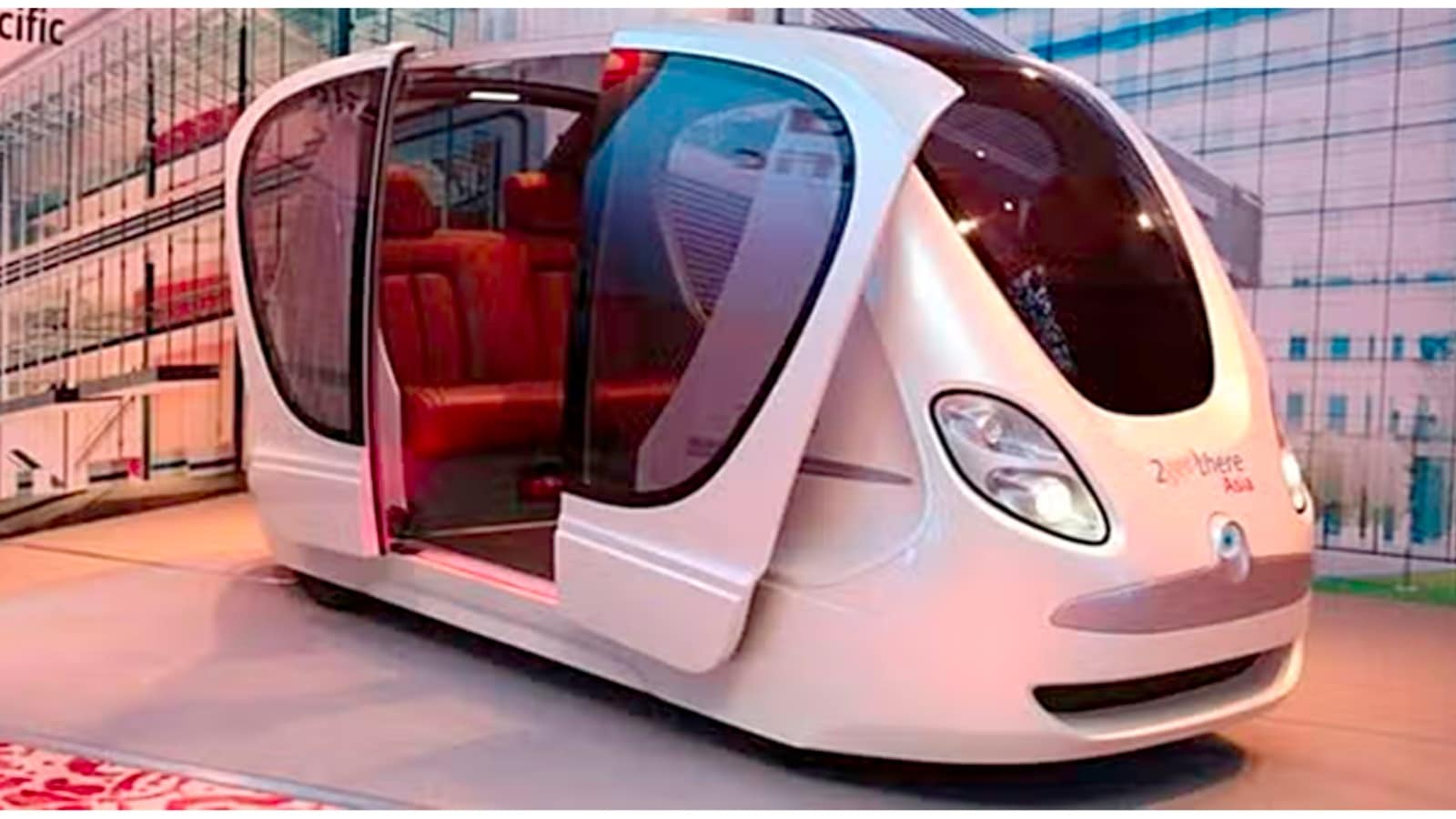
By 2028, if all goes according to plan, BKC will become home to India’s first large-scale pod taxi network, a personalised rapid transit (PRT) system in which small automated pods carry passengers directly to their destination. The system promises air-conditioned rides above traffic, minimal waiting time and direct connectivity within the business district.
But while transport planners broadly agree that BKC suffers from a severe last-mile connectivity problem, they remain divided over whether pod taxis are the answer.
Why BKC?
On paper, BKC appears tailor-made for a pod taxi system. Unlike suburban railways or metro lines designed to move large numbers of people over long distances, pod taxis are intended to solve short-distance connectivity gaps. BKC’s road network is congested, its pedestrian infrastructure remains uneven, and much of the area’s daily traffic consists of commuters travelling only a few kilometres between transit stations and office complexes.
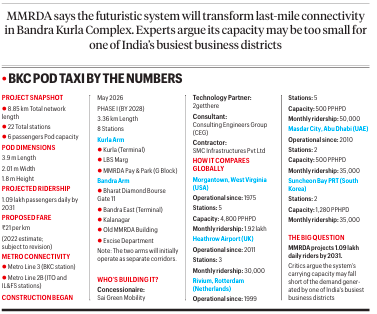
The initial phase of the project will cover 3.36 km with eight stations connecting major entry points and commercial destinations. Four stations are planned from the Bandra side to the old MMRDA building, while another four will connect the Kurla side to Bharat Diamond Bourse. By 2031, the network is expected to expand to 22 stations spread across BKC’s four-square-kilometre area.
Story continues below this ad
The pods are expected to travel at speeds of around 40 kmph, with a headway of 15 seconds between vehicles. Supporters argue that the technology addresses several constraints unique to BKC. Elevated guideways allow the pods to bypass road congestion, narrow support pillars minimise land requirements, and “off-line” stations enable vehicles to leave the main track without delaying other pods.
“The pod taxi is the country’s only project which is being built entirely without government subsidy. Instead, the executing agency will be paying the MMRDA Rs 1 crore licence fee and 2.65 percent of their revenue per year,” said Metropolitan Commissioner Sanjay Mukherjee.
A growing demand
According to a techno-economic feasibility study conducted by LEA Associates for the agency in 2021, around 4.46 lakh commuters were arriving at suburban railway stations every day to access BKC.
With new commercial developments, hospitals, metro lines and the Mumbai-Ahmedabad bullet train terminal expected to add to the area’s footfall, that figure is projected to rise to 5.8 lakh daily public transport commuters by 2041. The area is estimated to house 2.58 lakh people and 5.07 jobs over the coming two decades.
Story continues below this ad
The study estimates daily pod taxi demand could reach 1.09 lakh passengers by 2031 and increase to 1.71 lakh by 2041. For supporters, those figures justify experimenting with a new form of transit.
The capacity problem
Among transport planners, the biggest criticism of the pod taxi is not the technology itself but its carrying capacity. “BKC’s pod taxi has identified the correct problem of transit in BKC, that of last mile connectivity,” said Dwij Bhandari, chairman of the Indian Transport Infrastructure and Urbanism Community (ITIUC). “But it is like slapping a bandaid on a bullet hole.”
The concern stems from simple arithmetic.
“With six people in a pod, one pod 15 seconds after another would only be able to ferry around 1,500 people in an hour in each direction. In a full day of 16 operational hours, this would mean a capacity of around 23,000 passengers in each direction — much too short of what BKC requires,” said Neeraj Dixit, secretary of ITIUC and an urban planner and architect. This tabulates to a total daily capacity of around 46,000, not half as much as the expected demand on the system.
Even if every pod operates at full capacity, critics argue the system would serve only a fraction of the commuters entering BKC each day. Dixit anticipates bottlenecks in the peak direction at peak time.
Story continues below this ad
The experimental system may also end up affecting pedestrian infrastructure, an crucial mode of last-mile travel in the locality.
“Pod taxi stations at regular intervals, along with the supporting infrastructure, could place additional pressure on footpath and median space that many commuters in BKC rely on for last-mile travel foot travel. There could also be concerns about increased visual clutter and construction-related chaos relative to the expected long-term benefits,” said Vedant Mhatre, co-convener of The Walking Project.
For them, the pod taxi risks becoming a premium service – with fares of Rs 21 per km, with annual hikes of 4% to adjust for inflation – used by a limited number of passengers while doing little to address the area’s larger mobility challenges.
What the world experience shows
Pod taxis are hardly a new idea. The world’s oldest operational PRT system opened nearly 50 years ago in Morgantown, West Virginia, where it continues to serve students at West Virginia University. The system operates at speeds of around 48 kmph and carries significantly larger pods capable of transporting up to 20 passengers.
Other examples include Heathrow Airport’s PRT network in London, the Rivium business district system near Rotterdam, Masdar City’s driverless transport network in Abu Dhabi, and the SkyCube system in South Korea’s Suncheon Bay.
Story continues below this ad
However, critics note that most successful PRT systems operate in relatively controlled environments such as airports, university campuses, tourist zones or low-density business districts.The existing systems have riderships of only a fraction of the demand expected in BKC.
“These systems have niche use cases. They serve low-density, closed-loop environments with highly controlled traffic patterns. BKC or indeed wider MMR is anything but,” Dixit said.
That limited track record in dense urban settings is one reason transport experts remain cautious.
The case for pod taxis
Despite the scepticism, pod taxi technology is witnessing renewed interest globally. US-based company Glydways is currently developing systems in Atlanta, New York and Dubai and argues that conventional public transport systems are reaching their limits.
“Today’s transportation systems are built on interruption. On roads, vehicles stop and compete for space. In transit, people wait for service, stop at every station, and transfer across the network,” Glydways said in a response to The Indian Express.
Story continues below this ad
“That positions Glydways as more than a last-mile solution or a bus replacement. It adds new capacity to cities without taking away road space or requiring the political and financial burden of traditional megaprojects.”
The company says its systems can operate at speeds of up to 100 kmph, maintain headways as low as one second, function round-the-clock and cost only 10-20 per cent of comparable metro projects. It also claims significantly higher fare recovery than conventional public transport systems.
The technology risk
Beyond questions of demand and capacity, experts have also raised concerns about long-term maintenance and technological dependence.
Unlike buses, trains or metros, pod taxi systems rely on proprietary technology developed by a handful of companies globally. “The pod taxi is an exclusive system. There is no open market or third party to go for its parts or repairs, which could mean BKC is left stuck with a system that has no mechanic,” Bhandari said.
Story continues below this ad
The concern is informed by Mumbai’s experience with the monorail, which struggled with maintenance challenges and technology-related issues for years.
Other operational concerns, like the tussle with rickshaws, may also prove to be a hurdle.
Will it reduce traffic?
Even supporters acknowledge that the pod taxi is unlikely to transform traffic conditions in BKC. The most optimistic assessment is that it could absorb some future growth in demand rather than dramatically reducing congestion.
Even if, as the MMRDA claims, the pod taxi is able to handle the 1.09 lakh daily demand by 2031, the little dent it will make by taking the rickshaws and bus users of the road will be replaced by the increased demand of the area. As a result, it will make little difference to the traffic congestion.
Story continues below this ad
“It will at least make space for the additional traffic burden to grow in the future, keeping things on ground at status quo and not worse,” said an MMRDA official not willing to be named, when asked about the limitations of its capacity.
But what concerns the urban planners is what commuters in Mumbai will be left to contend with: another concrete structure in the landscape, used by a select few, blocking the possibility and potential of a better transit option.

