

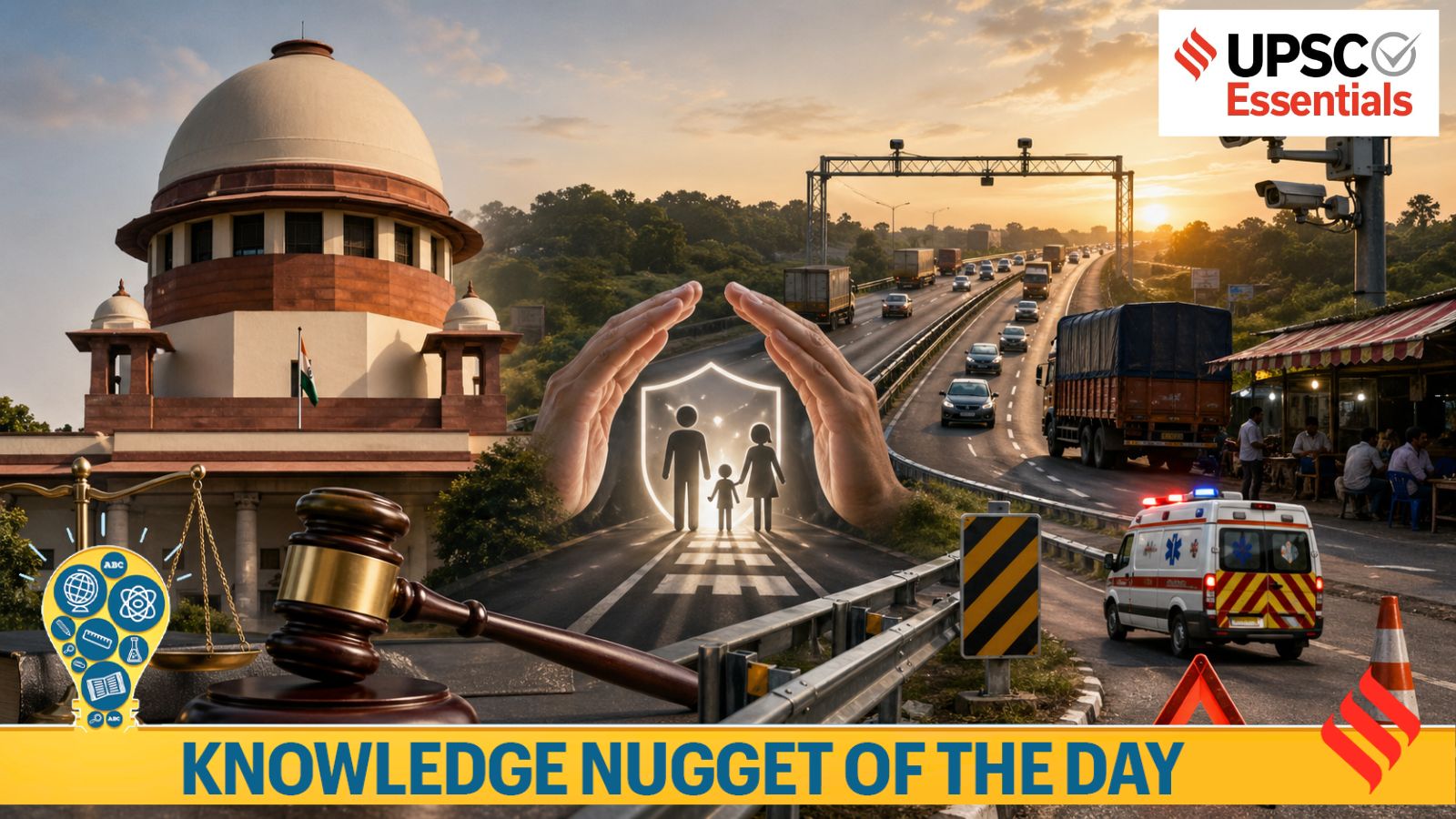
Take a look at the essential events, concepts, terms, quotes, or phenomena every day and brush up your knowledge. Here’s your UPSC Current Affairs knowledge nugget for today on a safe commuting environment, part of the Right to Life.
Gear up forUPSC Prelims 2026—Practice smarter, revise faster, and succeed with ourSpecial Quiz Magazine.Click Here
Flagging data that national highways constitute only about 2 per cent of India’s total road length but account for nearly 30 per cent of all road fatalities, the Supreme Court said that a high-speed roadway “must not become a corridor of peril” due to administrative lapses or infrastructural gaps, stressing that the right to life includes a safe commuting environment.
In this context, let’s take a closer look at SC’s directive, Right to Life, and Article 142, under which the top court exercised its extraordinary powers to issue the directive.
Key Takeaways:
1. The Supreme Court passed a significant order for preventing road accidents and issued a 13-point directive to the road departments at the centre and state levels in its suo motu case, where 34 lives were lost in two separate road accidents in November 2025.
2. It also recognised that Article 21 of the Constitution, which deals with protection of life and personal liberty, also includes safety of commuters on the road.
3. “The loss of even a single life to avoidable hazards like illegal parking or black spots etc., represents a failure of the State’s protective umbrella. The ‘Right to Life’ enshrined under Article 21 of the Constitution of India is not merely a guarantee against the unlawful taking of life, but a positive mandate upon the State to ensure a safe environment where human life is preserved and valued,” said the court.
Story continues below this ad
4. Therefore, recognising the safety of the commuter as an integral facet of the right to live with dignity as a constitutional obligation under Article 21 of Constitution of India, it is necessary in the interest to address the systematic root causes,” said the court.
5. The top court exercised its extraordinary powers under the Article 142 of the Constitution and issued directions.
13-point safety blueprint: Supreme Court’s directions
1. In its directions, the court has clearly said that no heavy or commercial vehicle shall park or stop on any National Highway carriageway or paved shoulder except at a designated bay, lay-bye, or Wayside Amenity.
2. The court said that the authorities should use Advanced Traffic Management System (ATMS) to track such vehicles, send alerts to police with GPS-timestamped photographic evidence and integrate it with e-Challan.
Story continues below this ad
3. These directions must be complied within 60 days from the date of the Supreme Court order. It has also prohibited the construction and operation of any new dhaba, eatery, or commercial structure within the Right of Way (ROW) of any National Highway.
4. The court has ordered that District Magistrates shall enforce the demolition of all new and existing unauthorised structures. State governments shall further issue notifications within 60 days prohibiting change of land use within 40 metres (residential) and 75 metres (commercial) from the mid-point of any National Highway, the court said.
Highways of Peril: SC Mandates Road Safety as a Right
CONSTITUTIONAL BASIS
Road Safety as a Fundamental Right
The Supreme Court held that the right to a safe commuting environment is an integral facet of the Right to Life under Article 21. Directions were issued under Article 142, the court’s power to do “complete justice.” No financial or administrative constraint, the court said, can override the sanctity of human life.
2%
National Highways share of India’s road network
30%
Share of all road fatalities on NHs
34
Lives lost in crashes that triggered SC action
“A road, particularly a high-speed Expressway, must not become a corridor of peril due to administrative lethargy or infrastructural gaps.”
— Supreme Court of India, April 13, 2026
13-POINT DIRECTIVE
SC’s Time-Bound Safety Blueprint
Acting on joint inputs from the Solicitor General and amicus curiae, the court issued structured directions covering parking, surveillance, infrastructure, and emergency response — each with strict deadlines.
⊘
No parking on carriageway 60 days
Heavy vehicles banned from stopping on NH lanes or paved shoulders except at designated bays; enforced via ATMS, GPS evidence and e-challans.
⊘
No new encroachments 60 days
No new dhabas or commercial structures within the Right of Way; all unauthorised structures to be removed within 60 days.
◉
Accident blackspots mapped 45 days
Authorities must identify and publish blackspots; install lighting, speed cameras and warning systems within prescribed timelines.
◈
Ambulance every 75 km Ongoing
Ambulances and recovery cranes to be deployed at intervals not exceeding 75 km across all national highways.
◈
Truck lay-bys and rest areas Ongoing
Lay-bys at regular intervals with rest areas, food, washrooms and clear signage to address driver fatigue.
◆
Full ATMS activation 60 days
Advanced Traffic Management Systems — cameras, speed detectors, message boards, emergency call boxes — to be fully operational.
COMPLIANCE FRAMEWORK
Who Must Act — and By When
The court directed multiple agencies to act in parallel. All must file a consolidated compliance report before the bench within 75 days. Copies were sent to chief secretaries and police chiefs across all states and UTs.
⬡
NHAI 75 days
Deploy ambulances and cranes, activate ATMS, construct lay-bys and wayside amenities, file compliance affidavit.
◉
Highway Authorities 30 days
File inspection report on encroachments, operationalise Rajmargyatra helpline 1033, conduct drone-based surveys.
⊘
District Administrations Stipulated
Constitute District Highway Safety Task Force with police and highway officials; enforce land-use restrictions near highways.
◆
Licensing Authorities 30 days
Review all existing licences and NOCs within highway safety zones; no new approvals without prior clearance.
◈
All States & UTs 75 days
Set up inter-state coordination mechanism; standardise enforcement protocols, surveillance and penalties nationwide.
Sources: Supreme Court of India order, April 13, 2026 · Indian Express report · Ministry of Road Transport & Highways
5. The court has called for the constitution of dedicated highway surveillance teams of state police and transport department personnel like NHAI to ensure round the clock monitoring of highways and its adjacent areas.
6. It has also asked the NHAI to completely operationalise its ATMS with TMCC cameras, VSDS speed detectors, VIDS cameras, variable message sign boards, and Emergency Call Boxes across all four and six lane highways and expressways.
Story continues below this ad
7. For quick response in an accident case, the court has directed NHAI to deploy BLS ambulances and recovery cranes at intervals not exceeding 75 km on every National Highway stretch, at toll plazas, Wayside Amenities, or dedicated posts.
Right to life
1. Article 21 of Constitution of India guarantees the fundamental right to protection of life and personal liberty. It ensures certain safeguards against arbitrary deprivation of life and liberty. This right is available to both citizens and non-citizens.
2. The right to life has been expansively interpreted to include various facets such as the right to live with dignity, livelihood, privacy, shelter, health, a clean and healthy environment, protection from the impacts of climate change, menstrual hygiene and the right to travel abroad.
Right to PrivacyIn August, 2017, a nine-judge bench of the Supreme Court of India in K. Puttaswamy v Union of India Case ruled unanimously that “the right to privacy is protected as an intrinsic part of the right to life and personal liberty under Article 21 and as a part of the freedoms guaranteed by Part III of the Constitution”. |
BEYOND THE NUGGET: What is Article 142 of Constitution of India?
1. Article 142 provides a unique power to the Supreme Court, to do “complete justice” between the parties, where, at times, the law or statute may not provide a remedy. In those situations, the court can extend itself to put an end to a dispute in a manner that would fit the facts of the case.
Story continues below this ad
2. While the powers under Article 142 are extraordinary in nature, the apex court has defined its scope and extent through its judgments over time.
Post Read Question
Right to Privacy is protected as an intrinsic part of Right to Life and Personal Liberty. Which of the following in the Constitution of India correctly and appropriately imply the above statement? (UPSC CSE, 2018)
(a) Article 14 and the provisions under the 42nd Amendment to the Constitution.
(b) Article 17 and the Directive Principles of State Policy in Part IV.
(c) Article 21 and the freedoms guaranteed in Part III.
Story continues below this ad
(d) Article 24 and the provisions under the 44th Amendment to the Constitution.
(Sources: Highways must not become ‘corridors of peril’: Supreme Court flags safety gaps, issues nationwide directions,Knowledge nugget of the day: Right to Privacy)
🚨 Click Here to read the UPSC Essentials magazine for April 2026. Share your views and suggestions in the comment box or at manas.srivastava@indianexpress.com🚨
Subscribe to our UPSC newsletter. Stay updated with the latest UPSC articles by joining our Telegram channel – Indian Express UPSC Hub, and follow us on Instagram and X.

