

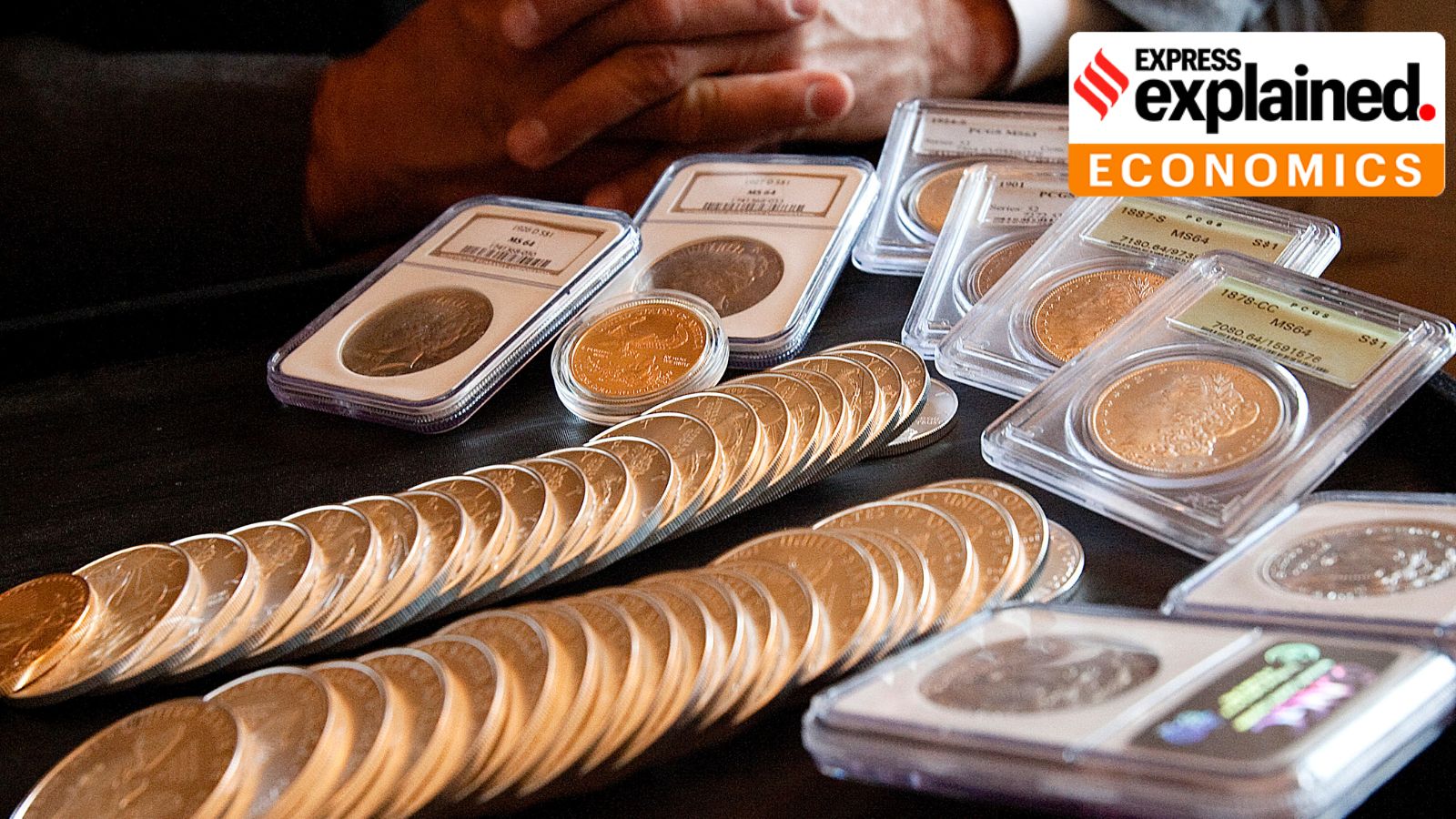
An unprecedented rally in the prices of gold and silver was brought to a pause last week as US President Donald Trump announced Kevin Warsh as his pick for the next Federal Reserve chair.
Gold declined from a peak of $5,523 per ounce on January 29, and silver from $116 per ounce on January 30. Over the following week, both metals rebounded sharply before resuming a downward trend. Spot silver fell by about 16.5% while gold averaged around $4,920 per ounce on Thursday (February 5), with the Fed signalling a lower likelihood for rate cuts, and the renewed possibility of US-Iran tensions despite planned talks on Friday.

How did Warsh’s nomination affect metals’ prices?
While Warsh’s nomination for Fed chair was the most immediate trigger of market volatility over the past week, analysts have concluded that gold and silver prices were bound to undergo corrective market action.
Warsh has long been regarded as tough on inflation, raising expectations of monetary tightening. In the 2010s, he became one of the fiercest critics of the Fed’s zero-interest-rate policy, even warning about inflation while unemployment was at 10%.
However, his monetary stances have often aligned with the ruling administration of the time, according to an analysis in The Atlantic. After calling for monetary tightening during the Obama administration, he reversed this stance during Trump’s first administration. In an article for The Wall Street Journal in 2018, he and his co-author, Stanley Druckenmiller, argued that, “given recent economic and market developments, the Fed should cease—for now—its double-barreled blitz of higher interest rates and tighter liquidity.” He since reprised a hawkish stance during the Biden era, criticising the Fed for prematurely cutting interest rates in September 2024.
Once his candidacy as Fed chair became a possibility, he made a case for rate cuts, writing in November 2025, that the US was on the brink of an AI-led productivity boom that would be a “significant disinflationary force” and that the Fed “should abandon the dogma that inflation is caused when the economy grows too much and workers get paid too much.”
And if Trump’s remarks on Wednesday are to be believed, Warsh would not have gotten the top job if he planned to increase interest rates. It remains to be seen whether Warsh will make good on this expectation.
Story continues below this ad
For now, investors consider Warsh as someone who would defend the Fed’s autonomy amidst Trump’s attacks on the central bank and its current chair, Jerome Powell, for not instituting rate cuts. This was good news for the US dollar, but not for dollar-backed bullion, with gold prices shedding 9% on January 30, its largest single-day decline since 1983.
The latest dip in silver prices comes with a stronger dollar, with the Fed signalling a reduced urgency to institute rate cuts in the interim. The dollar has also strengthened in the wake of planned US talks with Iran on the latter’s nuclear programme.
And what fuelled the original metals’ rally?
Trump has long maintained a proclivity for a stronger dollar, but his actions have often proven counterintuitive. In January, he triggered a fresh wave of uncertainty across markets even as his administration deposed Nicolas Maduro as president of Venezuela and revived a territorial claim of Greenland. He has also threatened tariffs against Canada and South Korea for not playing by his rulebook – Canada was targeted over a possible trade deal with China, while South Korea had allegedly not progressed quickly on the trade deal it concluded with the US last year. All these actions triggered a selloff in the US dollar, whose value is inversely related to that of gold.
Gold and silver are regarded as safe-haven assets to varying degrees. The world’s currencies were backed by gold until 1971, but central banks worldwide have continued to maintain reserves of both metals, as the US dollar ever since. During periods of heightened volatility, central banks have increased their gold reserves to hedge against a potential collapse of their currency.
Story continues below this ad
Silver, on the other hand, has traditionally been more volatile, given its smaller market size and lower liquidity than gold. Its relative scarcity and industrial utility lead to marked price swings. However, it is an important “store of value” and a hedge against inflation.
Since the 1997-98 Asian crisis, central banks have switched from being net sellers of gold to net buyers. According to World Gold Council data, global forex reserves increased from $3 trillion in 2000 to $13 trillion in 2014, after which they plateaued. Central banks began stockpiling gold in the wake of the war between Russia and Ukraine in 2022, but the pace has kept up in the Trump administration’s second term. Gold purchases by central banks averaged 400-500 tonnes annually pre-2022, and have exceeded 1,000 tonnes in 2022-24, dropping to about 863.3 tonnes in 2025, a level significantly above the pre-2022 average.
The share of the US dollar in global reserves has fallen from 71% in 2000 to 58% today, marking a slow and steady decline in trust in its value. This push towards de-dollarisation, which commenced with the outbreak of the Russia-Ukraine War in 2022, has only accelerated in Trump’s second term. Since his inauguration in January 2025, he has announced an evolving series of tariffs against the US’s trading partners and threatened the Fed’s autonomy. The result: A 9% decline in the US dollar in 2025, its largest ever decline in nearly a decade. This, too, has helped drive up the demand for safe-haven assets, driving up gold prices.

