

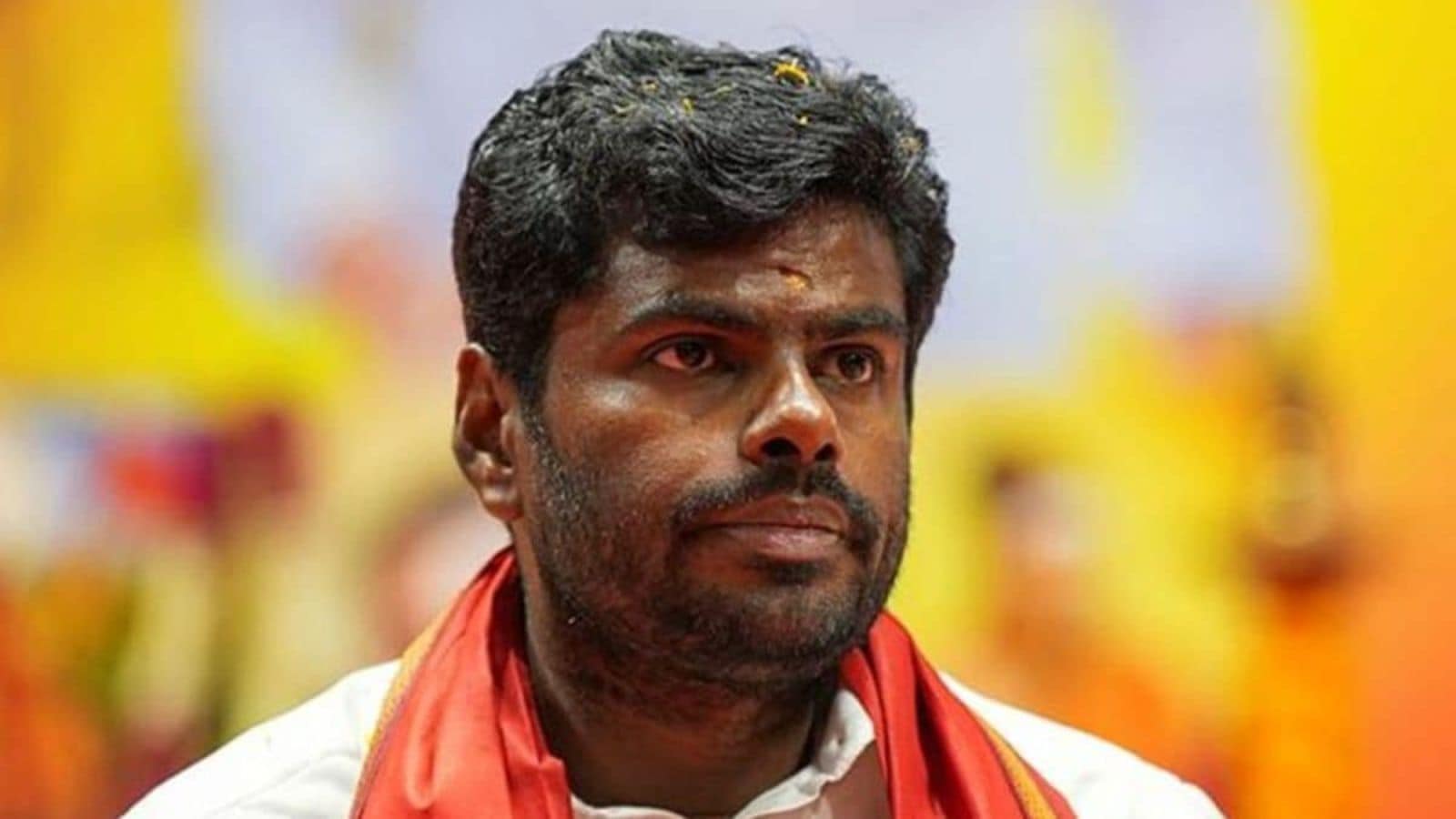
Reliable sources in the BJP said he has already made up his mind and that the Delhi visit is intended not merely as a political meeting but also as a gesture of gratitude towards a party with which he spent the last six years of his public life. “He wants to thank the leadership for the opportunities, experiences and political journey the BJP gave him after he resigned from the IPS,” a top source familiar with the discussions said.

The development, if confirmed formally on Tuesday, would mark one of the most significant political departures in Tamil Nadu since actor-turned-politician C Joseph Vijay’s electoral victory reordered the state’s political landscape and triggered fresh questions inside almost every major political formation.
For weeks, speculation surrounding Annamalai’s future had dominated political conversations in Chennai and Delhi alike. Yet while the rumours multiplied, Annamalai notably stopped short of issuing the sort of categorical denial that usually buries such speculation.
Inside BJP circles, the discussion gradually shifted from whether Annamalai was unhappy to what exactly he wanted.
Several leaders familiar with internal conversations said his message to the party’s national leadership had effectively narrowed to two options: restore him to a position where he could lead the BJP in Tamil Nadu with long-term autonomy and authority – for at least seven years – or allow him to pursue a different political path. The question gained urgency after Vijay’s rise dramatically altered Tamil Nadu’s political arithmetic.
The speculation reflects a larger crisis confronting not just the BJP but nearly every established political force in Tamil Nadu after Vijay’s rise.
For about half a decade, Annamalai was projected as the BJP’s future in the state. He resigned from the Indian Police Service, entered politics at a relatively young age and quickly emerged as the party’s most visible face. Even critics acknowledged his energy, organisational drive and ability to dominate political conversations. Yet his political identity often sat uneasily inside the BJP’s traditional framework.
Unlike many hard-line leaders elsewhere, Annamalai’s speeches frequently drew from Tamil identity, governance, corruption, development and administrative reform. He often appeared to be searching for a version of the BJP that could speak in a distinctly Tamil political language.
Many observers describe his approach as closer to an aspirational Dravidian politics than classical Hindutva. That distinction matters now.
Supporters argue that Annamalai’s real motivation has never been ideological purity but political agency. He appears, they say, less interested in defending a doctrine than in acquiring enough space to build something.
Then came Vijay. For many voters seeking a new alternative, he became the vessel for aspirations that Annamalai had once hoped to capture.
Delhi’s miscalculation
A senior BJP leader from Tamil Nadu privately argued that Delhi misread Tamil Nadu during the election. Had Annamalai been given greater autonomy and visibility, the leader said, Vijay might not have become the state’s uncontested symbol of political change.
Even after being sidelined before the elections and pushed into an alliance framework he had reservations about, Annamalai remained one of the NDA’s most sought-after campaigners, second only perhaps to AIADMK leader Edappadi K Palaniswami in drawing crowds.
That has strengthened the argument among Annamalai supporters that his personal political value exceeds the BJP’s organisational strength in Tamil Nadu.
Yet launching a new party would hardly be risk-free. When asked about speculation that Annamalai could launch a new political party, a senior RSS functionary in Tamil Nadu responded with a question of his own: “Does he have Rs 1,000 crore? At least ₹500 crore? If he does, then he can think about it.”
But Vijay’s emergence has fundamentally altered the opposition space. Any new formation led by Annamalai would enter a crowded battlefield where TVK already occupies much of the anti-establishment imagination.
Still, if he ever chose to launch an independent platform, it would start from a position stronger than that of most regional startups. It could immediately compete with parties such as the PMK, DMDK, VCK and the entire Left parties, while potentially challenging the AIADMK in sections of western Tamil Nadu, particularly among OBC-Gounder voters, the community from which Annamalai himself comes.
Not long ago, Annamalai’s challenge was to make the BJP bigger in Tamil Nadu. Now, his problem may be the opposite: finding a political vehicle large enough for all his energy, impatience and ambition. A veteran RSS leader from Coimbatore, who watched Annamalai’s growth in close circles, said, “Maybe he has reached that familiar moment in politics when a leader begins to outgrow the room he first walked into.”

