

6 min readJul 23, 2026 04:34 PM IST
First published on: Jul 23, 2026 at 04:33 PM IST
It has been seven years since Jammu & Kashmir was downgraded to a Union Territory. It has been five years since the Union government committed in Parliament to restore statehood. It has been four years since delimitation was done. It has been three years since the Supreme Court was assured of restoration. It has been two years since an elected government is in place.
Yet, so far, there has not even been a serious conversation about it. The only response from the Centre, a clear and consistent one, has been an assurance wrapped in ambiguity: Statehood will be restored at the “appropriate time”. The “appropriate time” is not a date on the calendar; it is whatever time suits the present dispensation. At the “appropriate time” is not a promise but an instrument of power. Every demand for a date is an indicator of impatience, and every postponement a proof of prudence.

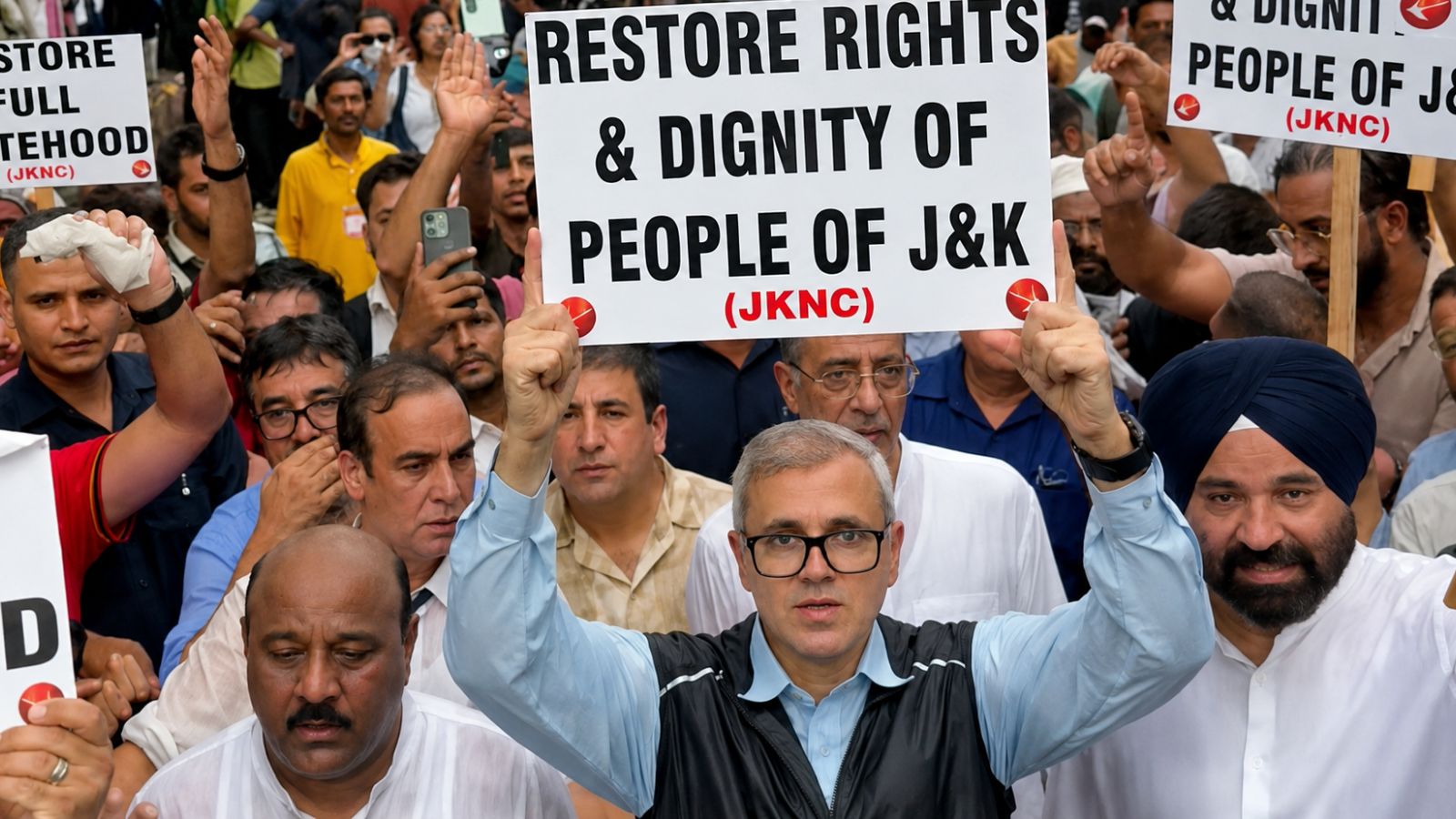
Faced with growing public disillusionment locally over the Omar Abdullah-led government’s performance, the National Conference recently launched an outreach drive. After civil society consultations, it called for a protest in New Delhi on July 20.
The National Conference positioned its protest as a broad-based political initiative rather than a party-specific agitation. Though well-placed to lead the J&K parties and wider civil society by virtue of a strong electoral mandate, all the Valley-centric parties decided not to participate in the protest. This has turned a potential show of strength into a display of fragmentation, thereby significantly reducing the political pressure on the Union government to act. Without a united front at least from the Valley, the Centre can easily treat the demand as partisan rather than regional, and delay statehood restoration on its own timeline.
Being a constituent of the UPA, the National Conference had also reached out to the national and regional parties to build a wider constituency of support and gain greater political traction. This could have provided an opportunity to frame the demand as a larger federal issue which touches upon the basic structure of India’s constitutional arrangements. For the most potent blueprint for the restoration of statehood is not a political manifesto of any party, but an agenda for federal democratic polity of India. But that was not to be.
As the National Conference assembled in New Delhi for restoration of statehood for J&K, the refrain in the lacklustre affair was unfulfilled promises rather than rights denied. Speeches, slogans and bytes invoked constitutional morality, legislative assurances, judicial precedents and political commitments. These are valid, necessary political arguments but have limited relevance in the current context.
For the Centre, it is amply evident that security and “normalcy” are the non-negotiable pre-conditions for restoring statehood. This is not a temporary hurdle. Until these concerns are credibly addressed, arguments based only on constitutional grounds will remain secondary in the decision-making process at the highest levels.
The restoration of statehood is not a simple administrative decision or a one-sided concession. It will be the outcome of a political bargain in which enhanced powers and privileges will come with greater responsibilitiesakaconditionalities. This is already visible in the case of Ladakh, where statehood has been made contingent on meeting certain revenue and self-sustainability criteria. J&K is unlikely to be treated differently.
This is why the political leadership in J&K needs to move beyond making a legal case. Engaging substantively with the Centre’s stated concerns on security and governance could prove more consequential than constitutional arguments alone. The tragic killing of a police officer on Amarnathyatraduty yesterday, the first terror attack in the Valley since Pahalgam, serves as a stark illustration of why constitutional arguments alone are insufficient without credible progress on the ground.
Treating the security issue as a chicken-and-egg problem, lack of full powers is cited as the reason for limited initiative, is technically correct but politically unwise because it restricts the space for political agency. While the elected government’s limited powers are a structural constraint, demonstrating statecraft even within the current framework could help build credibility with the Centre.
From the Union’s point of view, restoration of statehood may be seen as a decision to be taken at an appropriate time. However, from the perspective of J&K, it will be a process. Statehood cannot simply be restored by an executive order changing its status. Such a move would leave the underlying administrative and financial distortions created since 2019 largely unaddressed. Converting the former state into a Union Territory did not just alter its administrative boundaries, it fundamentally changed its governance DNA and deepened J&K’s dependence on the Centre.
It is high time to move away from the binary of statehood restoration to what it will entail, politically and administratively. A more strategic approach would require the J&K political leadership to move from episodic mobilisation to a sustained, multi-track engagement. In the short term, this would mean building a unified negotiating position across parties on the benchmarks for “normalcy” that the Centre considers non-negotiable.
In parallel, the focus should shift to negotiating a time-bound framework, possibly through a structured administrative mechanism of unwinding the central controls. Without such a phased and negotiated roadmap, the demand for statehood risks remaining a recurring political slogan instead of becoming a manageable political settlement.
It is unlikely that the recent Delhi protest will be the starting point of a political process for statehood with status. To reach a milestone on that road, the Valley-centric political leadership needs to prioritise pragmatic sequencing over fragmented posturing. This will determine if the J&K can convert public sentiment into concrete constitutional gains in the coming years.
The writer is the former finance minister of J&K

