

CBSE 12th Result 2026 Soon: With the Central Board of Secondary Education expected to announce CBSE Class 12 results soon. Every year, lakhs of students await their scores, and in 2026 too, over 16 lakh Class 12 students have participated across streams. Once the results are declared, students will be able to check their scores online, on the official portals at cbse.gov.in, cbseresults.nic.in, as well as on DigiLocker and Umang app.
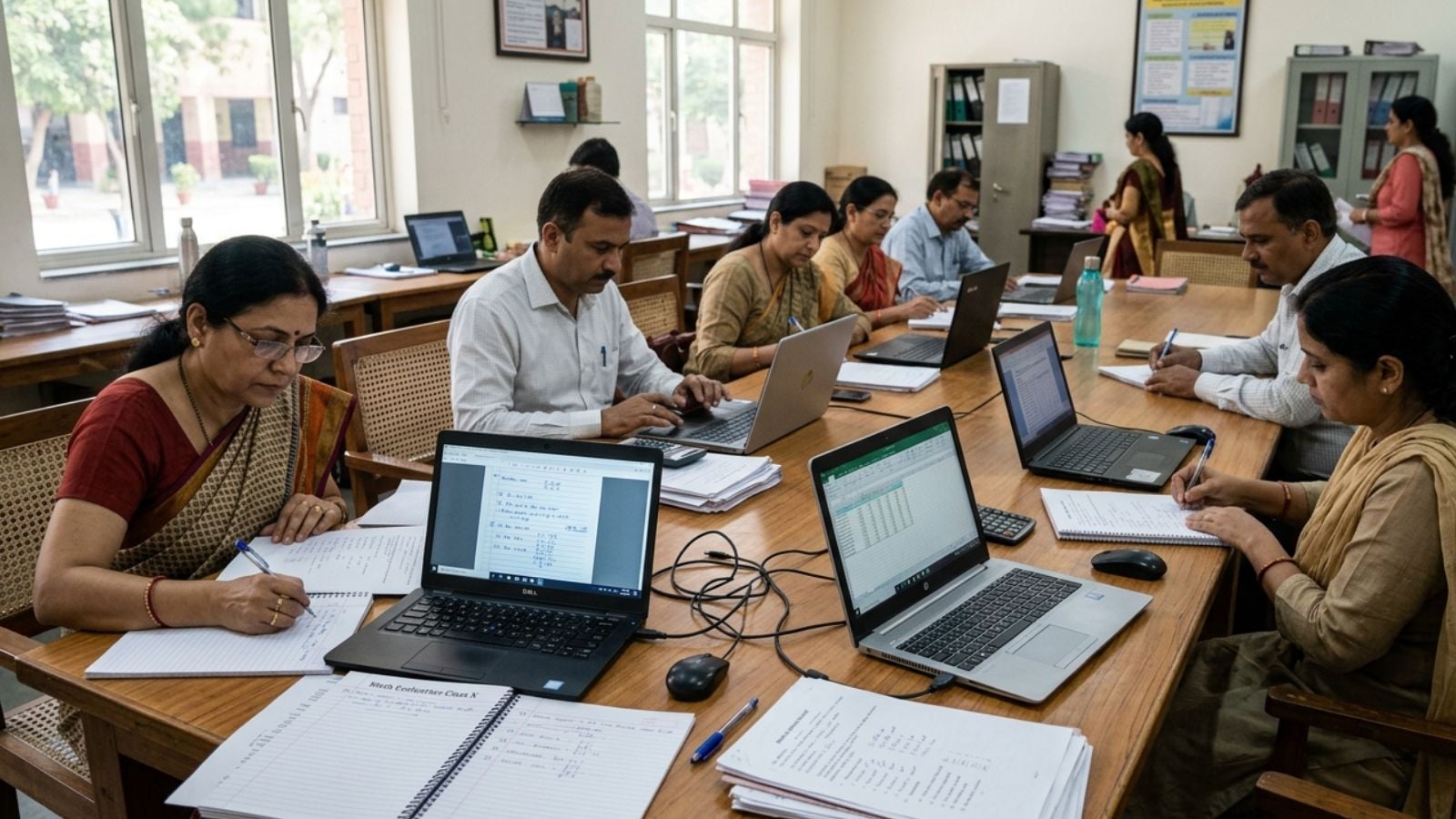
With the CBSE evaluation in its final stages, and as answer sheets are assessed and marks are compiled, a common question among students and parents alike is how exactly are CBSE marks calculated, and where do moderation, grace marks, and scaling come into play?
Here’s a detailed overview of the process.
What is CBSE’s moderation policy and why is it used?
CBSE applies a moderation policy to ensure fairness and uniformity in evaluation. Board exams are conducted across multiple sets of question papers, and slight variations in difficulty can impact student performance. Moderation is designed to balance this out.
According to CBSE’s official framework, moderation helps:
–Compensate students for ambiguous or error-prone questions
–Address differences in difficulty levels across paper sets
–Reduce subjectivity in evaluation by different examiners
–Maintain parity in pass percentages across years and subjects
–Ensure uniformity in marking standards
–In simple terms, moderation acts as a balancing mechanism so that no student is unfairly disadvantaged due to factors beyond their control.
Grace marks: What is the ‘up to 15%’ rule?
While CBSE does not officially specify a fixed percentage for grace marks in its policy documents, past developments provide insight into how it works in practice.
Nearly a decade ago, in 2017, during a case in the Delhi High Court, it was noted that CBSE could award up to 15% grace marks on particularly difficult questions. This came into focus when the board had briefly attempted to scrap moderation to control inflated scores and rising college cut-offs.
According to a report by The Indian Express, at the time, CBSE eventually chose not to challenge the High Court’s direction, allowing the moderation system, including such grace provisions, to continue. Then Union HRD Minister Prakash Javadekar had also clarified that marks should reflect actual performance rather than excessive inflation, even as moderation remained in place.
In practice today, this means:
Story continues below this ad
- Grace marks are applied selectively, not universally
- They are usually awarded for flawed or unusually tough questions
- The aim is fairness, not score inflation
How does CBSE ensure you pass? Understanding pass criteria
CBSE has clearly defined rules for passing the Class 12 board exams, or the ‘Senior School Certificate Examination’:
–Students are required to secure at least 33% marks in each subject (both theory and practical, where applicable)
–A grade above ‘E’ is required in all subjects
–Internal assessment must also be cleared
If a student fails in one subject, provisions like compartment/supplementary exams and subject replacement (in case of additional subjects) may apply under specific conditions.
Importantly, CBSE does not award overall divisions or distinctions, keeping the focus on subject-wise performance rather than aggregate labels.
Story continues below this ad
Scaling and relative grading: Why your marks aren’t everything
One of the most misunderstood aspects of CBSE evaluation is its relative grading system. Unlike fixed mark-based grading (for example, 91–100 = A1), CBSE uses a rank-based grouping system.
Here’s how it works:
–All students who pass a subject are arranged in rank order
–They are divided into eight equal groups (octiles)
–Grades are then assigned based on position within this group
CBSE uses a relative grading system, ranking students and assigning grades based on their position within eight equal groups.
Story continues below this ad
| Grade | Student rank | Description |
|---|---|---|
| A1 | Top 1/8th | Highest performers |
| A2 | Next 1/8th | Very good |
| B1 | 3rd 1/8th | Good |
| B2 | 4th 1/8th | Above average |
| C1 | 5th 1/8th | Average |
| C2 | 6th 1/8th | Below average |
| D1 | 7th 1/8th | Needs improvement |
| D2 | 8th 1/8th | Just passing |
| E | Fail | Essential repeat |
This means that your grade depends not just on your marks, but also on how others performed. Cut-offs for grades vary across subjects and years. Similarly, ties are handled by awarding the same grade to students with identical marks
For subjects with fewer than 500 passing candidates, CBSE aligns grading with similar subjects to maintain consistency.

