

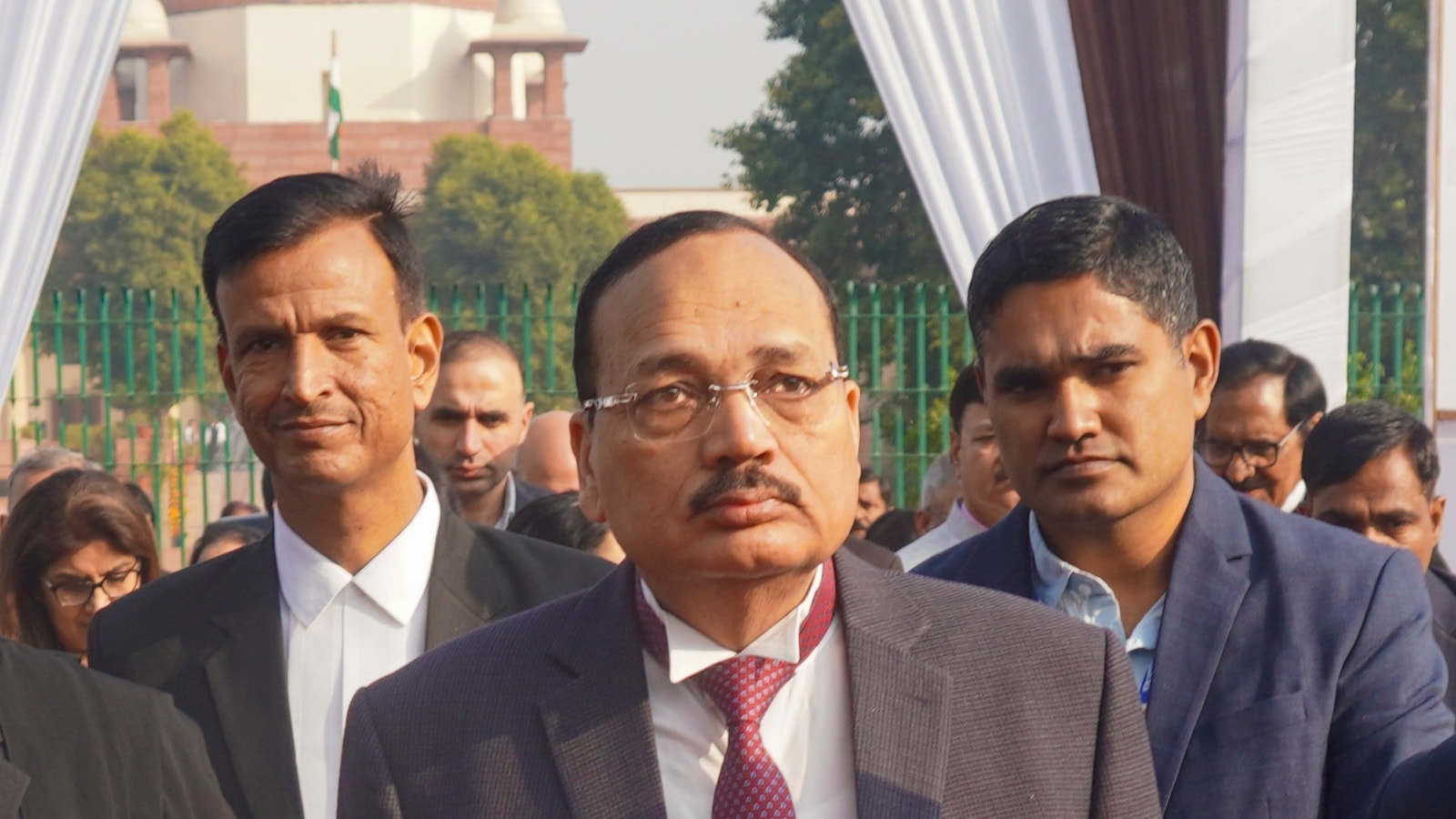
Chief Justice of India Surya Kant on Saturday said that the Supreme Court’s 1973 Kesavananda Bharati case verdict, which enunciated the basic structure doctrine, is “not… a mere legal precedent” but “stands instead, as one of the most profound affirmations of India’s commitment to constitutionalism and the rule of law”.
The CJI said that the basic structure doctrine is “the conscience that keeps our democracy from drifting into absolutism”.

Speaking at the inauguration of the ‘International Mooting Academy for Advocacy, Negotiation, Dispute Adjudication, Arbitration & Resolution’ (IMAANDAAR) at the O P Jindal University in Haryana, the CJI said that “the basic structure doctrine… was neither a flight of judicial fancy nor an indulgence in philosophical abstraction. It was, in truth, an act of constitutional archaeology: the judges unearthed, from within the four corners of the Constitution, those foundational principles that had always lain embedded in its design, waiting to be revealed by interpretation rather than invention.”
He said the “true brilliance of the Kesavananda majority lay in recognising that what could not be amended, was what made the Constitution meaningful—it’s just soul, painstakingly designed by our framers.”
During the event, the university campus hosted a re-enactment of the Kesavananda Bharati v. State of Kerala.
CJI Kant said, “Every generation that revisits Kesavananda Bharati, rediscovers that the Constitution’s strength does not lie in ink or parchment, but in the probity of those who interpret and defend it. Its survival has always depended on a community of custodians who read it not as a frozen command, but as a living charge.”
He said, “… the basic structure doctrine is not to be a relic of the past, but a map for charting our future. It is the conscience that keeps our democracy from drifting into absolutism, as we modernise our institutions and confront new frontiers.”
Story continues below this ad
The Constitution’s strength, he said, lies not in resisting change, but in ensuring that every change honours its foundational promise: human dignity anchored in liberty, equality, and fraternity.
CJI said that to him, “the true miracle of Kesavananda Bharati” is “not only that it produced the basic structure doctrine, but that it proved a young Republic could, by the strength of its conscience, rise to the moral stature of a much older one. That decision revealed something intrinsic about India’s democratic temperament. It showed that our constitutional culture is not brittle; it bends without breaking. It adapts, but it never abandons its moral compass.”
He said the basic structure doctrine is that “weave of our constitutional khaat (woven bed)”. “The text provides the frame, the institutions form the legs, but the rope—that interlacing of restraint, balance, and moral discipline—is what makes the entire structure useful, just, and lasting.”
The CJI said, “The idea that power must remain answerable to principle was always there, quietly embedded in the Constitution’s design…” and the Kesavananda verdict “gave form to what the Constitution had always whispered: that no authority, however exalted, may amend away the promise of justice.”
Story continues below this ad
Justice B V Nagarathna said the judgment’s enduring lesson is the connection between judicial independence and the supremacy of law. She said, “Judicial independence and supremacy of the law work together to guarantee what is fundamental to all of us: the rule of law and it should not be eroded by political pressures.”
She said the Kesavananda Bharati bench reflected both “independence in decision-making and institutional independence,” and that the basic structure doctrine emerged from this dual commitment. The doctrine identified features such as the supremacy of the Constitution, separation of powers, fundamental rights and judicial review as principles that “cannot be destroyed even by an amendment.”
Justice P S Narasimha said the basic structure doctrine is “not a claim of judicial supremacy but an affirmation of constitutional supremacy,” ensuring no institution alters the Constitution’s core. Justice M M Sundresh said that “the basic structure was never defined because it already existed as a natural right,” adding that its core principles of justice, liberty and equality must be protected by constitutional courts, whenever they are put at risk.
A message from PM Narendra Modi, read by V-C C Raj Kumar, called for “ease of justice for even the poorest of the poor” and said technology has widened access to courts through virtual hearings and translated judgments. Union Law Minister Arjun Ram Meghwal drew on Dr B R Ambedkar’s statement that the judiciary must be “independent of the executive and must also be competent in itself.” He said competence now requires e-courts and AI-enabled systems and repeated Ambedkar’s warning that “freedom is not a licence to do whatever we want”.

