

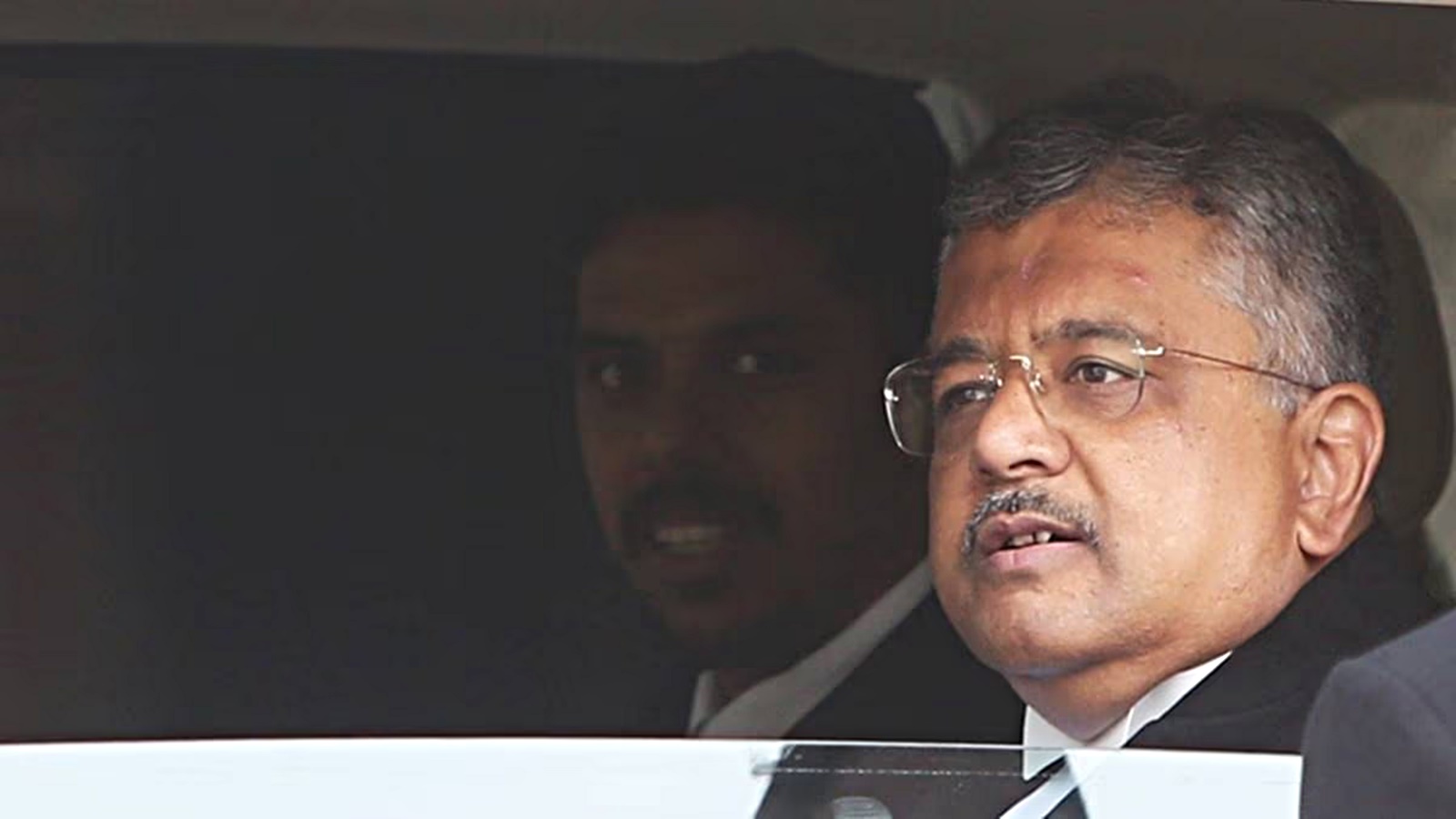
A fourth extension on June 20 reaffirms the role of Tushar Mehta, already the second-longest serving Solicitor General of India, as the Union government’s principal courtroom strategist.
Since he was appointed first as Additional SG in 2014, and promoted in 2018 to SG, Mehta, 61, has been the Narendra Modi government’s main line of defence in court on many consequential political decisions – from Kashmir to Ram temple, citizenship issues to electoral funding. Under him, the post of the SG – officially the second-highest law officer in the country, aiding and assisting the Attorney General of India – has emerged as the government’s primary voice in courts.

Mehta, who earlier worked under Modi as the Additional Advocate General of Gujarat, has been consistent in his arguments: that courts should give precedence to decisions taken by elected governments, particularly where questions of governance, security or public policy are involved.
Peers and opposing counsel alike speak of Mehta’s “relentlessness”. Senior Advocate Sanjay Hegde, who has appeared on the opposite side of Mehta in several Constitutional matters, told The Indian Express that the SG is a “fierce fighter” for the government. “Mr Mehta has evolved since his early days as a law officer and has built a good team of juniors on whom he relies,” Hegde says.
He also notes that Mehta is not averse to course-correcting when necessary. “Where mistakes have been made, he uses his good offices to rectify them before any adverse orders get passed.”
Mehta’s firefighting ability is also acknowledged by Senior Advocate Atmaram N S Nadkarni, who worked alongside Mehta when both were Additional Solicitors General. Calling him a “formidable counsel”, Nadkarni highlights Mehta’s ubiquitous presence across courtrooms. “He appears even in the Delhi High Court and other courts; it is marvellous how he manages to be at so many places,” Nadkarni says, adding that despite this workload, he has never seen Mehta “lose his temper or cool in court”.
The only other person to have a longer tenure than Mehta in the post was C K Daphtary, who served as SG in the first government after Independence, led by Jawaharlal Nehru, from 1950 to 1963.
Set to remain as SG till 2029, Mehta will be appearing for the government in several critical cases in the next few years, including challenges to the Waqf (Amendment) Act, anti-conversion laws, and the Places of Worship (Special Provisions) Act.
His court wins
Rafale deal: One of the earliest high-profile matters to come to Mehta’s table was the challenge to the Rafale fighter aircraft deal, alleging irregularities in the procurement process and seeking an investigation into the purchase.
Mehta said that courts should not enter questions of defence procurement and military preparedness unless there was clear evidence of illegality. The Supreme Court ultimately declined to interfere with the deal, in an order in December 2018. With the Congress making the deal a political plank, the Court order came as a big boost to the Modi government ahead of the 2019 general elections.
Ram temple: Another defining case where Mehta appeared was the Ram Janmabhoomi dispute. In November 2019, the Supreme Court ruled that the 2.77-acre disputed land be handed over to a government-run trust for a Ram Mandir, while mandating a 5-acre alternative plot in Ayodhya for a mosque – bringing to an end a dispute that had long been part of the BJP’s core agenda.
Article 370: The abrogation of the legislation by the Modi government on August 5, 2019, was the fulfilment of another ideological agenda of the BJP, removing Jammu and Kashmir’s special status. Appearing before a five-judge Constitution Bench, Mehta argued that Article 370 had been a temporary provision, and that Parliament could validly exercise legislative powers during President’s Rule, which J&K was under in 2019.
In December 2023, the Supreme Court unanimously upheld the government’s decision.
Citizenship issues: During litigation relating to challenges to Section 6A of the Citizenship Act, Mehta defended the government’s efforts to address illegal migration. Section 6A is a special provision inserted after the Assam Accord of 1985 that created a separate framework for determining citizenship in Assam. A Constitution Bench upheld the provision, accepting the framework defended by the Union.
The government’s approach to citizenship also came under scrutiny after Parliament enacted the Citizenship (Amendment) Act. While the law remains under challenge before the Supreme Court, Mehta has consistently argued that Parliament is entitled to create special citizenship pathways for persecuted minorities from neighbouring countries.
Covid: As thousands of migrant workers attempted to return home during the nationwide pandemic lockdown, petitions reached the Supreme Court seeking immediate relief for them. Mehta defended the administration’s response.
Similar arguments were advanced in litigation concerning the PM CARES Fund, when demands were made for the fund to be treated as a public authority subject to greater disclosure requirements. The petitions demanding that PM CARES be brought under the RTI were ultimately dismissed by the apex court in August 2020.
PMLA: Mehta has also underlined Executive authority in cases involving investigative agencies. In 2022, the Supreme Court heard challenges to key provisions of the Prevention of Money Laundering Act, which gives extensive investigative powers to the Enforcement Directorate and restricts bail to those accused under the Act, against claims of due process and personal liberty. Mehta argued that money laundering is a serious economic crime with international dimensions, requiring specialised powers to investigate effectively.
The Supreme Court largely upheld the law, reinforcing the ED’s powers, in July 2022.
EWS: Mehta also prevailed in the challenge to the 10% reservation for economically weaker sections. In November 2022, a Constitution Bench of the Supreme Court upheld the amendment creating the quota, accepting the government’s argument that economic disadvantage could be an independent basis for affirmative action.
UAPA: In prosecutions and bail applications under the Unlawful Activities (Prevention) Act, the principal anti-terror law, the SG has argued that judges should take into account the gravity of allegations and wider security implications when considering bail. While outcomes have varied across cases, the broader legal framework defended by the Union remains largely intact.
Sedition: During the Constitutional challenge to the law of sedition under the erstwhile IPC, the Centre adopted a different strategy. Rather than defending the law in its existing form, Mehta informed the Court that the government was reconsidering the provision. The proceedings led to a pause on new sedition prosecutions.
His court setbacks
The Supreme Court did not accept the government’s argument of institutional deference during the Pegasus spyware litigation. Faced with allegations that government agencies had used surveillance software against journalists, activists and politicians, Mehta argued that questions involving national security could not always be answered in open court. In October 2021, the Supreme Court appointed an expert committee to examine the allegations, declining to accept the government’s position at face value.
The electoral bonds case was another major defeat for the government. The Union government argued that anonymous political donations protected the privacy of contributors and encouraged formal banking transactions. A Constitution Bench of the Supreme Court, however, struck down the scheme in February 2024.

