

4 min readBengaluruUpdated: May 7, 2026 07:38 PM IST
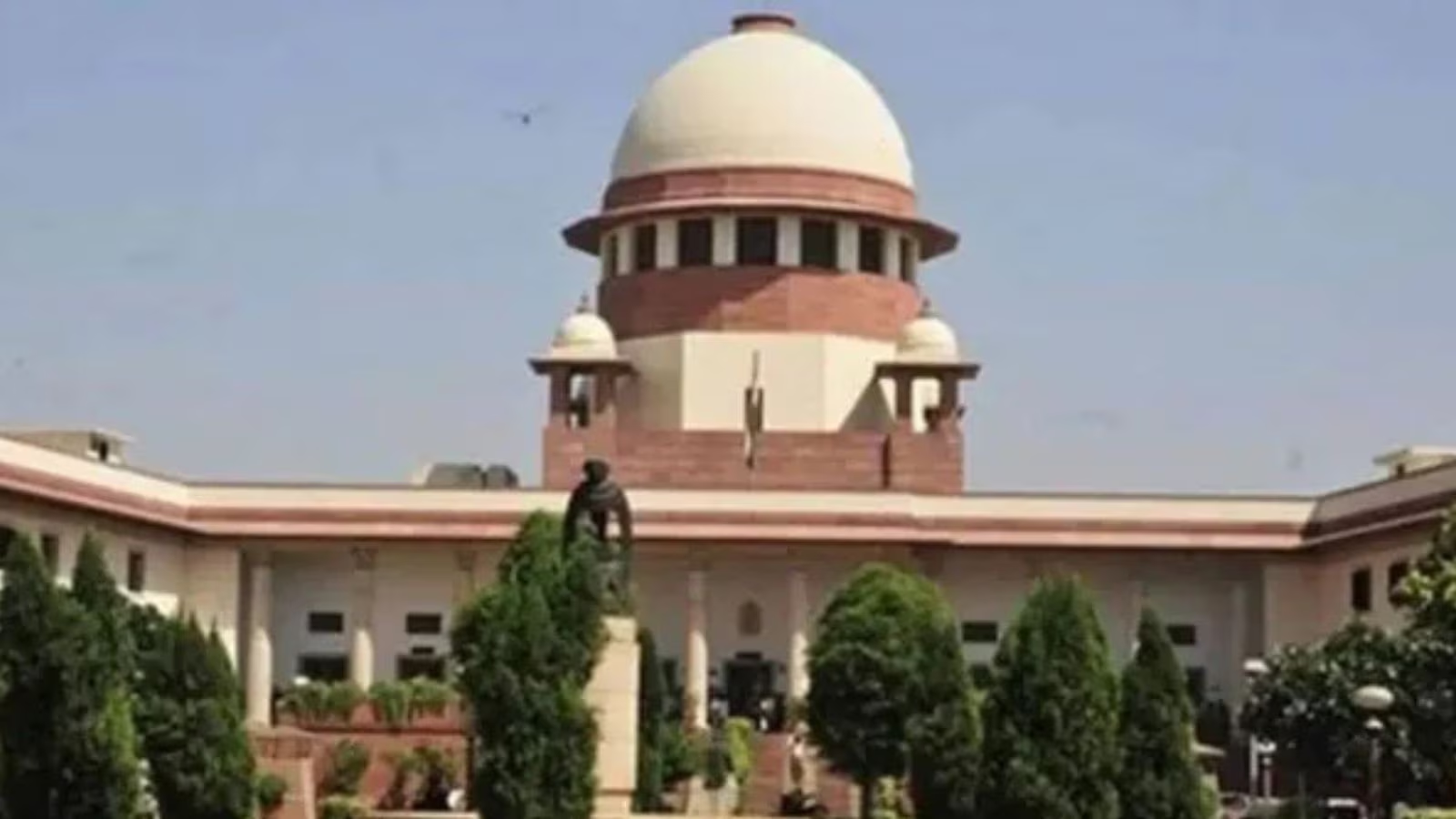
The Supreme Court has ordered the preservation and restoration of two of Mysuru’s most historically significant civic structures—the Devaraja Market and the Lansdowne Building— rejecting the Karnataka government’s stance that the buildings should be demolished and rebuilt.
A bench of Justices J B Pardiwala and Vijay Bishnoi, relying on the findings of an expert committee constituted by the Indian Institute of Technology (IIT), Roorkee, directed the Mysuru City Corporation and the Mysore Urban Development Authority on Monday to prepare a comprehensive conservation plan in line with the committee’s recommendations.

The IIT Roorkee committee, constituted on the Supreme Court’s direction, stated in its report that roughly 70 per cent of the vertical load-bearing elements —walls and columns—in both structures fall in the mild-to-moderate distress category and are repairable.
The horizontal elements, however, particularly roofs and slabs, showed more serious deterioration, with nearly 70 per cent in moderate-to-severe condition. In the Lansdowne Building, around 80 per cent of the terrace-level slabs were found to be in severe condition.
‘Insensitive and non-engineered alterations’
The committee was sharply critical of decades of poorly executed modifications. “This may also be brought on record that had a proper maintenance and upkeep of the buildings been undertaken in the past, the buildings would not have deteriorated to the extent observed at the site. It was both disappointing and surprising to see that many insensitive and non-engineered alterations and additions have been allowed in the past in these structures. It is strongly recommended that all such alterations and additions, i.e. construction of mezzanine floors, closure of many arches, etc, should be removed at the time of execution of restoration works, and all these buildings should be brought to their original architectural and structural forms,” the report said.
“Once restored and conserved, these buildings should be maintained properly, and accountability should be fixed towards that end. If these suggestions are not expected to be followed, then the buildings will face the same fate after a few years and would defeat the very purpose of restoring or conserving them,” the report added.
The government had argued that it had taken a considered decision to raze the structures and rebuild them with the same heritage facade, and that the state should have primacy in such matters. The bench was unpersuaded, noting that preservation through repair was clearly feasible based on the expert reports.
Story continues below this ad
The Indian National Trust for Art and Cultural Heritage (INTACH) had also submitted a report on the Supreme Court’s direction.
Going through the IIT report, the court observed, “Overall, the committee is of the opinion that both Devaraja and Lansdowne Buildings can be restored and conserved in view of their immense heritage value. It is crucial to note that both structures are part of the ensemble of the civic architecture of Mysuru. Further, they embody interconnected and interdependent values, underlining the relevance of these structures in contemporary times and their renewed sustenance in future. However, a detailed and scientifically sound evaluation needs to be undertaken, and a conservation plan needs to be implemented for restoring these structures. Many severely deteriorated or damaged elements of the structures would even need reconstruction as a part of this overall restoration work.”
Lansdowne Building
Once called Range Bazaar, the Lansdowne Building is near the iconic Mysuru Amba Vilas Palace, constructed in 1892. It was commissioned by Chamarajendra Wadiyar to honour the visit of Viceroy and Governor-General of India Henry Petty-Fitzmaurice, the 5th Marquess of Lansdowne, to Mysuru. The building was turned into a commercial complex.
Over the years, the building’s condition deteriorated, and four people died after a portion of the building collapsed in 2012. Though the local civic agency and the state government formed several committees, no concrete solution emerged.
Devaraja Market
Story continues below this ad
The Wadiyar dynasty built the Deveraja Market in 1886 as a weekly market. Named after Dodda Devaraja Wadiyar, it was built on 3.60 acres of land, and one can access it from four directions. Devaraja Market, which houses hundreds of shops, has witnessed several fire incidents. In 2016, an entrance gate collapsed because of structural weakness.

