

Close Menu
  • Home
  • Education
  • Health
  • National News
  • Politics
  • Relationship & Wellness
  • World News
What's Hot

CSK vs MI IPL 2026 Highlights: Ruturaj, Kartik score half centuries as Chennai defeat Mumbai by 8 wickets

May 2, 2026

IPL 2026 | Inside Mumbai Indians' struggles: What's hurting Hardik Pandya's men this season? | Cricket News – The Times of India

May 2, 2026

Knowledge Nugget | SC Links Road Safety to Right to Life: What it means for citizens and state

May 2, 2026
Facebook X (Twitter) Instagram
Facebook X (Twitter) Instagram YouTube
Global News Bulletin
SUBSCRIBE
  • Home
  • Education
  • Health
  • National News
  • Politics
  • Relationship & Wellness
  • World News
Global News Bulletin
Home»National News»Can conviction rely solely on dying declaration? Supreme Court answers, acquits woman’s father-in-law 25 years on
National News

Can conviction rely solely on dying declaration? Supreme Court answers, acquits woman’s father-in-law 25 years on

editorialBy editorialMay 2, 2026No Comments5 Mins Read
Facebook Twitter Pinterest LinkedIn Tumblr Email Telegram Copy Link
Can conviction rely solely on dying declaration? Supreme Court answers, acquits woman’s father-in-law 25 years on
Share
Facebook Twitter LinkedIn Pinterest Email Copy Link

4 min readNew DelhiMay 1, 2026 11:12 AM IST

Supreme Court news: Holding that even though a conviction can be based solely on a dying declaration, courts must still test it against surrounding circumstances and the overall evidentiary record, the Supreme Court acquitted the victim’s father-in-law in a 2001 burn death case, citing serious inconsistencies and lack of reliable proof.

A bench of Justices Aravind Kumar and N V Anjaria was hearing three connected criminal appeals arising from a Madhya Pradesh High Court verdict that had acquitted the accused of murder but upheld their conviction under Section 498A (husband or relative of husband of a woman subjecting her to cruelty) of the Indian Penal Code (IPC).

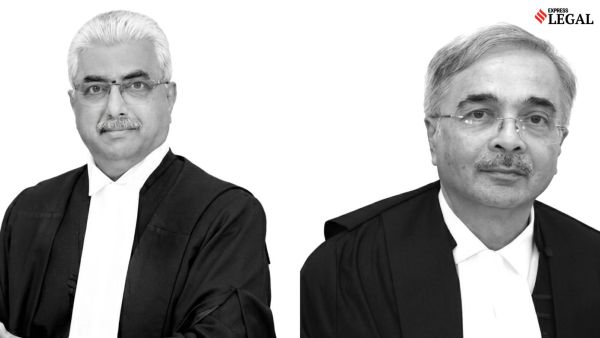
Justices Aravind Kumar and N V Anjaria Supreme Court Justices Aravind Kumar and N V Anjaria stressed that where two interpretations of evidence are possible, the one favouring the accused must prevail.

“While conviction can be solely based on a dying declaration, the court still has to weigh the same in light of surrounding circumstances and the principles governing evidence,” the Supreme Court bench said on April 30, laying down a crucial caveat on the evidentiary value of such statements.

Case background: Marriage, death within 9 months

The case dates back to July 12, 2000, when the deceased woman married one Nagendra Singh. Within nine months, on April 15, 2001, she sustained severe burn injuries at her matrimonial home in Madhya Pradesh and was hospitalised.

The prosecution alleged that she was subjected to harassment over dowry demands, including a car. In her first dying declaration recorded on April 16, 2001, she accused her husband and in-laws of pouring kerosene on her and setting her ablaze.

However, in a second dying declaration recorded on April 17, 2001, she stated that she had poured kerosene on herself and set herself on fire due to distress. She succumbed on April 22, 2001.

Court proceedings

The trial court convicted the husband and his parents under IPC sections 302 (murder) and 498A, awarding life imprisonment under the former charge.

Story continues below this ad

On appeal, the Madhya Pradesh High Court set aside the murder conviction, citing contradictions in evidence, but retained the conviction under Section 498A and reduced the sentence to the period already undergone.

Appeals before Supreme Court, contradictions

  • Three appeals came before the Supreme Court – one by Narendra Singh (father-in-law), challenging his conviction for cruelty; one by the deceased’s brother, seeking restoration of the murder conviction; and one by the state of Madhya Pradesh, also challenging the acquittal under IPC Section 302.
  • The Supreme Court found that the two dying declarations were inconsistent on the core issue of whether the death was homicidal or suicidal. This contradiction created a serious doubt about their reliability.
  • It also noted that the first declaration appeared influenced, as evidence showed the presence of persons allegedly prompting the victim.
  • Family members of the deceased introduced allegations of dowry demand during the trial that were missing from their earlier police statements. The Supreme Court viewed these as afterthoughts, weakening their credibility.
  • Neighbouring witnesses turned hostile and did not support the prosecution’s case. No independent evidence established cruelty or dowry demand.
  • A letter allegedly written by the deceased expressing distress was not proved through forensic examination and was, therefore, discarded.

Court’s observations on criminal law principles

  • The Supreme Court bench reiterated that suspicion, however strong, cannot substitute proof.
  • It stressed that where two interpretations of evidence are possible, the one favouring the accused must prevail.
  • The apex court also cautioned against implicating family members without specific and credible evidence, particularly in cases under IPC Section 498A.

Final verdict

The appeal filed by Narendra Singh was allowed, and his conviction under Section 498A was set aside. Appeals by the state and the deceased’s brother seeking a conviction under Section 302 IPC were dismissed.

Vineet Upadhyay

Vineet Upadhyay is an Assistant Editor with The Indian Express, where he leads specialized coverage of the Indian judicial system.

Expertise


Specialized Legal Authority: Vineet has spent the better part of his career analyzing the intricacies of the law. His expertise lies in “demystifying” judgments from the Supreme Court of India, various High Courts, and District Courts. His reporting covers a vast spectrum of legal issues, including:


Constitutional & Civil Rights: Reporting on landmark rulings regarding privacy, equality, and state accountability.


Criminal Justice & Enforcement: Detailed coverage of high-profile cases involving the Enforcement Directorate (ED), NIA, and POCSO matters.


Consumer Rights & Environmental Law: Authoritative pieces on medical negligence compensation, environmental protection (such as the “living person” status of rivers), and labor rights.


Over a Decade of Professional Experience: Prior to joining The Indian Express, he served as a Principal Correspondent/Legal Reporter for The Times of India and held significant roles at The New Indian Express. His tenure has seen him report from critical legal hubs, including Delhi and Uttarakhand. … Read More

© IE Online Media Services Pvt Ltd

Follow on Google News Follow on Flipboard
Share. Facebook Twitter Pinterest LinkedIn Tumblr Email
Previous ArticleSpirit airline makes final landing: American budget-friendly flight halts operations – The Times of India
Next Article Up Man Murder At Birthday Party: UP horror: Wife, in-laws spike man’s drink with ‘Sulphas’ at birthday party; he dies | Agra News – The Times of India
editorial
  • Website

Related Posts

CSK vs MI IPL 2026 Highlights: Ruturaj, Kartik score half centuries as Chennai defeat Mumbai by 8 wickets

May 2, 2026

Knowledge Nugget | SC Links Road Safety to Right to Life: What it means for citizens and state

May 2, 2026

What to watch on OTT: The House of the Spirits, Glory

May 2, 2026

RR vs DC IPL 2026 Playing 11 Today Match: Will Ravi Bishnoi play for Rajasthan Royals vs Delhi Capitals

May 2, 2026

‘I’m only 80’: Javed Akhtar corrects Aamir Khan, says his age comment has ‘a negative effect’

May 2, 2026

Britney Spears charged with driving under the influence of alcohol and drugs

May 2, 2026
Add A Comment
Leave A Reply Cancel Reply

Economy News

CSK vs MI IPL 2026 Highlights: Ruturaj, Kartik score half centuries as Chennai defeat Mumbai by 8 wickets

By editorialMay 2, 2026

Kartik Sharma of Chennai Super Kings celebrates win during Match 44 of the TATA Indian…

IPL 2026 | Inside Mumbai Indians' struggles: What's hurting Hardik Pandya's men this season? | Cricket News – The Times of India

May 2, 2026

Knowledge Nugget | SC Links Road Safety to Right to Life: What it means for citizens and state

May 2, 2026
Top Trending

CSK vs MI IPL 2026 Highlights: Ruturaj, Kartik score half centuries as Chennai defeat Mumbai by 8 wickets

By editorialMay 2, 2026

Kartik Sharma of Chennai Super Kings celebrates win during Match 44 of…

IPL 2026 | Inside Mumbai Indians' struggles: What's hurting Hardik Pandya's men this season? | Cricket News – The Times of India

By editorialMay 2, 2026

Hardik Pandya, Rohit Sharma and Jasprit Bumrah (Image credit: Agencies) NEW DELHI:…

Knowledge Nugget | SC Links Road Safety to Right to Life: What it means for citizens and state

By editorialMay 2, 2026

Take a look at the essential events, concepts, terms, quotes, or phenomena…

Subscribe to News

Get the latest sports news from NewsSite about world, sports and politics.

Facebook X (Twitter) Instagram YouTube

News

  • Education
  • Health
  • National News
  • Relationship & Wellness
  • World News
  • Politics

Company

  • Information
  • Advertising
  • Classified Ads
  • Contact Info
  • Do Not Sell Data
  • GDPR Policy
  • Media Kits

Services

  • Subscriptions
  • Customer Support
  • Bulk Packages
  • Newsletters
  • Sponsored News
  • Work With Us

Subscribe to Updates

Get the latest creative news from FooBar about art, design and business.

© Copyright Global News Bulletin.
  • Privacy Policy
  • Terms
  • Accessibility
  • Website Developed by Plenary Media Solution

Type above and press Enter to search. Press Esc to cancel.