


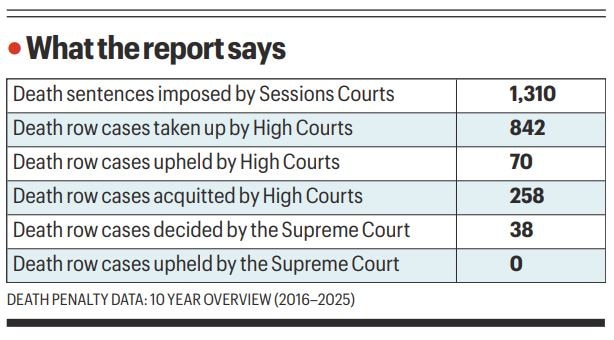
A high acquittal rate of death row prisoners by High Courts and the Supreme Court shows a pattern of “erroneous or unjustified convictions” in the trial courts, a study of ten years of death penalty data by the Square Circle Clinic, a criminal laws advocacy group with the NALSAR University of Law in Hyderabad, has found.
In the last ten years, while trial courts across India have sentenced 1,310 people to death, only 70, a “staggeringly low number of cases”, were confirmed by the High Courts. Of the 70 death sentences confirmed by the High Courts, the Supreme Court decided only 38 of them and upheld none.

The report will be released Wednesday.
As of December 31, 574 people were on death row. The report states that this is “the largest number of persons on death row at the end of a calendar year since 2016”, even as appellate courts continue to overturn or commute most death sentences imposed at the trial stage. In 2025 alone, sessions courts across the country sentenced 128 people to death in 94 cases.
Over the last 10 years, 364 people who had been sentenced to death were later acquitted by appellate courts. In 2025 alone, High Courts overturned death sentences into acquittals in more than 25% of the cases they decided, while the Supreme Court acquitted accused persons in over half of the cases it heard.
Over the last few years, the Supreme Court has repeatedly stressed on due process and procedural safeguards for death penalty sentencing. In 2022, it had directed that trial courts must call for and engage with three specific reports — psychological evaluation, probation officer’s report, and prison conduct records — before imposing a death sentence.
In August 2025, in a landmark ruling in Vasanta Sampat Dupare v. Union of India, the Supreme Court held that death penalty sentencing hearings are an essential component of the right to a fair trial under Articles 14 and 21 of the Constitution. Effectively, it had said that sentencing hearings that do not comply with the 2022 guidelines will be considered a violation of fundamental rights, leading the Court to reopen the sentencing stage for persons on death row who had already exhausted their appellate process.
This shift in approach reflects in the Supreme Court’s decisions in death row cases. For the third consecutive year (2023–2025), the Court confirmed zero death sentences and conversely, the acquittal rate has surged. In 2025, the Supreme Court acquitted accused persons in over 50% of the cases it decided (10 out of 19 cases), the highest number of acquittals since 2016.
Story continues below this ad
Even at the High Court level, the 10-year data show a similar pattern. Between 2016 and 2025, High Courts acquitted nearly four times as many persons from death row as they confirmed. In 2025, High Courts disposed of cases involving 131 persons, setting aside death sentences for around 90% of them through acquittals, commutations or remands. Effectively, the acquittal rate is nearly four times the confirmation rate, the report states.
The report cautions that these outcomes cannot be dismissed as an episodic error. “Wrongful or erroneous or unjustified convictions… are not random or freak accidents in the Indian criminal justice system,” the report states.
However, this correction has not trickled down to the sessions court level, where the sentencing hearing takes place. In 2025, sessions courts failed to comply with the 2022 Supreme Court guidelines requirements in 79 out of 83 cases. The report records this as a non-compliance rate of 95.18%.
The report links it to the pace at which sentencing hearings are conducted. In 18 cases in 2025, sentencing was carried out on the same day as the pronouncement of guilt. In more than two-thirds of cases, the sentencing hearing followed within five days. Such timelines, the report notes, “significantly constrain the states from securing the reports relating to the accused’s mental health, jail conduct and personal history” and hinder the defence’s ability to present mitigation material.
Story continues below this ad
The report flags a widening gap between legislative intent and judicial behaviour. While higher courts have grown noticeably cautious about confirming death sentences, Parliament and state legislatures have moved in the opposite direction, expanding the scope of capital punishment. Over the past decade, “the use of the death penalty by the judiciary may be on the decline”, even as legislatures have continued to widen its reach.
While executions have declined, the report flags the growing use of life imprisonment without remission as an area of concern. Over the decade, appellate courts have increasingly commuted death sentences to fixed-term or whole-life sentences that exclude remission for decades or until the end of a person’s natural life. This, the report warns, is “a worryingly unregulated area of law that is in need of a framework to save it from the arbitrariness that currently plagues it”. It cautions that such sentences should not be seen as benign alternatives, noting that “they take away from a person an important essence of life – hope.”
Geographically, the death row population remains concentrated in a few states. Uttar Pradesh continues to have the largest number of persons on death row, followed by Gujarat, Haryana, Maharashtra, Kerala and Karnataka. Women constituted 4.18% of the death row population in 2025. Across the decade, murder simpliciter and murder involving sexual offences accounted for the majority of death sentences imposed by sessions courts.

