

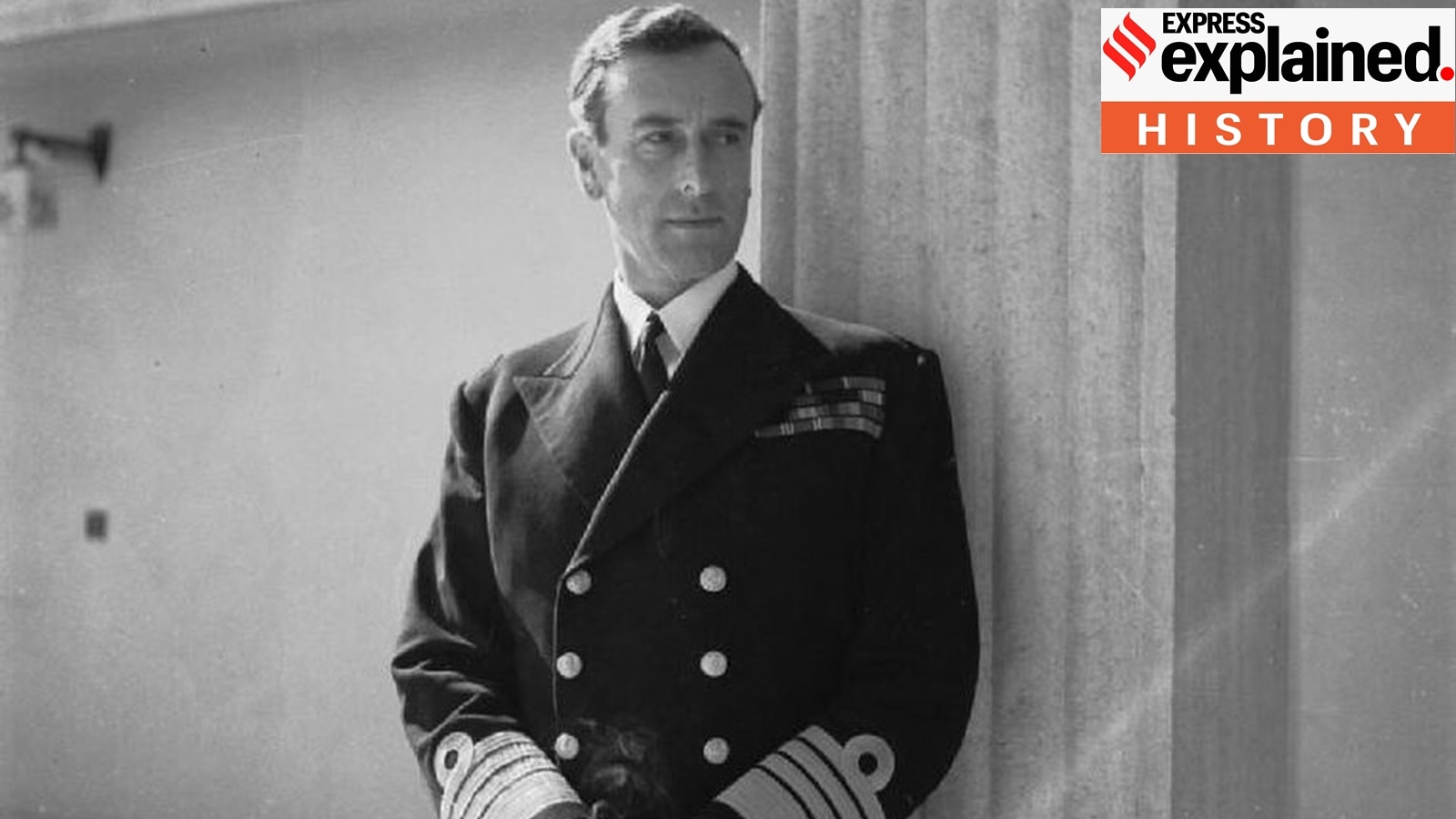
It was in June 1947 that Lord Louis Mountbatten announced his plan for the Independence and Partition of India, pulling back the expected date by almost a year. Thus, while India became free earlier than expected, this came at the cost of great violence and chaos. Earlier this week, we explained what the Mountbatten Plan was and why Congress and the Muslim League accepted it. Today, we will look at the reasons behind why the Viceroy expedited up the Empire’s withdrawal from India.
Mountbatten left the Indian leaders with as little time as possible between their acceptance of the Partition plan and its public announcement on All India Radio on the evening of June 3, 1947. In a hurried broadcast, the partition of British India was formally declared. When the speech concluded, Mountbatten returned to the Viceroy’s House for some “well-earned whiskeys and sodas.”
In the days that followed, he addressed the press to explain both the urgency and the reasoning behind the rapid decision.
Press Meet on June 4
On June 4, at a press conference, Mountbatten explained that the transfer of power would be advanced by almost a year, to August 15, 1947. “The date I chose came out of the blue,” he admitted. Why that date? Because it marked the second anniversary of Japan’s surrender—though, he conceded, nothing more significant than that. In Indian Summer (2008), historian Alex von Tunzelmann notes that Mountbatten revealed the imminent date of independence with the ease of “a stage magician pulling a rabbit from a hat.”
UK Prime Minister Clement Attlee had originally set Mountbatten an exit date of June 1, 1948. Even that was an ambitious timeline, given the complexity of Indian politics and the potential consequences of partition. “And yet, undaunted by the task before him, the last Viceroy took the bizarre and unilateral decision to speed independence up,” writes Tunzelmann.
“It was a bombshell!” wrote the Commander-in-Chief’s private secretary, Shahid Hamid, in his diary that afternoon. “Two states will be born 77 days from now. There is no parallel in history!”
Why was India’s independence date fixed for August 15, 1947?
In Shattered Lands (2025), historian Sam Dalrymple notes that the precise reason for Mountbatten’s accelerated transfer of power remains widely debated. “The most persuasive answer is that, with Sardar Patel blocking his access to the intelligence services, he felt burdened by the responsibility over millions of lives and had no knowledge of what was actually going on, or power to change it.”
Story continues below this ad
Tunzelmann offers an alternate reasoning. Just before the Mountbattens left England in March, his wife Edwina had responded briskly to a relative’s concerns: “Don’t worry,” she said. “This is going to be a marvellous experience – and Dickie says we’ll be back as soon as we can – and that means not long.”
By the end of May, Mountbatten had pressed the government into making the period even shorter than it might have been. Edwina had not wanted to go to India in the first place and, in the early weeks, urged her husband to ensure their return to Britain as quickly as possible. “Perhaps,” notes Tunzelmann, “if he could carry out the transfer of power swiftly and efficiently enough, he might still save his marriage.”
Horror and confusion were widespread across India in June and July 1947. Dalrymple describes how the official secrecy surrounding the border negotiations only heightened the vulnerability of farmers, fishermen, and factory workers. “Would Muslims living in India count as Indians or as stranded Pakistanis? And what would be expected of the subcontinent’s other religious communities – the Sikhs, Christians, Buddhists, Jains, Parsis, Jews, Sanamahis, Bahais, Bons, atheists and agnostics? Even the basic question of who counted as Hindu and Muslim had yet to be worked out.”
“When I got out to India I realized . . . that, although we in London had visualised the programme of transfer for June 1948 as moving at lightning speed, in India it was regarded as being much too slow,” Mountbatten told a meeting of the East India Association in London the following year. “Everybody there was agreed on this point: the leaders, leading British officials, my staff advisers.”
Story continues below this ad
However, Tunzelmann disagrees. After seeing the plan at Simla, even Nehru had warned that it was moving too fast. Liaquat Ali Khan of the Muslim League stated that he did not believe that under any circumstances—united or divided—India could be ready to stand on its own by June 1948. Several of the princes too pleaded for a longer British presence.
‘The rush was Mountbatten’s, and his alone’
According to Tunzelmann, records show no evidence of anyone else urging Mountbatten to hasten the process— not the British government, not his advisers, not the Sikhs, not the Muslim League, not Gandhi, and not even the majority of the Congress leadership. Nehru and Patel may have signalled their desire to begin governing, but neither called for a fixed independence date as early as August that year. “The rush was Mountbatten’s, and his alone.”
He would soon come to recognise this. In a letter to his daughter Patricia, cited by Dalrymple, Mountbatten wrote: “I’ve made a mess of things through over-confidence and over-tiredness. I’m just whacked and worn out and would really like to go. I’m so depressed darling, because until this stupid mishandling of the Jinnah situation I’d done so well”.

