

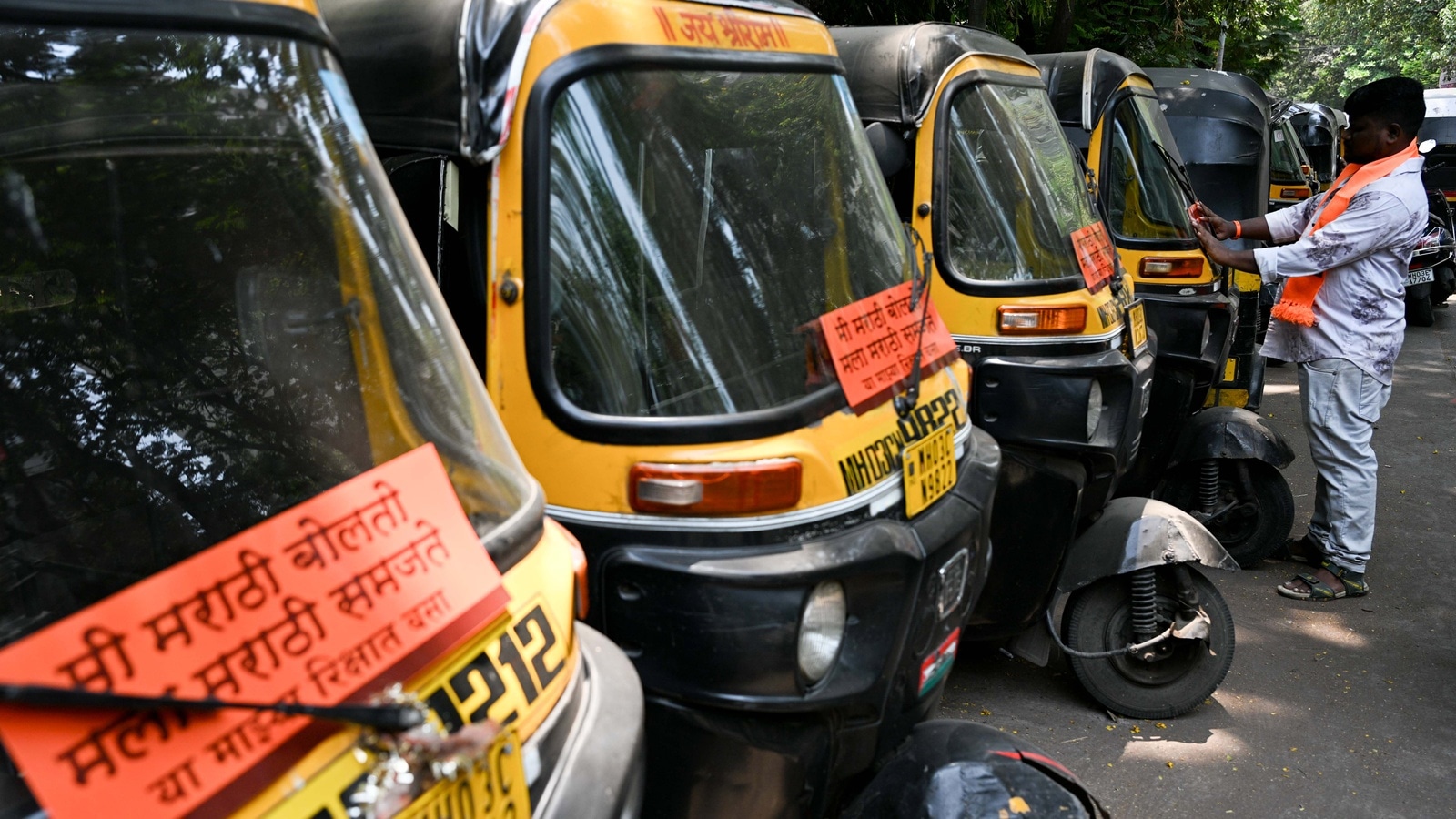
The Maharashtra Transport Department on Friday launched a 100-day statewide verification drive targeting autorickshaws, taxis and other public service vehicles—an exercise that combines routine checks on permits and licences with a new focus on drivers’ working knowledge of Marathi.
Yet, the rollout was subdued on Day 1. With RTO offices shut for Maharashtra Day, there was little visible enforcement on the ground, raising questions about implementation even as the policy itself has sparked debate.
What prompted the drive, how will it be enforced, and does the Marathi requirement have legal backing? Here’s what to know.
The drive follows a policy push led by Maharashtra Transport Minister Pratap Sarnaik, who last month warned that permits of public service vehicle drivers could be cancelled if they do not know Marathi. This led to a proposal to amend the Maharashtra Motor Vehicles Rules, 1989, under the Motor Vehicles Act, 1988, to expand the requirement of Marathi proficiency across licensing and permit systems.
Under the proposed changes, licensing authorities can assess whether an applicant has a working knowledge of Marathi before granting permission to drive public service vehicles (Rule 4). Amendments to Rule 78 make this an additional condition for permits, while Rule 85 requires drivers to demonstrate such knowledge at the time of permit renewal.
While Marathi was earlier required in a limited way, mainly for issuing badges, the amendments aim to formalise it across the system. The proposed changes are not final and the state has invited public suggestions and objections.
Officials say the push for basic Marathi aims to address commuter complaints about communication gaps with drivers. At the same time, authorities are using the exercise to identify irregularities such as fake licences, permit violations and illegal shared transport operations.
Story continues below this ad
The scale of the sector is significant. In Mumbai alone, there are over 2.8 lakh autorickshaw permits and around 20,000 taxi permits, covering an estimated five lakh drivers across shifts. Officials say the problem is not limited to specific pockets like BKC or Mira-Bhayandar, but extends across busy urban and semi-urban corridors where informal, unregulated services often operate.
Implementation, and impact on commuters
From Day 1, enforcement will be carried out through flying squads and inspection teams deployed at transport hubs, railway stations and key arterial roads. Autos and taxis will be stopped for random checks, with officials verifying licences, permits and badges. Simultaneously, drivers will be informally assessed on their ability to understand and respond in basic Marathi. The inspections will be spread across locations and time slots over 100 days, with no fixed checkpoints, to ensure wider coverage.
The government has made it clear that this phase is corrective, not punitive. Drivers found lacking basic Marathi skills during checks will be directed to RTOs, where they will receive learning material, including the ‘Practical Marathi’ guidebook, along with access to training modules.
At the same time, compliance will be built into routine processes. Drivers visiting RTOs for licence issuance, badge approvals or permit renewals will also be assessed for working knowledge of Marathi, in line with proposed rule changes.
Story continues below this ad
The drive includes action against unauthorised transport services, with officials targeting vehicles operating without valid permits or licences, including illegal shared autos and taxis. Penalties could include fines, suspension or cancellation of licences, and, in serious cases, FIRs. If enforcement is carried out at scale, it could temporarily reduce the number of such vehicles on the road, but officials say commuters are unlikely to face immediate disruption.
The move has attracted criticism from Opposition parties. Mumbai Congress chief and Lok Sabha MP Varsha Gaikwad said that while making Marathi knowledge mandatory, the government must not snatch employment of individuals. “On the one hand, it wants to make Marathi mandatory to auto and taxi drivers. On the other hand, it is bringing projects like pod taxis, which will snatch employment of these drivers. Think about employment and economic upliftment as well,” she said.
Is this legal?
In 2017, the Bombay High Court set aside a similar decision by the Transport Department that required Marathi proficiency for autorickshaw permits. The court held that the state lacked the statutory power to impose such a condition, noting that autorickshaws fall under the category of “motor cabs”, which are exempt from the Marathi language requirement for badges applicable only to “public service vehicles”.
Back then, the Maharashtra government had justified the eligibility condition, stating Rule 24 of the Maharashtra Motor Vehicles Rules laid down the procedure for issuing badges required to be worn by motor cab drivers, with knowledge of local language Marathi as one of the conditions. The state claimed there was nothing wrong in the condition that required motor cab drivers to communicate with citizens in Marathi and read and understand Marathi road sign boards.
Story continues below this ad
Rule 24 stipulates the procedure for issuing badges to drivers having authorisation for “public service vehicles”, except motor cabs. Conditions mandate topographical knowledge of the operation area and working knowledge of Marathi and any one language commonly spoken in that area.
The government had argued that drivers without knowledge of Marathi may not understand commuter instructions, causing inconvenience to commuters. It referred to a High Court order of November 17, 2016, which had prima facie observed the eligibility condition was “not unreasonable” as public service vehicle drivers are expected to know the regional language.
But the High Court, reiterating a 1966 verdict, held that the autorickshaw is included in the definition of the motor cab and that Rule 24 specifically excludes such motor cabs. So, the said Rule has “no application whatsoever to autorickshaws” and “the eligibility condition based on Rule 24 could not have been incorporated as a qualification for a person applying for the grant of a Contract Carriage Permits for autorickshaws”.
Under the Maharashtra Motor Vehicles Act, a Contract Carriage means a motor vehicle that carries passengers for hire or reward and is engaged under an express or implied contract. This includes a motor cab, which is defined as “any motor vehicle constructed or adapted to carry not more than six passengers excluding the driver for hire or reward”.
Story continues below this ad
The court said that the government was “under a mandate to act within four corners” of the Act and Rules. “Only by giving an excuse of public interest, the state government cannot circumvent the provisions of the said Act and the Rules framed thereunder,” the court held.
Regarding the 100-day drive, Transport Department officials told The Indian Express that they had not introduced a new regime, adding that the eligibility condition follows Rule 24 of the Rules and the present move enforces the existing rule.
A senior Transport official claimed that badges are mandatory after availing permit, and that taxis and autos are “public service vehicles” while tourist taxis will come under the “motor cabs” category. The official added that Rule 24 is required for badge and not for permit, and the court had not quashed the decision regarding badges.
Meanwhile, drivers’ unions claimed a violation of fundamental rights, including the freedom to practice profession or business. The move is likely to be challenged before the court in due course.
Have any other states issued similar directives?
Story continues below this ad
After the Maharashtra government’s decision, the Karnataka Pradesh Congress Committee floated a similar proposal to the Karnataka Chief Minister to mandate proficiency in Kannada for auto and cab drivers, citing similar flashpoints over the language in cities like Bengaluru. The proposal divided unions, with some seeking such implementation to avoid communication gaps between drivers and commuters, while others said that it was not needed. No decision has been taken yet on the proposal.
So far, no other state has implemented such a mandate, involving auto and cab drivers. However, issues over mandating regional languages have seen legal challenges and court interventions.
For instance, in 2022, the Maharashtra government had passed a resolution to amend the Maharashtra Shops and Establishments Act, mandating that signboards be put up on shops and commercial establishments displaying the names of the establishments in Marathi. While retail associations went to court against the amendment, the Bombay High Court had upheld the state’s decision, terming it a “reasonable requirement” and observed that it “does not prohibit the use of any other language.”
The court had also observed that “a public purpose is sought to be achieved by the said rule”. An appeal was filed before the Supreme Court in ߧ while granting time for a hearing, the top court had asked the associations to install signboards in Marathi.
Story continues below this ad
Various states have also mandated proficiency in local languages for government posts citing effective communication. In 2023, the Tamil Nadu Assembly amended legislation to make at least 40% marks in the Tamil language mandatory for all state government jobs; the Madras High Court upheld this in 2024. These provisions, however, are for government jobs — not for cab and auto drivers.
(with inputs from Alok Deshpande and Sadaf Modak)

