

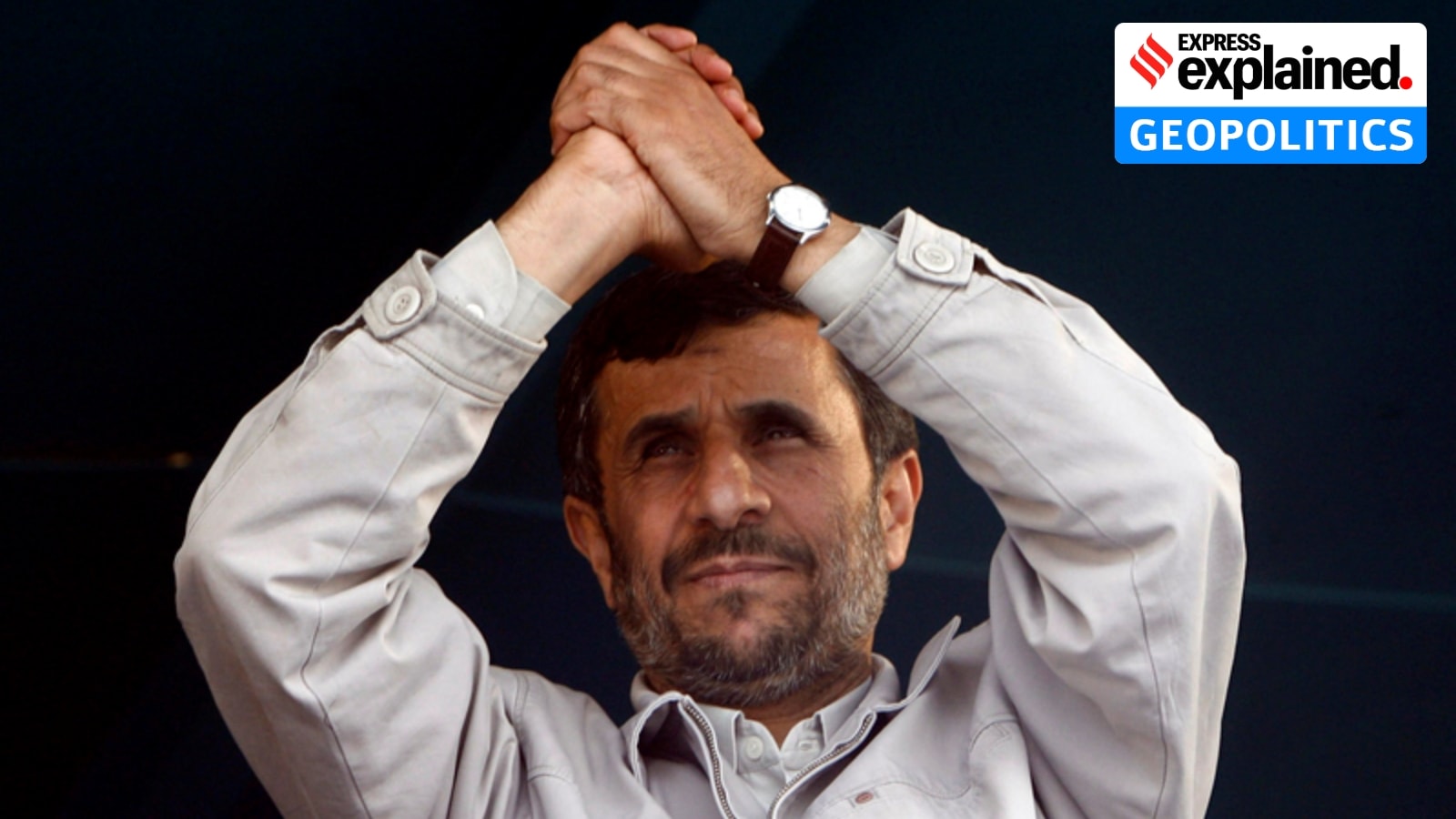
On Wednesday (May 20), The New York Times reported that the US-Israeli strikes on February 28 which killed Iran’s Supreme Leader, Ali Khamenei, was also meant to help prop up an unlikely figure to lead the anticipated post-Khamenei transition: former President Mahmoud Ahmadinejad.
The February 28 strike to free Ahmadinejad from unofficial house arrest, however, both injured him and killed officials believed (by Washington) to be more amenable to the US. Rumours of Ahmadinejad’s death had circulated in the first week of the war, his affiliates confirmed his survival, but the former President has not been seen since.
Mahmoud Ahmadinejad’s eight years as President of Iran from 2005 to 2013 was a strong reflection of the internal mosaic of the Islamic Republic, and its non-monolithic nature. A doctorate in civil engineering and transportation planning, Ahmadinejad’s political career matured during the reformist Mohammad Khatami’s presidency (1997-2005), when Ahmadinejad relied on hardline opposition to Khatami’s politics.
Here, he benefitted from a strong focus on orthodox religious policies as Mayor of Tehran (2003-05), alongside a pre-existing image as a politician especially sensitive to veterans of the Iran-Iraq war, as a former officer of the Islamic Revolutionary Guard Corps (IRGC) himself.
The two years prior to Ahmadinejad’s first term had featured significant US intelligence and military action in the Middle East, especially during its 2003 invasion and occupation of Iraq. The paranoia that this triggered amongst the IRGC’s ranks directly contributed to a reluctant but effective IRGC consolidation around Ahmadinejad’s politics.
While Ahmadinejad’s 2009 re-election has remained in public memory for alleged electoral fraud and the Green Movement protests it triggered (one of Iran’s largest protests), his 2005 election was also significantly disputed by competing candidates such as Mehdi Karroubi and Ali Akbar Rafsanjani (both reformists), who alleged that the IRGC’s Basij (a heavily armed, volunteer paramilitary militia) had helped tilt the election in Ahmadinejad’s favour.
Handing 10 of 25 cabinet positions to the IRGC, Ahmadinejad oversaw a significantly hardline foreign policy posture (buoyed by the threat presented by the US in neighbouring Iraq). During his first term, Iran stepped up its activities to expand its influence in Iraq by leveraging US inexperience, boosted ties with Venezuela to form an “anti-imperialist” front, and resumed nuclear enrichment at its Natanz facility. Ahmadinejad’s anti-Israel and anti-US drive, along with fundamentalist domestic policy positions, became a key marker of his presidency.
Story continues below this ad
While Ahmadinejad continued his hardline posture in his second term, the stain of the 2009 demonstrations harmed his continued presence in government and re-entrenched the Islamic Republic’s need to ensure overt balance (by allowing more reformists in the electoral contest after hardliner administrations) — an objective crucial for regime preservation.
Moreover, numerous disagreements between Ahmadinejad and the Supreme Leader’s office (as well as the IRGC) waylaid the former’s career, adding to the latter’s assessment of the President having become a polarising figure. Ahmadinejad himself had begun to view the state’s intervention in the 2009 elections as a carte blanche for his second term (a view Khamenei did not share). This eventually led to Ahmadinejad’s eventual ostracisation, as the reformist Hassan Rouhani administration led Tehran towards the 2015 US-Iran nuclear deal with Khamenei’s blessing.
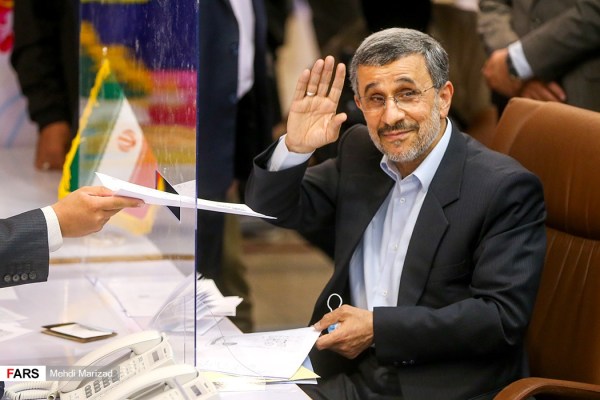 Mahmoud Ahmadinejad in 2021. The former Iranian President was officially prohibited from contesting the 2017, 2021, and 2024 elections. Photo: Wikimedia Commons
Ahmadinejad was officially prohibited from contesting the 2017, 2021, and 2024 elections (which gave way to reformist, conservative, and reformist governments respectively). But he focused on rebranding himself by leaning into middle-class grievances and offering support for popular demonstrations and working to consolidate his own base even as Khamenei consistently deemed his presidential candidacy as “not being in the best interest of the country”. Geopolitical expert Hamidreza Azizi also noted that by 2021, Ahmadinejad was terming himself a “liberal democrat”, vocally criticising corruption in government, discouraging Iran’s intervention in Syria, and branding himself as a modern politician.
Why did the US need an Ahmadinejad-like figure?
While the US evidently misread Iran’s political landscape, the Trump administration’s need to rely on an internal ally who can benefit Washington (in the US view) is historically informed. Even in 1953, when the US helped covertly topple the populist Prime Minister Mohammad Mosaddegh and reinstate the monarch Mohammad Reza Pahlavi, the Central Intelligence Agency relied on Lt Gen Fazlollah Zahedi to rally loyal law enforcement and military units to stage a coup d’état. Even in that year, it had taken Zahedi two attempts.
Story continues below this ad
For the second Trump administration, it is Washington’s more recent success in Venezuela — where Nicholas Maduro was replaced by Delcy Rodriguez — which encouraged replication in Iran. The NYT report also reaffirms that Washington’s Venezuela experience strongly influenced Trump to override discouraging advice.
Choosing Ahmadinejad in particular was effectively a recognition by Washington of his changed self-description. But he has historically had to contend with other actors such as Ali Larijani, Mohammad Baqer Ghalibaf, and Mohsen Rezai, with at least the former two also branding themselves as “pragmatic conservatives” who looked to channel popular resentment but while being loyal to the goal of regime preservation.
Strategic affairs expert Afshon Ostovar noted that Ahmadinejad, Larijani, Ghalibaf, and Rezai commanded the loyalties of different sections of the IRGC; each had espoused their own versions of modernist political positions.
Since the war began on February 28, three of these came to occupy crucial de facto positions in the Iranian government, with Ghalibaf and Larijani effectively overseeing strategic decision-making as Parliament Speaker and Supreme National Security Council Secretary respectively, and Rezai as advisor to incumbent Supreme Leader Mojtaba Khamenei.
Story continues below this ad
Larijani and Rezai especially had benefitted from increased space to regain influence in late 2025, especially after Israel’s 12-day war in June. Ahmadinejad’s absence from this space — despite being an incumbent member of Iran’s Expediency Discernment Council — leading up to the 2026 war signalled his continued peripheral position, relative to the other three in Ali Khamenei’s view. This arguably injected greater confidence amongst Trump administration officials who backed a transition that featured Ahmadinejad in a key role, if he indeed was a detractor.
Why did it fail?
At first glance then, Ahmadinejad would seem like the ideal candidate to lead systemic change from within the Iranian state. His approach, however, was calibrated, playing on key strands of popular resentment and drew on the possibility of a range of post-Khamenei frameworks of government within the Islamic Republic — not outside of it. This calibration is arguably why he believed it could work.
The US-Israeli strategy of precision strikes to make way for Ahmadinejad arguably decimated the potential for progress in the former president’s efforts to garner sufficient organising potential, exploit possible rifts within the IRGC, take advantage of the inevitable post-Khamenei space, and exploit any new Overton window that would result from his years-long rebranding. Named after the American policy analyst Joseph Overton, Overton window refers to the range of policies and ideas that is politically acceptable to the public at any given time.
In contrast, wartime nationalism and its rally-around-the-flag effect has disrupted Iran’s anti-regime landscape further. It is uncertain what peacetime conditions will hold for Iran, given that internal fractures are likely to emerge once immediate external pressures arising from the US and Israel are diluted.
Story continues below this ad
It is clear, however, that Ahmadinejad’s association with US aggression against Iran significantly reduces his chances in particular. Moreover, Iran has a long history of staunch regime allies (from both principlist and reformist camps) falling out, facing arrest, and attempting rebranding — all working in varying ways but within the Islamic Republic’s larger framework.
Ahmadinejad himself was by no means already entrenched as a radical anti-system outlier, and not significantly different from other detractors looking to regain/secure power. Apart from the fact that his attempt to win over the educated middle class was yet to fully mature, he did not show any public indication or ability to push for the Islamic Republic’s replacement as a political system.
Still, should Israel or the US still look to remove key figures such as Ghalibaf and Rezai — having already assassinated Larijani — both Washington and Tel Aviv could still believe in the plan’s theoretical success. But the Iranian regime’s ability to leverage wartime nationalism and prevent the US or Israel from securing any strategic victories while punishing their regional allies has led to even less optimal conditions for leaders such as Ahmadinejad from even attempting subversive actions, least of all those sufficient enough to lead to systemic overhaul.

