

Mains Examination:General Studies II: Indian Economy and issues relating to planning, mobilization, of resources, growth, development and employment.
What’s the ongoing story: The war in West Asia has exacerbated a key pain point for the country’s economy: the rupee’s value.
• What has been India’s strategy of settling international trade in Indian Rupees (INR)?
• How India saved ₹14,000 crore in foreign exchange in February 2026?
• Why Reserve Bank of India (RBI) introduced a framework for rupee-based trade?
• What is “internationalisation of the rupee”?
• What is “depreciation of Rupee”?
• Devaluation of Rupee and depreciation of Rupee-compare and contrast
• Why settling trade in domestic currency particularly useful during periods of rupee depreciation?
• What is Vostro accounts in rupee trade settlement?
• What is the difference between Vostro and Nostro account?
• What are the key limitations of rupee-based trade settlement?
Story continues below this ad
• How rupee trade settlement can help reduce external sector vulnerabilities?
Key Takeaways:
• After closing around 91-per-dollar on February 27, the rupee fell by as much as 4.5% to 95.24 in March before action by the RBI to curb speculative bets helped it gain some ground. But new RBI data shows that the situation could have been worse if not for a long-term bet placed in mid-2022 by authorities that has begun paying some dividends.
• The data shows that Indian traders settled more than Rs 14,000 crore of imports in rupees in February this year — up from around Rs 11,000 crore in January. This amounts to roughly $1.5 billion (Rs 14,057 crore) of foreign exchange being saved by India in February alone. This is not an insignificant sum at a time when the rupee has been under extreme pressure due to foreign investors dumping billions of dollars of Indian stocks and debt, forcing the RBI to defend the currency through a variety of instruments.
• In the first 11 months of 2025-26, Rs 1.39 lakh crore worth of imports — around $15 billion at the current exchange rate — have been settled in rupees, up 45% from Rs 96,154 crore in April 2024-February 2025. In 2024-25 as a whole, imports worth Rs 1.13 lakh crore were settled in rupees, up 13% from Rs 99,596 crore in 2023-24.
Story continues below this ad
• As a percentage of total imports, while there has been progress, the numbers remain small: in April 2025-February 2026, only 2.35% of India’s imports were paid in rupees, up from 1.85% in 2023-24 and 1.94% in 2024-25.
• To be sure, exports are also being paid for in rupees. In fact, these payments exceed those for imports, although the gap has narrowed sharply. From 57% in 2023-24, imports settled in rupees have risen to 95% of exports settled in the domestic currency in the first 11 months of 2025-26.
• In October 2022, months after the RBI announced a framework for the settlement of international trade in rupees, a report by a committee of the central bank said it made strategic sense to settle bilateral trade in rupees, initially with regional partners. “Further, invoicing and settling of international trade transactions in INR with trade partners with whom we have a trade deficit (say, the oil exporting countries) will in general lead to a reduction in the current account deficit denominated in convertible currencies,” it said.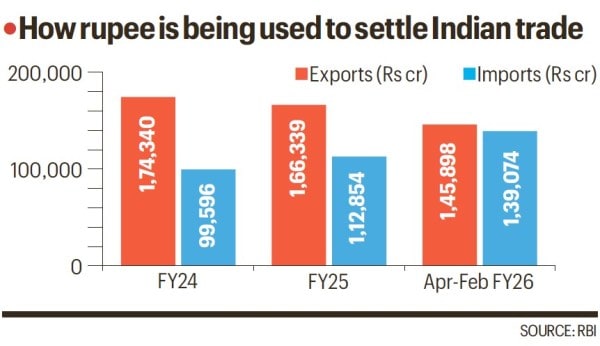
Do You Know:
• Currency depreciation occurs when a currency loses value relative to other currencies. Triggered by factors such as economic fundamentals, interest rate differentials, or inflation, this decrease can enhance export competitiveness but may also displace investor confidence.
Story continues below this ad
• Rupee depreciation is a decline in the value of the Indian Rupee (INR) relative to foreign currencies, mainly the US Dollar (USD), driven by market forces in a floating exchange rate system.
• Internationalisation of the rupee refers to promoting its usage in cross-border trade, investments, and financial transactions without mandatory conversion to a dominant foreign currency like the USD.
• Special Rupee Vostro Accounts (SRVA) are specialized bank accounts opened by foreign banks with Authorized Dealer (AD) Indian banks to facilitate trade settlements directly in Indian Rupees (INR). Introduced by the RBI in 2022, this mechanism allows invoicing and payment in INR, bypassing third-party currencies like the US dollar, which reduces exchange rate risks and facilitates trade with sanctioned nations.
• A Nostro account is a bank account held by a domestic bank in a foreign currency at another (correspondent) bank in a foreign country. Derived from Latin for “ours,” these accounts are used to manage foreign currency holdings and facilitate international transactions, such as trade and foreign exchange, allowing for faster settlement.
Other Important Articles Covering the same topic:
Story continues below this ad
📍Rupee’s fall: What it means for you and what you can do to de-risk
Previous year UPSC Prelims Question Covering similar theme:
1) Consider the following statements: (UPSC CSE, 2021)
1. The effect of devaluation of a currency is that it necessarily improves the competitiveness of the domestic exports in the foreign markets
2. increases the foreign value of domestic currency
3. improves the trade balance
Which of the above statements is/are correct?
(a) 1 only
(b) 1 and 2
(c) 3 only
(d) 2 and 3
2) Which one of the following is not the most likely measure the Government/RBI takes to stop the slide of the Indian rupee? (UPSC CSE, 2019)
(a) Curbing imports of non-essential goods and promoting exports
(b) Encouraging Indian borrowers to issue rupee-denominated Masala Bonds
(c) Easing conditions relating to external commercial borrowing
(d) Following an expansionary monetary policy
3) Convertibility of rupee implies (UPSC CSE, 2015)
(a) being able to convert rupee notes into gold
(b) allowing the value of rupee to be fixed by market forces
(c) freely permitting the conversion of rupee to other currencies and vice versa
(d) developing an international market for currencies in India
Story continues below this ad
Previous year UPSC Main Question Covering similar theme:
📍How would the recent phenomena of protectionism and currency manipulations in world trade affect macroeconomic stability of India? (2018)
Politics
Tripura leads, big states lag:2.5 lakh panchayats ranked in PAI 2.0 report
Preliminary Examination:Indian Polity and Governance-Constitution, Political System, Panchayati Raj, Public Policy, Rights Issues, etc.
Mains Examination: General Studies II: Indian Constitution—historical underpinnings, evolution, features, amendments, significant provisions and basic structure.
Story continues below this ad
What’s the ongoing story: Gram Panchayats in Tripura, Kerala, and Odisha have performed better, while those in Punjab, Uttar Pradesh, Bihar, and Rajasthan lagged on the Centre’s Panchayat Advancement Index (PAI) 2.0, which assessed 2,59,867 rural local bodies based on their performance and progress on nine themes covering sustainable development goals (SDGs).
• What is the Panchayat Advancement Index (PAI)?
• What is the Panchayat Development Index( PDI)?
• In which year was Pai 2.0 launched?
• What are the top five states performed strongly in PAI 2.0 rankings?
• Why Tripura emerged as the top-performing state in PAI 2.0?
• Which is the primary unit of assessment under PAI 2.0?
• What are the limitations of composite indices like PAI in assessing rural development?
• “PAI 2.0 reveals a governance paradox where smaller states outperform larger ones in grassroots development”-what is your opinion?
• The term Panchayati Raj signifies what?
• What was the 73rd Amendment Act of 1992?
Story continues below this ad
• The 73rd Amendment Act of 1992 has given a practical shape to which article of the Directive Principles of State Policy?
• The Panchayati Raj Institutions (PRIs) have not performed well or to the expected standard, despite being granted constitutional status and protection under the 73rd Amendment Act (1992)-Why?
Key Takeaways:
• Of the 2,59,867 Gram Panchayats, 3,635 have been ranked as ‘Front Runner’, 1,18,824 as ‘Performer’, 1,23,719 as ‘Aspirant’, and 13,689 as ‘Beginner’. No panchayat could make it to the ‘Achiever’ category.
• Among the ‘Front Runner’ panchayats, 943 were in Tripura, which constituted 80 per cent of the state’s total 1,176 rural local bodies. The state was followed by Kerala, where 10 per cent of its 941 Gram Panchayats have been assessed as ‘Front Runner’. With 8 per cent of its total 6,794 Gram panchayats assessed as ‘Front Runner’, Odisha stood next.
• Panchayats in these states have performed relatively better vis-à-vis several big states. For instance, only 51 of 57,678 Gram Panchayats in Uttar Pradesh were assessed as ‘Front Runner’. In Rajasthan, the number stood at eight out of 11,037; in Bihar, 2 out of 8,053; and in Punjab, just one out of 13,233.
• “PAI is a report card on the performance of each of the more than 2.5 lakh panchayats in the country. Each panchayat is assessed on more than 150 parameters across sectors such as health, water, infrastructure, and sustainability. The release of PAI 2.0 (FY 2023–24) reinforces the government’s commitment to strengthening Panchayati Raj Institutions and advancing the vision of ‘Viksit Gram Panchayats’ through participatory, transparent, and data-driven local governance,” said a source at the Union Ministry of Panchayati Raj.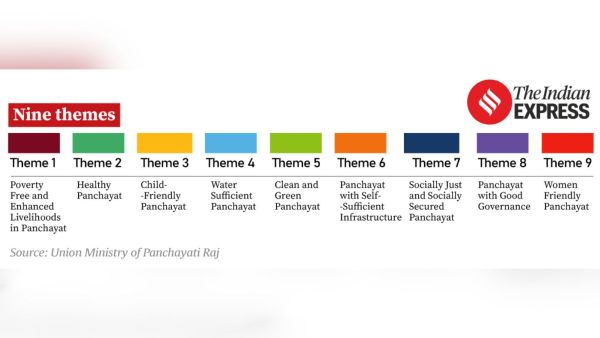
Do You Know:
• The Ministry of Panchayati Raj launched the Panchayat Advancement Index (PAI) — a transformative tool to measure the progress of over 2.5 lakh Gram Panchayats (GPs) across India. The PAI captures Panchayats’ performance across nine themes of Localized SDGs (LSDGs) i.e. Poverty-Free and Enhanced Livelihoods in Panchayat, Healthy Panchayat, Child-Friendly Panchayat, Water-Sufficient Panchayat, Clean and Green Panchayat, Panchayat with Self-Sufficient Infrastructure, Socially Just and Socially Secured Panchayat, Panchayat with Good Governance and Women-Friendly Panchayat. These themes align global goals with rural realities, helping local governments tailor their strategies for holistic development.
• The PAI 2.0 is prepared by the Union Ministry of Panchayati Raj after assessing panchayats based on their performance across 150 indicators covering nine SDGs –from poverty-free and enhanced livelihoods to women-friendly panchayats—during the 2023-24 financial year.
According to the ministry officials, the Gram Panchayats have been ranked under five categories based on their score on a scale of 0-100: ‘Achiever’ (90-100), ‘Front Runner’ (75-90), ‘Performer’ (60-75), ‘Aspirant’ (40-60 ) and ‘Beginner’ (below 40).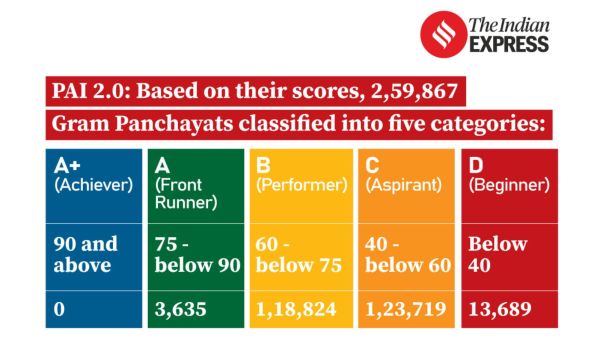
The PAI 2.0 covers all Gram Panchayats in the country, except West Bengal.
Other Important Articles Covering the same topic:
📍How the new Panchayat Advancement Index ranks rural local bodies
Previous year UPSC Prelims Question Covering similar theme:
4) Local self-government can be best explained as an exercise in (UPSC CSE, 2017)
(a) Federalism
(b) Democratic decentralisation
(c) Administrative delegation
(d) Direct democracy
5) The fundamental object of Panchayati Raj system is to ensure which among the following? (UPSC CSE, 2015)
1. People’s participation in development
2. Political accountability
3. Democratic decentralisation
4. Financial mobilisation
Select the correct answer using the code given below
(a) 1, 2 and 3 only
(b) 2 and 4 only
(c) 1 and 3 only
(d) 1, 2, 3 and 4
Previous year UPSC Main Question Covering similar theme:
📍To what extent, in your opinion, has the decentralisation of power in India changed the governance landscape at the grassroots? (2022)
📍Assess the importance of the Panchayat system in India as a part of local government. Apart from government grants, what sources can the Panchayats look out for financing developmental projects? (2018)
📍In absence of a well-educated and organised local level government system, ‘Panchayats’ and ‘Samitis’ have remained mainly political institutions and not effective instruments of governance. Critically discuss. (2015)
Nation
SC rejects AIIMS review plea against its order to terminate 7-month pregnancy
Preliminary Examination: Current events of national and international importance.
Mains Examination:General Studies II: Issues relating to development and management of Social Sector/Services relating to Health, Education, Human Resources.
What’s the ongoing story: The Supreme Court on Wednesday dismissed the review petition filed by AIIMS against its direction to medically terminate a 15-year-old girl’s seven-month-old pregnancy.
• What is the case about?
• What exactly Supreme Court said for the reproductive autonomy of a woman?
• What is reproductive autonomy of a woman?
• What Medical Termination of Pregnancy Act says about abortion?
• Is medical termination of pregnancy allowed?
• ‘Reproductive autonomy is central to the right to life and personal liberty under Article 21’—Discuss in light of recent Supreme Court’s order.
• Know the evolution of abortion laws in India from the 1971 Act to recent Supreme Court rulings.
• “Abortion rights in India are legal but not absolute”-Decode the quote
• What are the ethical dilemmas involved in late-term abortions?
• What are the challenges faced by minors and rape survivors in accessing abortion services in India?
• Compare India’s abortion framework with global trends in reproductive rights.
Key Takeaways:
• Taking exception to the review petition, a bench of Justices B V Nagarathna and Ujjal Bhuyan said: “It is strange that the review petitioner-All India Institute of Medical Sciences is not inclined to obey the order of the Supreme Court and instead, is assailing the order of this Court dated 24.04.2026 in order to defeat the constitutional rights of the minor daughter of the appellant herein.”
• The court had on April 24, allowed the Medical Termination of Pregnancy (MTP), underscoring the reproductive autonomy of a woman.
• The bench had said that “the right to make decisions concerning one’s body particularly in matters of reproduction is an integral facet of personal liberty and privacy under Article 21 of the Constitution. The right cannot be rendered ineffective by imposing unreasonable restrictions especially in cases involving minors and unwanted pregnancies such as in the instant case.”
• The mother of the minor girl had approached the court seeking permission for MTP as it had crossed the statutory limit set by the Medical Termination of Pregnancy Act. Though she moved the Delhi High Court earlier, the request for MTP was rejected on April 21.
• Seeking review of the April 24 order, AIIMS said the medical board had carried out a fresh assessment of the minor on April 25.
• Highlighting “grave legal and ethical implications” in the matter, the review petition said, “the Medical Board has unambiguously opined that at the current stage of gestation, the termination of the pregnancy of Minor ‘N’ will not be a conventional abortion but will result in a preterm delivery of a viable fetus — one that has a fair chance of survival. The Court’s order proceeds on the premise of termination of pregnancy; however, the medical reality, as disclosed by the post-order assessment, is that a living, viable child will be prematurely delivered into the world.”
Do You Know:
• Section 312 of the Indian Penal Code, 1860, criminalises voluntarily “causing miscarriage” even when the miscarriage is with the pregnant woman’s consent, except when the miscarriage is caused to save the woman’s life. This means that the woman herself, or anyone else including a medical practitioner, could be prosecuted for an abortion.
• In 1971, The Medical Termination of Pregnancy Act (MTP Act) was introduced to “liberalise” access to abortion since the restrictive criminal provision was leading to women using unsafe and dangerous methods for termination of pregnancy.
• The MTP Act allowed termination of pregnancy by a medical practitioner in two stages.
For termination of pregnancy up to 12 weeks from conception, the opinion of one doctor was required.
• For pregnancies between 12 and 20 weeks old, the opinion of two doctors was required — they would have to determine “if the continuance of the pregnancy would involve a risk to the life of the pregnant woman or of grave injury to her physical or mental health” or there is a “substantial risk” that if the child were born, it would suffer from such physical or mental abnormalities as to be seriously “handicapped” before agreeing to terminate the woman’s pregnancy.
• In 2021, Parliament amended the law and allowed for a termination under the opinion of one doctor for pregnancies up to 20 weeks. For pregnancies between 20 and 24 weeks, the amended law requires the opinion of two doctors.
Other Important Articles Covering the same topic:
📍UPSC ethics simplified: abortion rights vs ethics
Previous year UPSC Prelims Question Covering similar theme:
6) ‘Beijing Declaration and Platform for Action’, often seen in the news, is (UPSC CSE, 2015)
(a) a strategy to tackle the regional terrorism, an outcome of a meeting of the Shanghai Cooperation Organization
(b) a plan of action for sustainable economic growth in the Asia-Pacific Region, an outcome of the deliberations of the Asia-Pacific Economic Forum
(c) an agenda for women’s empowerment, an outcome of a World Conference convened by the United Nations
(d) a strategy to combat wildlife trafficking, a declaration of the East Asia Summit
Explained
Preliminary Examination:Current events of national and international importance.
Mains Examination:General Studies II:Bilateral, regional and global groupings and agreements involving India and/or affecting India’s interests.
What’s the ongoing story: There had been murmurs for years. Yet, when the United Arab Emirates (UAE) announced its exit from the Organization of the Petroleum Exporting Countries (OPEC), it came as a shock. The exit of a major member will weaken the powerful cartel’s ability to influence global oil supply and prices as it did for decades.
• Map Work-UAE
• Map Work– OPEC and OPEC+ countries
• Why is the UAE leaving OPEC and OPEC+?
• What does the UAE move mean?
• Why the UAE wants to pump more oil?
• What is the Organisation of the Petroleum Exporting Countries (OPEC)?
• What is the difference between OPEC and OPEC+?
• What does OPEC and OPEC+ do?
• How does OPEC+ influence global oil prices and geopolitics?
• UAE to exit OPEC+ and OPEC—What could this mean for oil prices?
• How much oil do OPEC and OPEC+ countries produce?
• Why OPEC is also called as a ‘cartel’?
• Have other countries left OPEC?
• Which countries are in OPEC and OPEC+?
• OPEC+ and India-Connect the dots
Key Takeaways:
• The UAE’s decision, and the consequent structural weakness within OPEC, is expected to exert downward pressure on oil prices in the longer term. In the short term, however, there will be no impact as long as the Strait of Hormuz remains blocked, say experts and analysts.
• It is clear that the UAE wants to produce as much oil as possible, even in a low oil price environment. This would mark a divergence from the years of production quotas enforced by OPEC’s de facto leader, Saudi Arabia, to influence oil prices.
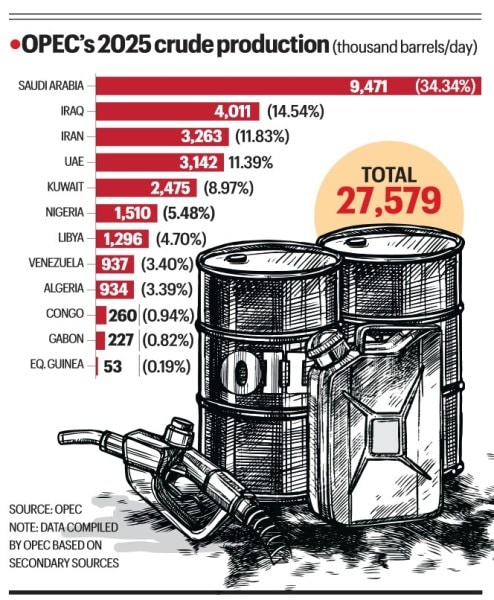 OPEC oil production (2025).
Do You Know:
• Founded in September 1960 at the Baghdad conference in Iraq, OPEC was originally established by five members — Iran, Kuwait, Iraq, Saudi Arabia and Venezuela. Prior to OPEC’s formation, Western multinational oil companies (often referred to as the Seven Sisters) largely dictated the prices paid to oil-producing nations. OPEC was created to counter this dominance, coordinating the petroleum policies of its member states to ensure that they received stable returns.
• The UAE formally joined the alliance in 1967, six years before the OPEC oil embargo was imposed on nations like the US and the Netherlands owing to their support of Israel in the Arab-Israeli war. With oil prices nearly quadrupling in that period as a result, OPEC steadily gained geopolitical leverage while extending membership to countries such as Algeria and Nigeria. In 2025, the UAE was OPEC’s fourth-largest oil producer, accounting for over 11% of the group’s cumulative oil production. It trailed Saudi Arabia, Iraq and Iran.
• The wider OPEC+ alliance was created in 2016. It included 10 major non-OPEC producers led by Russia. A response to the US’s booming shale oil production, OPEC+ produced over 40% of the world’s crude oil.
• OPEC, and OPEC+ by extension, derive their power through their influence in oil supply management. OPEC attempts to manage oil prices by regulating production limits and setting strict quotas for each of its member countries. The Saudi Arabia-led group claims that the production quota system is designed to protect the market from oversupply during times of reduced global demand.
Other Important Articles Covering the same topic:
📍After UAE’s exit from OPEC, India must spell out its energy alliances
📍‘Impact of UAE’s move will be felt only in the longer run’
Previous year UPSC Prelims Question Covering similar theme:
7) Consider the following statements: (UPSC CSE, 2024)
Statement-I: Recently, Venezuela has achieved a rapid recovery from its economic crisis and succeeded in preventing its people from fleeing/emigrating to other countries.
Statement-II: Venezuela has the world’s largest oil reserves
Which one of the following is correct in respect of the above statements?
(a) Both Statement-1 and Statement-II are correct and Statement-II explains Statement-I
(b) Both Statement-I and Statement-II are correct, but Statement-II does not explain Statement-I
(c) Statement-I is correct, but Statement-II is incorrect
(d) Statement-I is incorrect, but Statement-II is correct
Vikram VT 21: Can it replace ageing combat vehicle fleet?
Preliminary Examination: Current events of national and international importance.
Mains Examination:General Studies III: Science and Technology- developments and their applications and effects in everyday life
What’s the ongoing story: The Defence Research and Development Organisation (DRDO) recently launched its Vikram VT 21 project with two Advanced Armoured Platforms — wheeled and tracked. What are the features of this platform and why DRDO is pitching it as potential solution for the Indian Army’s requirement for a Futuristic Infantry Combat Vehicle (FICV) to replace its ageing BMP-2 fleet of Infantry Combat Vehicles (ICVs).
• What is Vikram VT 21?
• Know the features of Vikram VT 21?
• Why there is the need for an Futuristic Infantry Combat Vehicle?
• How DRDO’s new armoured platforms address the limitations of India’s ageing BMP-2 fleet?
• What are the strategic importance of having both tracked and wheeled combat vehicle variants for India?
• What is the role of indigenous defence manufacturing in strengthening India’s military capabilities?
• Know the significance of the Futuristic Infantry Combat Vehicle (FICV) programme in India’s defence modernisation.
Key Takeaways:
• The Indian Army’s requirement for a Futuristic Infantry Combat Vehicle (FICV) stems from the need to replace the ageing BMP-2 fleet — which has been in service since the 1980s — and keep pace with modern, network-centric warfare.
• Network-centric warfare refers to the effective use of information technology and computer networking to connect different military units, sensors, and command systems on the battlefield into a single, integrated network. This allows real-time sharing of information, faster decision-making, and better coordination, giving forces greater situational awareness and operational effectiveness
• With enhanced mobility, protection, and firepower, FICV is crucial for infantry operating in high-threat environments, including along borders with China and Pakistan.
• The FICV is required to integrate advanced sensors, surveillance systems, and digital communication for real-time battlefield awareness and support rapid deployment and combined arms operations, crucial for future conflicts.
• In 2002, the Defence Acquisition Council Chaired by the Defence Minister approved Acceptance of Necessity (AON) for 24 capital acquisition proposals. One of them was FICV. DRDO has said Vikram VT 21 is a potential solution for the Indian Army’s requirement of a FICV.
• For DRDO, the challenging task that lies ahead is going through the development trials, the user trials, the acceptance from the users — Indian Army, before it is inducted and finally scaling up the production. At the time of the unveiling on April 25, DRDO Chairman Samir V Kamat expressed confidence that DRDO will be able to achieve these goals within the next three years.
Do You Know:
• An Advanced Armoured Platform (AAP), Vikram VT 21 is a modern military combat vehicle built with enhanced armour protection to withstand certain projectiles, blasts, and shrapnel plus which has improved mobility across varied terrains and integrated weapons and surveillance systems.
• The Vikram VT 21 project includes two variants. First is wheeled, which run on tyres and are faster, easier to maintain, and better suited for roads and urban and semi urban environments. Second is tracked, which moves on continuous tracks like tanks, offering superior grip, stability, and performance on rough, uneven, or off-road terrain.
• These platforms have been co-developed by the Vehicles Research and Development Establishment (VRDE), a premier facility of the DRDO along with two industry partners Bharat Forge Limited and Tata Advanced Systems Limited, with support from several MSMEs and other DRDO facilities.
Other Important Articles Covering the same topic:
📍In India’s new air defence system, a lesson for the future
In Beijing’s revocation of Meta’s $2-bn AI firm deal, signals for US-China tech race
Preliminary Examination: Current events of national and international importance.
Mains Examination:General Studies II: Effect of policies and politics of developed and developing countries on India’s interests
What’s the ongoing story: China on Monday (April 27) blocked US tech giant Meta’s$2-billion dealto acquire the Chinese-origin AI agent Manus.
• Why did the Manus deal come under review?
• What does this mean for the larger US-China AI race?
• How the US-China rivalry is shaping the global artificial intelligence ecosystem?
• Know the implications of technology protectionism on global innovation and investment flows.
• How does China’s assertion of control over AI start-ups reflect its broader industrial and national security strategy?
Key Takeaways:
• When it launched in early 2025, Manus was hailed as a major technological accomplishment, especially in the context of the race between the US and China to develop artificial intelligence. Soon after, Manus shifted its base to Singapore, and by December, Meta — the parent company of Instagram, Facebook and WhatsApp — moved to acquire it.
• What is unusual is that Beijing has cracked down on the deal despite the company’s distance from China. It even summoned the two co-founders earlier this year and prevented them from leaving the country under the regulatory review, the Financial Times reported.
• Meta is now preparing to unwind the acquisition following the order, The Wall Street Journal reported on Tuesday.
• In a one-paragraph statement, the Chinese government said the office of the foreign investment security review working mechanism has decided to prohibit foreign investment in Manus and ordered the parties to revoke the deal.
• China sees a national security imperative in Manus, which is a general AI agent. These agents are built by training on vast amounts of data, but unlike chatbots such as ChatGPT or Google Gemini, they are equipped with “tool calling”. This ability allows them to retrieve updated information in real-time from the web, equipping them to handle complex prompts, code, and interact with other apps, such as calendars and emails.
• Manus was billed as the world’s first general AI agent and received praise from Twitter co-founder Jack Dorsey and AI platform Hugging Face’s Victor Mustar. In a statement on the deal, Meta said it would “integrate it into our products.” Although some have questioned whether the technology in question is genuinely unique or proprietary.
Do You Know:
• Control of data and technology, especially the kind seen as novel or unique, is becoming crucial in the geopolitical calculations of major countries. India, for instance, was among the earliest countries to restrict TikTok following the Line of Actual Control (LAC) standoff with China in 2020, citing data security and sovereignty.
• With China and the US the frontrunners in tech development, their geopolitical rivalry inevitably sets the tone for how they engage with each other. FT reported in January that the Chinese leadership was concerned about “selling young crops,” or giving away emerging companies in these domains.
• Before Manus, China had targeted the American semiconductor company Nvidia by investigating its 2019 acquisition of the Israeli-American network and data transmission company Mellanox Technologies. China cited market competition and anti-monopoly laws as the basis for the investigation, but its timing was notable. It came after a longer sequence of events in which the US government, under the Biden administration, restricted Nvidia from selling high-quality chips to the country.
• Nvidia eventually sold an inferior category of chips in China, which were also later banned under the Trump administration. In turn, China reportedly limited its companies from purchasing the chips.
Other Important Articles Covering the same topic:
📍China This Week | Manus at the centre of AI race, a robot race, and a rare meeting on Taiwan
The World
Rare earth mining pollutes Mekong tributaries, threatens ‘the world’s kitchen’
Preliminary Examination: General issues on Environmental ecology, Bio-diversity and Climate Change – that do not require subject specialization.
Mains Examination:General Studies III: Conservation, environmental pollution and degradation, environmental impact assessment
What’s the ongoing story: Perched on the bow of his long-tail fishing boat, 75-year-old Sukjai Yana untangled a handful of small fish from his net, disappointed by his catch and fretting over whether he can sell them.
• Map Work-Mekong River and its tributaries
• Rare earth mining in the Mekong basin-know in detail
• Tributaries of the Mekong River-know in detail
• Why the Mekong region is called “the world’s kitchen”?
• How Mekong river is living example of transboundary environmental issue?
• How unregulated mining activities in one country can create transboundary environmental and economic crises in another?
Key Takeaways:
• Some days Yana earns nothing: Demand for fish is falling due to worries over contamination of the Mekong River and its tributaries by toxic runoff from rare earth mines upstream that is threatening millions who rely on those waters for farms and fisheries.
• Yana is one of 70 million people in mainland Southeast Asia who depend on the nearly 3,100-mile Mekong River. Rising demand for rare
earth materials is driving an unregulated mining boom centered in war-torn Myanmar, to the west, that is spreading to Laos, in the east.
• The Mekong has long faced mounting pressures, from plastic pollution to hydropower dams hemming it upstream and sand mining devouring its banks. But experts warn that the toxic runoff from the mines could pose an existential threat.
• Exposure to heavy metals such as arsenic, mercury, lead and cadmium raises risks of cancer, organ failure and developmental harm, especially for children and pregnant women.
• Thailand is bearing the brunt of the mining boom as such toxins imperil its global food exports — from bags of rice in U.S. supermarkets to edamame snacks served in Japan and garlic used in Malaysian kitchens. Responses remain local and limited, while smuggling and Myanmar’s civil war complicate regional fixes, raising concerns for downstream Cambodia and Vietnam.
• Agriculture is the backbone of Southeast Asia’s economies, said Suebsakun Kidnukorn of Mae Fah Luang University in northern Thailand’s Chiang Rai, warning that rare earth mines are destroying “the world’s kitchen.”
Do You Know:
• Rare earths are vital to modern technology, from smartphones and electric vehicles to missiles and jets. Despite the name, they are common. It is the costly mining and complex refining process, concentrated in China, that makes them scarce.
• The U.S.-based Stimson Center has used satellite photo analysis to identify nearly 800 suspected unregulated rare earth and other mining sites along Mekong tributaries in Laos, Myanmar and Cambodia.
• Many in Myanmar are in areas of active fighting. The war has driven a “diversification of mines” geographically, according to Regan Kwan of the Stimson Center, who has tracked expansion of mining to 26 sites along rivers in Laos.
• Rare earths are mined by digging up rock or washing chemicals through soil to extract the minerals, creating toxic waste. The physical footprint of this process is recognizable in satellite data, Kwan said.
• Myanmar is China’s leading supplier of heavy rare earths, exporting more than $4.2 billion worth of such materials to China between 2017 and 2024, mostly after a military takeover in 2021.
Other Important Articles Covering the same topic:
📍Why rare earths are at the heart of a renewed China-US trade slugfest
Previous year UPSC Prelims Question Covering similar theme:
8) In the Mekong-Ganga Cooperation, an initiative of six countries, which of the following is/are not a participant/ participants? (UPSC CSE, 2015)
1. Bangladesh
2. Cambodia
3. China
4. Myanmar
5. Thailand
Select the correct answer using the code given below:
(a) 1 only
(b) 2, 3 and 4
(c) 1 and 3
(d) 1, 2 and 5
9) Recently, there has been a concern over the short supply of a group of elements called ‘rare earth metals’. Why? (UPSC CSE, 2012)
1. China, which is the largest producer of these elements, has imposed some restrictions on their export.
2. Other than China, Australia, Canada and Chile, these elements are not found in any country.
3. Rare earth metals are essential for the manufacture of various kinds of electronic items and there is a growing demand for these elements.
Which of the statements given above is/are correct?
(a) 1 only
(b) 2 and 3 only
(c) 1 and 3 only
(d) 1, 2 and 3
Economy
EPFO to launch new portal for inoperative pre-UAN accounts
Mains Examination:General Studies II: Issues relating to development and management of Social Sector/Services relating to Health, Education, Human Resources.
What’s the ongoing story: In an attempt to resolve the long-pending issue of unclaimed deposits, the Employees’ Provident Fund Organisation (EPFO) is set to launch a portal for members to access their inoperative accounts through Aadhaar-based authentication.
• What is E-PRAAPTI?
• E-PRAAPTI-know its key features
• What is Universal Account Number (UAN)?
• Know about Employees’ Provident Fund Organisation (EPFO)
• What are the challenges posed by inoperative EPF accounts?
• How digitisation of EPFO services contributes to financial inclusion and ease of living?
Key Takeaways:
• The portal, to be named E-PRAAPTI — EPF Aadhaar-Based Access Portal for Tracking Inoperative Accounts — will be helpful for those EPF members who do not have a Universal Account Number (UAN) and had EPF accounts in the physical mode.
• Union Labour and Employment Minister Mansukh Mandaviya said the dedicated digital platform would facilitate identification, tracking, UAN linking and activation of old EPF accounts. “The portal will provide a streamlined Aadhaar-based authentication mechanism that will enable members to securely access their old EPF account which may not have an UAN linked with it and initiate the process for updating their member profile, followed by seamless UAN linking and activation,” he said.
Do You Know:
• The EPFO has a total of 31.83 lakh inoperative accounts, of which around 41% have been inoperative for over 5-10 years while about 22% are lying idle for over 20 years. In its meeting in March, the EPFO’s Central Board of Trustees had decided to address this issue by giving a nod for auto-settlement of such inoperative accounts, initially for those with unclaimed balance of Rs 1,000 or less, to their registered bank accounts.
• Inoperative accounts are those EPF accounts in which no interest is credited after a specified period. Mainly belonging to EPFO members who have retired after the age of 55 years, an EPF account is treated as inoperative if no contribution is received for a continuous period of three years after the member attains 55 years of age or from the date of retirement, whichever is later. If the member is below the age of 55 and there has been no contribution, such EPF accounts continue to earn interest till the age of 58.
Other Important Articles Covering the same topic:
📍Withdrawals are draining employees’ retirement corpus: What EPFO numbers reveal
Previous year UPSC Prelims Question Covering similar theme:
10) With reference to casual workers employed in India, consider the following statements: (UPSC CSE, 2021)
1. All casual workers are entitled for Employees Provident Fund coverage.
2. All casual workers are entitled for regular working hours and overtime payment.
3. The government can by a notification specify that an establishment or industry shall pay wages only through its bank account.
Which of the above statements are correct?
(a) 1 and 2 only
(b) 2 and 3 only
(c) 1 and 3 only
(d) 1, 2 and 3
|
PRELIMS ANSWER KEY |
| 1.(a) 2.(d) 3.(c) 4.(b) 5.(c) 6.(c) 7.(d) 8.(c) 9.(c) 10.(b) |
For any queries and feedback, contact priya.shukla@indianexpress.com
Subscribe to our UPSC newsletter. Stay updated with the latest UPSC articles by joining our Telegram channel – IndianExpress UPSC Hub, and follow us on Instagram and X.

