


From India’s 100th Ramsar Site and the new IIP series to NAeG 2026 and the Nilgiri Tahr population estimate, here are the key current affairs developments from June 1-7, 2026, relevant for UPSC Prelims and Mains.
— The Ministry of Statistics and Programme Implementation (MoSPI) has released the new IIP series with an updated base year (2022-23).
— It has 2022-23 as the base year, as against 2011-12 in the old one, and updates various methodologies used in the compilation of the index.
— As per the new IIP, India’s industrial output grew by 4.9% in April, higher than the 3.2% growth recorded in March.
— The sectoral composition of the old IIP was Manufacturing, Mining & Quarrying, and Electricity & Gas Supply. To broaden the composition, the new series has added a new sector Gas Supply and Water Supply, Sewerage & Waste Management activities.
What are the changes in the new IIP 2026?
- In the Mining sector, the new series includes minor minerals and rare earth minerals in addition to major minerals, making the index more inclusive and representative of the sector.
- The Electricity Index is now compiled at a more disaggregated level based on the source of electricity generation: (i) Non-Renewable Sources and (ii) Renewable Sources.
- The revised basket consists of 1,042 products mapped to 463 item groups as compared to 839 items mapped to 407 item groups in the 2011-12 series.
| Sector composition of IIP | IIP 2026
(Base year 2022-23) |
Old IIP
Story continues below this ad (Base year 2011-12) |
| Manufacturing | 76.062 | 77.633 |
| Mining & Quarrying | 11.053 | 14.372 |
| Electricity & Gas Supply | 10.865 | 7.995 |
| Gas Supply and Water Supply, Sewerage & Waste Management activities | 2.020 | — |
— To attract foreign funds, the Centre has scrapped the capital gains tax, both long-term and short-term, on investment by Foreign Institutional Investors (FIIs) in government bonds.
— The withholding tax that FIIs pay on their interest income from these debt instruments is also scrapped.
— At present, FIIs pay 12.5% tax on long-term capital gains, 30% on short-term capital gains, and around 20% withholding tax on interest income.
— Capital gains tax is the tax levied on profits earned from selling capital assets such as shares, mutual funds, property, gold, or bonds.
Story continues below this ad
— Withholding tax, or WHT, is a tax collected at the source of income. It is paid by foreign investors on the interest they earn on their holding of Indian bonds.
— Instead of waiting for an investor or foreign company to pay taxes at the end of the financial year, the government requires the payer to deduct a portion of the income before it is remitted to the recipient.
— The deducted amount is then directly deposited with the government. In simple terms, whenever income is earned — whether through employment, investments, royalties or other sources — the government ensures tax collection in advance through withholding tax.
— A high withholding tax is seen as a major deterrent for foreign capital inflows at a time when India is grappling with rising external pressures, including a sharp surge in crude oil prices.
Polity
— The awards, conferred by the Ministry of Panchayati Raj annually, recognise outstanding local rural bodies across the country for their contribution towards the Localisation of Sustainable Development Goals (LSDGs) and excellence in grassroots governance.
— This year, 42 panchayats from 17 states and union territories were selected for the two categories of awards – Deen Dayal Upadhyay Panchayat Satat Vikas Puraskar (DDUPSVP) and Nanaji Deshmukh Sarvottam Panchayat Satat Vikas Puraskar (NDSPSVP).
Story continues below this ad
— Out of the 42 panchayats, the maximum 6 were from Karnataka, followed by Andhra Pradesh (5), Kerala (4), Telangana (2) and Tamil Nadu (1). Odisha also stood among the best performers, with 5 panchayats from the state winning the awards.
 Created using AI
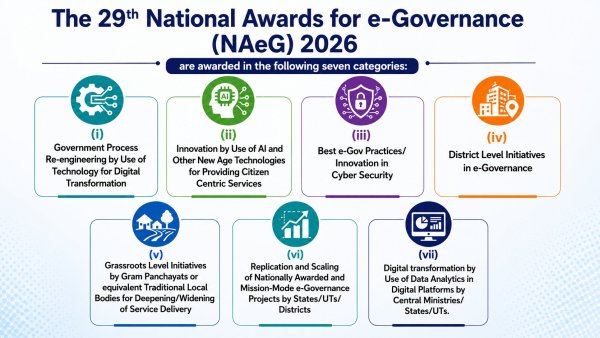
— The Union government has named 17 projects of the Central, state, and local governments across the country as the winners of the National Awards for e-Governance (NAeG).
— Ten projects would be given the Gold Award, six would be awarded the Silver Award, and one Jury Award during the 29th National Conference on e-Governance (July 1-2, 2026) in Jaipur, Rajasthan.
— The theme of this year’s conference, “Viksit Bharat 2047: AI-Enabled, Data-Driven and Secure Digital Governance.”
Story continues below this ad
— NAeG Awards are presented every year to recognise and promote excellence in the implementation of e-Governance initiatives by the Department of Administrative Reforms and Public Grievances (DAR&PG), Government of India. These awards have been given since 2003.
— The winners of this year include the Agriculture Ministry’s platform for farmers, known as Agri Stack; the Consumer Affairs Ministry’s e-Jagriti platform for filing complaints; Panchayat Advancement Index (PAI) of the Ministry of Panchayati Raj and the Prayagraj Mela Authority’s conduct of the Mahakumbh 2025.
International Cooperation
— External Affairs Minister S Jaishankar and his Indonesian counterpart Sugiono held bilateral talks on 7th June as the two nations agreed to advance cooperation in defence, maritime security, digital connectivity and infrastructure.
— Jaishankar co-chaired the 8th India-Indonesia Joint Commission Meeting with Sugiono in New Delhi.
Story continues below this ad
— From the struggle against colonial powers, democratic traditions and pluralist culture, India & Indonesia share deep linkages. Independent India and Indonesia became chief votaries of the independence of Asian and African countries, the spirit of which led to the Bandung Conference of 1955 and later formation of NAM in 1961. Indonesia is a key pillar of India’s Act East Policy.
— India and Nepal completed the internal processes to enforce the mutual legal assistance pact to tackle “cross-border crimes”, as the visiting Foreign Minister of Nepal, Shishir Khanal, met External Affairs Minister S Jaishankar.
— This is the first official visit by the Nepalese Foreign minister after the new government led by PM Balendra Shah assumed office in March this year.
— Both Ministers welcomed the completion of internal processes for entry into force of the India-Nepal Mutual Legal Assistance Agreement in Criminal Matters (MLAA).
Story continues below this ad
— This Agreement will benefit the people of India and Nepal by providing an institutional legal framework to enhance the effectiveness of investigation, prosecution and judicial proceedings relating to cross-border crimes.
— The ministers jointly launched the Peer-to-Peer (P2P) linkage between Unified Payments Interface (UPI) of India and National Payments Interface (NPI) of Nepal for facilitating cross-border personal remittances, the MEA said.
Environment
— According to the third synchronised population estimation conducted in April 2026, the Nilgiri Tahr population has increased to 1,364, showing a 4.68 per cent increase over last year.
— The Nilgiri Tahr (Nilgiritragus hylocrius) inhabits the verdant sub-alpine grasslands of the Western Ghats in Tamil Nadu and Kerala, and it plays a vital role in nutrient cycling in the high-altitude mountain ecosystem
— Nilgiri Tahr is the state animal of Tamil Nadu. It is listed as Endangered in the IUCN Red List of Threatened Species and is protected under Schedule I of the Wildlife (Protection) Act of India, 1972.
— It is a distinctive, mountain-dwelling ungulate endemic to the Western Ghats of southern India. It is one of only three extant Tahr species globally – alongside the Himalayan Tahr (Hemitragus jemlahicus) and the Arabian Tahr (Arabitragus jayakari) – and the only one restricted entirely to the Indian subcontinent.
— With its specialized adaptation to grasslands close to crags and sheer cliffs, the Nilgiri Tahr serves as a flagship species for the high-elevation habitats of the Western Ghats.
 Infographic created by NotebookLM
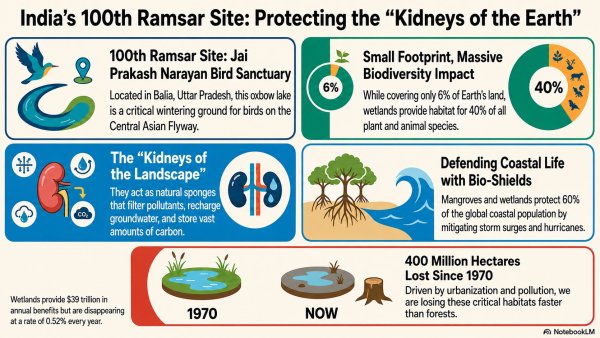
— On the occasion of World Environment Day, Prime Minister Narendra Modi announced on X the addition of India’s 100th Ramsar site – Jai Prakash Narayan Bird Sanctuary (Surha Tal) in Ballia, Uttar Pradesh, to the list of Wetlands of International Importance.
— In 1991, ‘Surha Taal’ was created with the consolidation of the land area of 45 villages of Baansdih in Ballia town area, aggregating to a total of 3432.93 hectares area. In 2002, its name was changed to “Jai Prakash Narain Bird Sanctuary”.
— It is situated a distance of 10 kms away from the Ballia City area, stretching up to Bhikampur village to its west, Singhauli in the north-east and bounded by Dulwara Village in the south-east direction. It falls under the jurisdiction of Ballia and Baansdih town area.
— Surah Taal is a natural perennial oxbow lake (also called a meander lake) which serves as a critical wintering ground for avian species traveling along the Central Asian Flyway. According to UP Eco tourism, it is also a major source of irrigation and groundwater recharge, supporting both wildlife and the nearby farming landscape.
— The Union Cabinet has approved a two-year clean mobility scheme to reduce air pollution in the Delhi-National Capital Region (NCR).
— It will incentivise replacement of older trucks and buses with BS-VI or stricter emission-compliant vehicles. Government vehicles will be excluded from this scheme.
— Bharat Stage emission norms are India’s standards for regulating pollution from motor vehicles. They set legal limits on exhaust emissions of pollutants such as carbon monoxide, hydrocarbons, nitrogen oxides and particulate matter.
— Each successive BS tightens these limits, pushing manufacturers to adopt cleaner engine technologies, better exhaust treatment systems and cleaner fuel.
— The BS IV norms have been enforced across the country since April 2017. In 2016, the Centre had announced that the country would skip the BS-V norms altogether and adopt BS-VI norms by 2020.
— The main difference between BS-IV and BS-VI (which is comparable to Euro 6) is in the amount of sulphur in the fuel. BS-VI fuel is estimated to bring around an 80% reduction in sulphur content — from 50 parts per million (ppm) to 10 ppm.
— Under the BS-VI regime, full modern exhaust after-treatment systems (technologies fitted to a vehicle’s exhaust), such as diesel particulate filters (DPFs) and selective catalytic reduction (SCR) units, are mandatory. These systems function as filters and chemical reactors within the exhaust stream, breaking down or trapping harmful gases and particles before they are released into the air.
Science and Technology
— In a major operation, the Sakinaka police busted an illegal mephedrone manufacturing unit in Gujarat and seized contraband worth nearly Rs 75 crore.
— Mephedrone, which has various street names such Meow Meow, White Magic, M-Cat and Drone, is a synthetically manufactured stimulant of the amphetamine and cathinone category.
— According to the laboratory and scientific services portal of United Nations Office on Drugs and Crime (UNODC), “Cathinone, the principal active ingredient in leaves of the khat plant also known as catha edulis, can be considered as the prototype from which a range of synthetic cathinones have been developed.”
— As Bihar approaches a decade of alcohol prohibition, codeine cough syrups have surged as a cheap substitute, with seizures and addiction cases rising, especially among youngsters and in rural areas.
— Codeine is a naturally occurring opioid derived from morphine, a compound found in the opium poppy.
— Used primarily as a cough suppressant, it is found in various medicines, particularly cough syrups, where it works by suppressing the brain’s cough centre.
— It is commonly prescribed for upper respiratory infections or chronic conditions like bronchitis, which cause persistent dry coughs. However, it is not the first-line treatment for the common cold.
— In response to the rising misuse, Bihar tightened the regulation of codeine syrups by designating them as “intoxicants” under the Bihar Prohibition and Excise Act in 2016. This designation restricts sale and possession without a permit, with penalties including fines, confiscation of goods, and imprisonment.
 Infographics created by NotebookLM
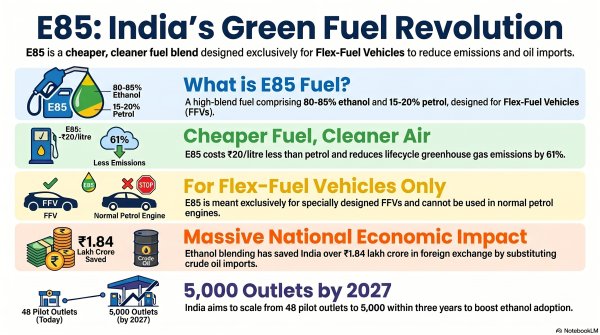
— India’s largest carmaker, Maruti Suzuki India has launched the WagonR Flex Fuel, billed as the country’s first mass-market flex-fuel passenger car, marking a significant step in India’s push towards alternative fuels. On June 5, Union Petroleum and Natural Gas Minister Hardeep Singh Puri launched the “E85 fuel” at a retail fuel outlet in New Delhi.
— The car is capable of running on pure ethanol (E100), although it has been homologated to run on E85 fuel—85% ethanol and 15% petrol.
— Technically, it means the car can run on various fuel blends, from E20 to E100, but given that approved standards in India are up to E85, the car has been certified to use ethanol blend of up to 85%.
— Flex-fuel vehicles are equipped with modified internal combustion engines that can run on petrol, ethanol, or any combination of the two without requiring manual adjustments by the driver. Sensors in the vehicle detect the fuel blend and automatically alter engine settings such as fuel injection and ignition timing to ensure optimal performance.
— NITI Aayog officially classifies ethanol-based Flex-Fuel Vehicles (FFVs), including vehicles running on high ethanol blends such as E85, as Zero-Emission Vehicles.
— According to the government, ethanol blending in petrol has increased from less than 1.5% in 2013-14 to 20% in 2025-26, achieving the 20% blending aim five years ahead of schedule.
| Ethanol
Ethanol, or ethyl alcohol, is a liquid that has several uses. At 95% purity, it is called rectified spirit and is used as the intoxicating ingredient in alcoholic beverages. At 99%-plus purity, ethanol is used for blending with petrol. It is a common type of biofuel, a renewable fuel derived from biomass, from plants or agricultural, animal, domestic, and industrial biowaste. Biofuels are significantly cleaner than conventional fossil fuels, though lifecycle impacts vary based on feedstock and production methods. Read more about India’s Ethanol drive here. |
— US artificial intelligence company Anthropic is extending access to its closely guarded cybersecurity initiative, Project Glasswing, to a select set of organisations in India, including key government entities.
— Under the programme, vetted organisations are granted access to Claude Mythos Preview, an unreleased AI model that Anthropic says is capable of identifying critical software vulnerabilities at a level that could fundamentally alter the balance between cyber attackers and defenders.
— Mythos is part of a new generation of large AI systems that sit above Anthropic’s existing flagship models in terms of reasoning, coding ability and problem-solving. Internally described as a “step change” in capability, the system is designed to analyse software, understand complex codebases and identify security weaknesses with minimal human supervision.
— AI model Mythos can detect critical software vulnerabilities. This matters for India as it shields vital infrastructure like banking and power, even as Anthropic battles the US Pentagon over boundaries of AI misuse.
Persons in News
— The executive council of Bhopal’s Barkatullah University has passed a proposal to change its name to Vagdevi Bhojpal University.
— Maulana Barkatullah Bhopali was a freedom fighter and the ‘first prime minister of independent India’, as he, along with some associates, most notably Raja Mahendra Pratap, set up India’s first ‘government in exile’ in Kabul in 1915. This was one of the first times that Indians had set up their own independent political body outside British control.
— Maulana Barkatullah is believed to have been born on July 7, 1854, in Bhopal. A meritorious student, he went to Bombay and then London for studies. He then started teaching in Liverpool, where he came into contact with Indian revolutionaries.
— Barkatullah firmly believed that the British could be driven out of India only if Hindus and Muslims fought shoulder to shoulder and resisted the divide-and-rule ploy.
— Four years later, the leaders of this ‘government’ travelled to Moscow to meet Vladimir Lenin, the head of government of Soviet Russia.
— After the British victory in the First World War, the Indian revolutionaries’ plans suffered major reverses. However, Barkatullah kept travelling, to Brussels, Switzerland, France, etc., working for his cause.
— In 1927, despite his failing health, he travelled to California in the US for a Ghadar Party event. This is where, in September 1927, he breathed his last. He was laid to rest in Sacramento, with Raja Mahendra Pratap by his side till the end.
— South Korean President Lee Jae Myung has chosen Han Seong-sook, the country’s Minister for small and midsize businesses and startups, to be Prime Minister of the country.
— If approved by Parliament, Ms. Han would become South Korea’s first female Prime Minister in 20 years.
— Marjane Satrapi, the Iranian-French graphic novelist and filmmaker, died at the age of 56. She is best known for her autobiographical graphic novel Persepolis, which she later directed as a film.
— Satrapi, born in 1969 in Rasht in northern Iran, was from a long line of Iranian aristocrats.
— In 1983, her parents – politically active Marxists who participated in demonstrations against the shah – sent her to Austria to finish her studies as the 1979 Iranian revolution brought Ayatollah Ruhollah Khomeini to power, along with growing religious fundamentalism.
— She returned home due to homesickness and attended the University of Tehran, obtaining a degree in visual communications, which would lay the foundation for her artistic path, before leaving once more in 1994 for France.
Places in News
(Just FYI: The location of the place is important, considering that UPSC has asked several questions about places that were in the news, such as Aleppo and Kirkuk, in the 2018 UPSC Prelims. The best way to remember them is to plot them on a world map.)
— Mount Everest’s highest camp – Camp IV- has once again come under scrutiny after a viral video revealed large amounts of waste scattered across the snow-covered site.
— Located on the South Col between Mount Everest and Lhotse, Camp IV sits at an altitude of around 26,000 feet. It serves as the last resting point before climbers enter the notorious “Death Zone” on their way to Everest’s 29,032-foot peak.
Sports
(Just FYI: With the unpredictability of the UPSC Prelims like the question Grand Slam in this year prelims, you can’t be sure of anything. It is wise to know what it is and not go into too much detail.)

— Trionda is the name of this World Cup edition football, designed by Adidas (official sponsor). The ball needs to be charged for 90 minutes for six hours of play. This is because it contains a sensor inside — something Adidas first adopted with the Al Rihla ball used at the 2022 World Cup in Qatar. This is how “connected ball technology” works.
— It has the lowest number of panels ever used to make a football. And, unlike the mercurial Jabulani ball used during the 2010 World Cup, it promises far fewer surprises than what many players had to contend with in South Africa.
— The Trionda has a 500 hz ‘inertial measurement unit’ motion sensor inside one of its four panels, with counterbalances placed on all other panels as well to ensure that its flight remains true. An inertial measurement unit measures and reports an object’s specific force, orientation, and how fast it rotates or revolves around an axis.
— The sensor will be complemented by pitchside sensors, which track player movements. FIFA has also chosen to scan each footballer at the tournament, and VAR will also use a 3D digital avatar of the player.
— Combine all this information gathered — add AI to the mix — and FIFA and Adidas believe there lies a path to issuing lightning-fast offside calls and other VAR checks like accidental handballs and accurate player tracking.
— The 2026 FIFA World Cup will start on June 11. The game is being hosted bythree hosts: Canada, Mexico, and the US.
— Mirra Andreeva (Russian) defeated Maja Chwalinska (Polish) in the French Open final in straight sets to clinch her maiden Grand Slam title.
— Mirra Andreeva, 19 years old, became the youngest player to win the women’s singles title since Monica Seles in 1992.
— The French Open called Roland Garros, is played on clay soil. It is one of the four Grand Slams.
— The Australian Open, French Open, Wimbledon and US Open are considered a notch above regular tour events. They are jointly called Grand Slam tournaments.
Winners of the French Open 2026
 Praggnanandhaa contemplates his next move against Magnus Carlsen in Round 8 of Norway Chess. (Michal Walusza / Norway Chess)
—Bibisara Assaubayeva from Kazakhstan won the Norway Chess Women’s tournament, and R Praggnanandhaa won the Norway Chess tournament.
— The event Norway Chess featured two elite tournaments running in parallel: the renowned Norway Chess and Norway Chess Women. Both competitions followed a 6-player double round-robin format with equal prize funds, highlighting a strong commitment to gender equality in chess.
— A signature of Norway Chess is its distinctive scoring format. When a classical game ends in a draw, an Armageddon game determines the winner, ensuring decisive results in every round.
Test Your Knowledge
(Note: The best way to remember facts for UPSC and other competitive exams is to recall them through MCQs. Try to solve the following questions on your own.)
(1) Consider the following statements about the Index of Industrial Production (IIP):
1. Released by the Ministry of Statistics and Programme Implementation (MoSPI).
2. The new base year is 2023-24.
3. The highest weightage is for Mining & Quarrying.
Which of the statements mentioned above is/are correct?
(a) 1 only
(b) 2 and 3 only
(c) 2 only
(d) 1 and 3 only
(2) “If rainforests and tropical forests are the lungs of the Earth, then surely wetlands function as its kidneys.” Which one of the following functions of wetlands best reflects the above statement? (UPSC CSE 2022)
(a) The water cycle in wetlands involves surface runoff, subsoil percolation and evaporation.
(b) Algae form the nutrient base upon which fish, crustaceans, molluscs, birds, reptiles and mammals thrive.
(c) Wetlands play a vital role in maintaining sedimentation balance and Soil stabilization.
(d) Aquatic plants absorb heavy metals and excess nutrients.
| Prelims Answer Key |
| 1. (a) 2. (d) |
For your suggestions and feedback, write to khushboo.kumari@indianexpress.com
Subscribe to our UPSC newsletter. Stay updated with the latest UPSC articles by joining our Telegram channel – IndianExpress UPSC Hub, and follow us on Instagram and X.
🚨 Click Here to read the UPSC Essentials magazine for May 2026. Share your views and suggestions in the comment box or at manas.srivastava@indianexpress.com🚨

