

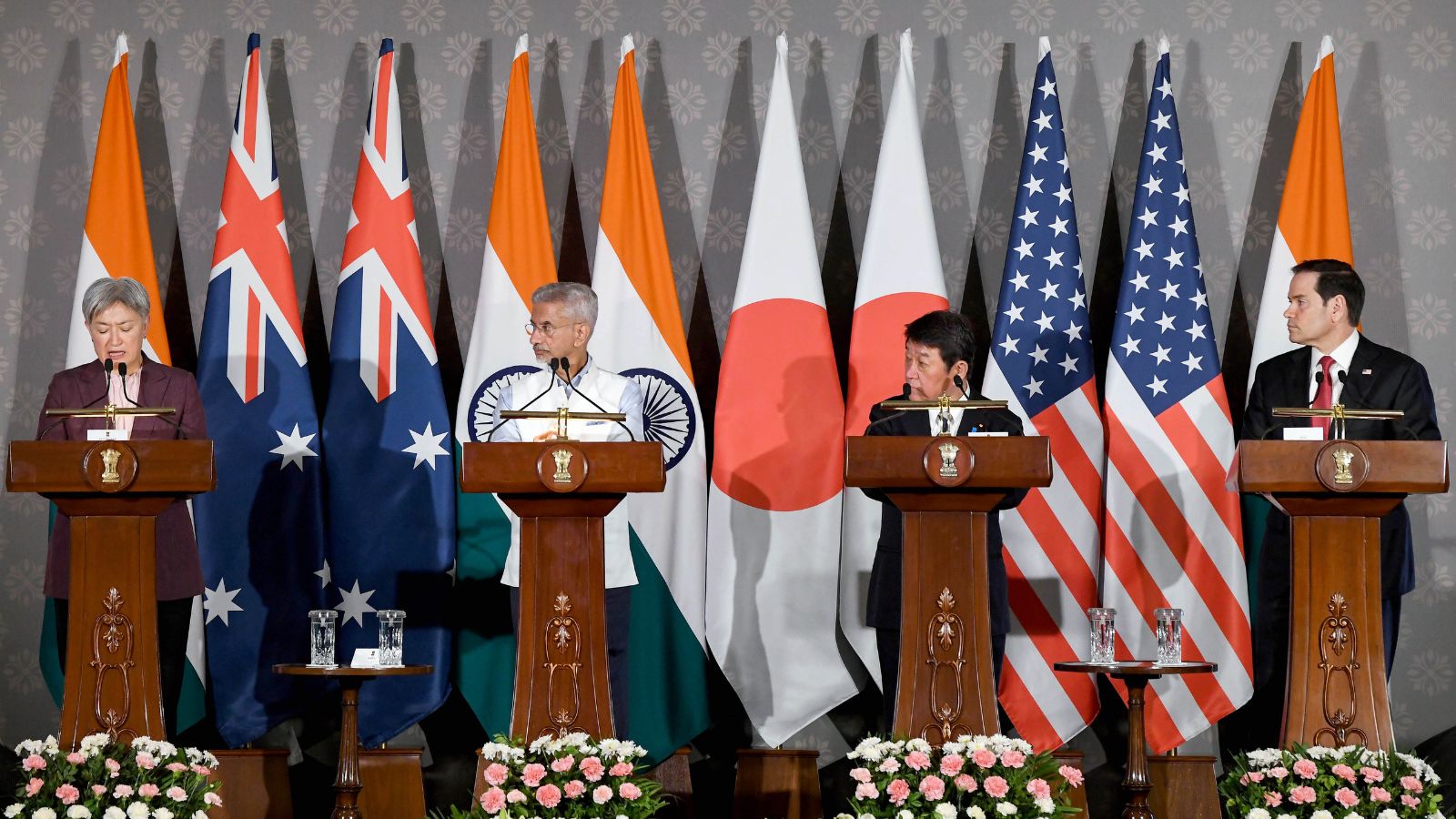
The foreign ministers of the Quadrilateral Security Dialogue (Quad), comprising India, the United States, Australia, and Japan, met Tuesday at Hyderabad House in New Delhi to align strategic perceptions and launch a series of major initiatives spanning maritime surveillance, port infrastructure, critical minerals, and regional energy security.
External Affairs Minister S Jaishankar, who chaired the session, stated that the four maritime democracies devoted a large part of their bilateral exchanges to analysing the “current state of the world,” with a specific focus on issues of particular relevance to the Indo-Pacific.
The meeting yielded what US Secretary of State Marco Rubio described as “real concrete achievables”, highlighting a transformation of the Quad into a “partnership of action”.
Chief among the announcements was the launch of the Indo-Pacific Maritime Surveillance Corporation initiative, designed to leverage each member country’s surveillance capabilities to enhance information sharing. This is accompanied by the expansion of the Indo-Pacific Maritime Domain Awareness Initiative, which provides near-real-time commercial tracking data to countries across the region.
The Quad also unveiled its first-ever joint port infrastructure project under the Quad Ports of the Future Partnership. The partners announced a pilot project to advance port infrastructure in Fiji to directly address insufficient port capacity in the Pacific Islands. Addressing economic volatility and trade vulnerabilities, the ministers launched the Quad Critical Minerals Initiative framework.
“We naturally focused on issues of particular relevance to the Indo-Pacific, because we are four maritime democracies located at different ends of the Indo-Pacific. The exchange of perspectives was an exercise of considerable value,” said Jaishankar.
“The maritime domain has seen a steady expansion of collaboration, including surveillance and domain awareness, logistics network, undersea cables training capacity building and HADR activities. We will be continuing to deepen these areas in the times ahead,” he added.
Story continues below this ad
Without mentioning the Strait of Hormuz, he said, “We spent some time on the question of safe and unimpeded maritime commerce and reaffirmed the significance of scrupulously observing international law.”
“Our four nations are also market economies. We believe strongly that economic resilience should be promoted, that the supply chain should be strengthened, trusted and secure technologies diffused, and production capacities enhanced. Our deliberations touched on the current energy and fertiliser availability, as well as that of critical minerals and resources. The goal is to intensify cooperation among ourselves while also assisting others. We, the Quad nations, are open societies that foster innovation and creativity in our quest for growth and prosperity,” he said.
Rubio said the Quad countries represent roughly a third of the world’s GDP and are home to nearly 2 billion people. These nations share strong values and are vibrant democracies, committed to similar concepts of economic development and they also have many aligned interests in this area, he added.
“We all agreed that we wanted this gathering, this partnership, to be more than just a place where we got together every now and then, and discussed the problems of the world that we held in common, but a place of action, a form of action where we can begin to turn our collective interests into action, to the benefit of the people of our countries,” he said.
Story continues below this ad
“But ultimately to the benefit of many other countries who around the world who would benefit from some of the things we’re working on today, and I’m very happy today that as a result of the work that our teams have been doing leading up to this conversation today, and our conversations today, we have real concrete achievables that we can announce to our respective countries and to the world on the issue of maritime security,” Rubio added.
Rubio said there are two “big announcements”. “The first is the launch of the Indo-Pacific Maritime Surveillance Corporation initiative, which is going to leverage each of our country’s maritime surveillance capabilities in the Indo-Pacific to enhance information sharing.”
“Related to that is also the expansion of the Indo-Pacific Maritime Domain Awareness Initiative, which provides and can provide near real-time commercial maritime domain awareness data to countries throughout the India, throughout the Indo-Pacific, and, and last, I also want to thank India for committing to hosting the next iteration of the Quad at Sea Mission, which brings together our respective coast guards together in one place on one ship, and the reason why maritime security is so important, beyond the fact that current events remind us of what can happen when maritime security is impeded, is the fact that 60% of global maritime trade passes through the Indo-Pacific, and it’s a vital national interest, not just to the four countries represented here today, but to dozens and dozens of countries, countless countries around the world,” he said.
The second initiative, he said, “is an exciting one, and that is that we’re going to be partnering on issues of port infrastructure, in particular in response to insufficient port capacity in the Pacific Islands.”
Story continues below this ad
“We’re announcing plans to work with Fiji to advance that country’s port infrastructure. It’ll be the first time that the Quad partners work together on a project on a port infrastructure project.” “We believe it will be very successful, and that it will serve as a model for other projects in the future,” he said.
Securing critical supply chains
Rubio said that the third topic is the issue of critical minerals. “We’ll announce the Quad Critical Minerals framework, which will guide each of us to leverage economic policy tools and coordinate investment to strengthen critical mineral supply chains, including in mining and processing, and in critical minerals recycling,” he said.
Finally, on energy and fuel security, Rubio said, “We’ll be announcing the Quad initiative on Indo-Pacific energy security that will help strengthen regional energy resilience, and through this initiative the partners will work to identify areas of cooperation and technology and management and policy and international market analysis and emergency response exercises. We want, we’ll be releasing a standalone statement on this initiative, and the Department of Energy from the United States will be hosting Quad partners later this year for a fuel security forum to further expand on this.”
“We are deeply committed to this partnership. It is a linchpin and a cornerstone of our global strategy as a nation in the United States,” Rubio said.
Story continues below this ad
Australian Foreign Minister Penny Wong said, “We recognise our obligation, our responsibility to provide real choices, particularly as strategic circumstances in our region are deteriorating. The region is facing acute economic stress. We know the world is more unpredictable. We know economic volatility is increasing, and we know the consequences for our region of the Iranian closure of the Strait of Hormuz, and what that means for our energy security, for our economies and for our people.”
“We recognise the efforts of Secretary Rubio towards a diplomatic resolution to ensure freedom of navigation is restored and crucial energy supply flow, and we recognise the importance of maintaining the principle of freedom of navigation and our opposition to any tolling proposition,” she said.
“We are today announcing the strongest ever commitment from the Quad to the Pacific through the Quad Ports of the Future Partnership, where we are launching a pilot for port infrastructure in Fiji, and I was in Fiji just a couple of weeks ago, and I know how important this will be to that country. It’s a practical demonstration of our collective ability to deliver high-quality, resilient infrastructure in partnership with the region, and in response to Pacific priorities. In addition, we are focusing on what more we can do to assure a transparent, more secure maritime domain in the Indo-Pacific.”, she said.
“This is the context in which freedom of navigation and strategic stability can be operationalised, and you are seeing that we will be coordinating our maritime surveillance efforts, initially in the Indian Ocean and at Exercise Malabar, through the Indo-Pacific Maritime Surveillance Collaboration Initiative, and we are also expanding the Domain Awareness Initiative to the Indian Ocean. This will enable partners to access near real-time unclassified satellite tracking data to combat illegal fishing trafficking, and also enable us to better support humanitarian disaster response,” she said.
Story continues below this ad
“We know we are stronger when we work together. We know we work better in partnership across our region, and we work best by listening to the priorities of our region and delivering practical outcomes to make a difference to our people’s lives,” Wong said.
Developing resilience and strengthening capacity
Japanese Foreign Minister Toshimitsu Motegi said, “Today’s meeting gave us a good opportunity to send an unswerving and unshaken message that the Quad will advance the necessary concrete cooperation for Free and Open Indo Pacific…We were able to align our strategic perceptions on regional developments and agreed to strongly oppose attempts to unilaterally change the status quo by force or coercion. We shared deep concern over the export restrictions of critical minerals and others as well. We discussed the North Korean situation, including nuclear and missile problems and cyber activities, reaffirmed our commitment towards complete denuclearisation of North Korea, and received support from the other three countries aiming to bring an immediate solution to the abduction issue.”
“Moreover, as the Iranian situation imposes an enormous impact on the Indo-Pacific region energy supply viewpoint included. We confirmed the importance of diplomatic efforts in ensuring free and safe navigation in the Strait of Hormuz, as well as stability to be brought to the Middle East. The energy security initiative to secure a stable supply of energy in the Indo-Pacific region is a timely initiative. We would like to partner it with Power Asia, a cooperation framework for procurement of crude oil and petroleum products that Japan is promoting,” Motegi said.
The Japanese Foreign Minister said, “The Critical Minerals Initiative framework launched today is a very important initiative from the perspective of strengthening the supply chain of critical minerals, and we will proceed with concrete cooperation in this way. Today, we have agreed to promote various cooperation projects. We would like to work together among Quad to develop resilience and strengthen capacity to determine their own paths in the region and to promote cooperation that truly benefits this region.”
Story continues below this ad
Jaishankar also flagged the issue of countering terrorism. “As democratic nations, we also devoted attention to countering the common threat of terrorism. There must be zero tolerance for terrorism and nations subject to terrorist attacks have the right to defend themselves.”

