

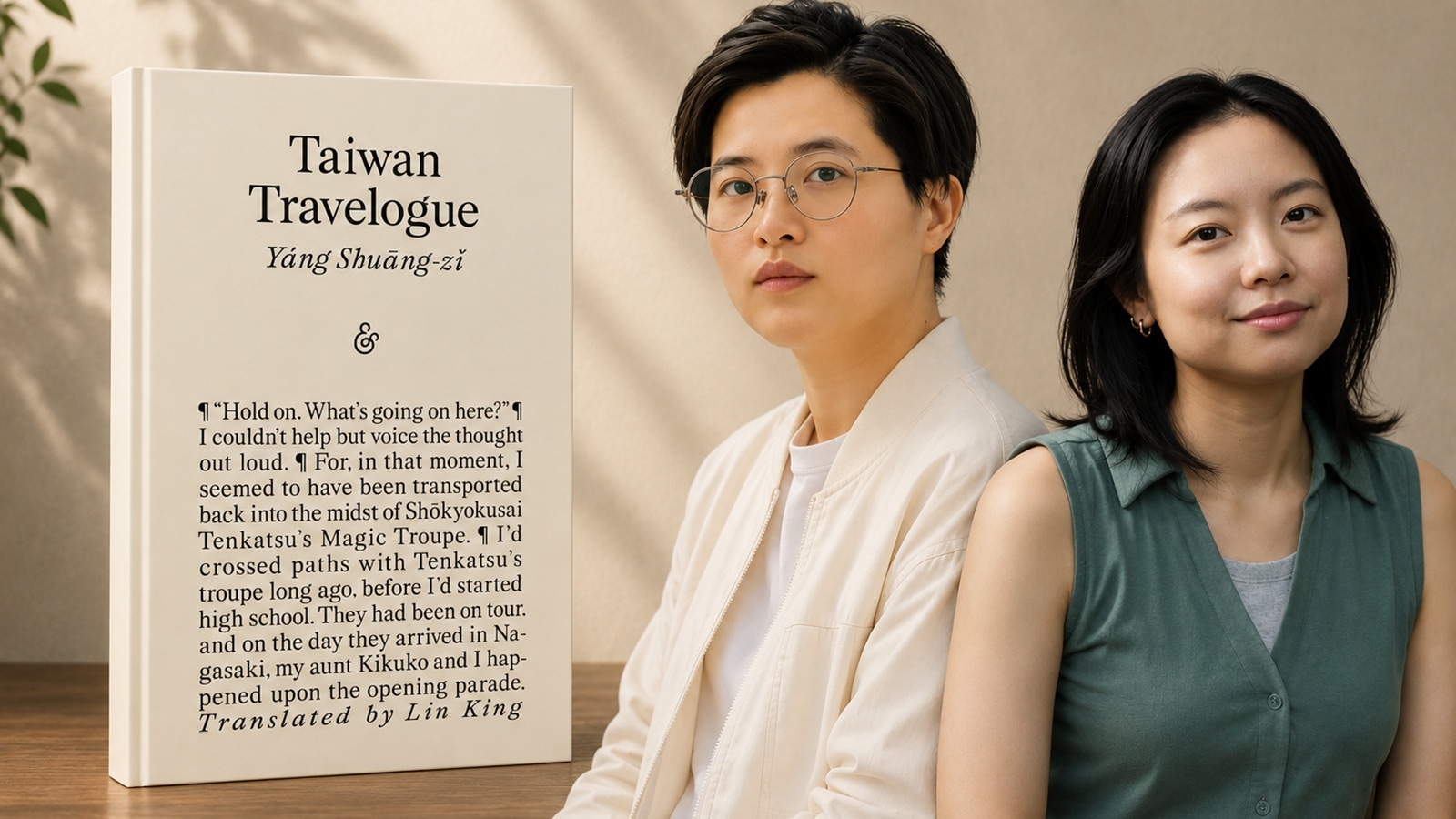
A novel about a Japanese writer who falls in love with her Taiwanese interpreter while touring a colonised island in the 1930s won the 2016 International Booker Prize, claiming one of literature’s most coveted honours for translated fiction for the first time for a Taiwanese author.
The book, Taiwan Travelogue by Yáng Shuāng-zǐ and translated by Lin King, was announced as the winner at a ceremony at Tate Modern. The £50,000 (approximately Rs 65 lakh) prize, which is divided equally between author and translator, was presented by Natasha Brown.
“We’re living through times when it can seem like nuance is in short supply,” Brown said while presenting the award. “Times when empathy, understanding and even basic human decency is often cast as weakness. Books, I think, offer an antidote. They’re these little empathy machines.” She called the winning book “a shining example of nuanced, layered, sumptuous storytelling.”
Taiwan Travelogue is the first book translated from Mandarin Chinese to win the International Booker Prize, and Yáng and King are the first Taiwanese and Taiwanese-American winners in the prize’s history.
A novel of disguises
Disguised as a translation of a rediscovered Japanese travel memoir, Taiwan Travelogue follows Aoyama Chizuko, a young Japanese novelist who arrives in colonial Taiwan in May 1938, invited by the imperial government but entirely uninterested in its agenda. What she wants is the food, the landscape, and, increasingly, urgently, her Taiwanese interpreter, Chizuru.
Over scenic train rides and braised pork rice, lively banter and winter melon tea, Chizuko grows infatuated, but Chizuru keeps her distance. The novel’s heartbreak lies in understanding why.
“Can love overcome a power imbalance?” Brown asked in the judges’ citation. She called it “a captivating, slyly sophisticated novel” that succeeds simultaneously as a romance and as a postcolonial reckoning, adding that Lin King’s translation “perfectly conveys the nuances of the novel’s narrative voices.”
Story continues below this ad
Literature cannot be kept separate from the soil: Yáng
 Author Yáng Shuāng-zǐ with translator Lin King. (Source: David Parry for Booker Prize Foundation)
Accepting the prize, Yáng spoke directly about the relationship between literature and politics, and about what it means to write from Taiwan. “Some people believe that art and literature must be kept far from politics,” she said. “But I am of the belief that literature cannot be kept separate from the soil in which it has grown.”
She placed her novel within a longer tradition of Taiwanese writing grappling with questions of identity and sovereignty. “Taiwan’s people have endured multiple colonial regimes and faced threats of invasion,” she said. “When confronted by a geopolitical force so much greater than our own, what use do we have for literature? But I have always believed that literature wields power. Literature appears slow, but it acts with steady result.”
She dedicated her closing words to her homeland. “The centuries-old creed in Taiwanese literature is in fact the century-old pursuit of freedom and equality by Taiwan’s people,” she said. “I feel very fortunate to have been born Taiwanese. I feel very proud to stand before you today as a writer from Taiwan.”
‘The juicy bits’
Lin King, who had initially expected the book to find only “a very small and very niche readership,” delivered what may have been the evening’s most charged speech. She revealed that in 2022, following Russia’s invasion of Ukraine, she made a deliberate decision to translate only writing from Taiwan. “I will continue to do so,” she said, “until the day comes that my homeland’s sovereignty is no longer a provocation or a punchline.”
Story continues below this ad
She described Taiwan Travelogue as a conscious challenge to publishing convention, specifically, the industry assumption that translators are best when invisible. The English edition, with its layers of footnotes, multiple pronunciation systems, and competing narrative voices, was designed to refuse simplification. “It demands much attention and work from the reader precisely because it refuses to simplify Taiwan’s multilingual, multicultural and multi-ethnic reality,” she said.
King also disclosed that there had been a lengthy gap between the book’s American and British publication dates because no British publisher was willing to put the translator’s name on the cover. “Not until And Other Stories came to the rescue,” she said.
In the United States, she said, while concluding , orange juice is sold as either “no pulp” or “with pulp.” She had recently learned that in Britain, it is either “smooth” or “with juicy bits.” “I hope we can all start thinking of translation not as the pulp,” she said, “but as the juicy bits, and proudly labelling it so on the carton.”
A historic win for an Independent publisher
The novel is published in the United Kingdom by And Other Stories, the Sheffield-based independent press, which won the prize last year with Heart Lamp by Banu Mushtaq, translated by Deepa Bhasthi. It is the publisher’s second win in as many years and their seventh nomination overall.
Story continues below this ad
Taiwan Travelogue has already had a remarkable run. First published in Mandarin in 2020, it won Taiwan’s highest literary honour, the Golden Tripod Award. Lin King’s English translation won the National Book Award for Literature in Translation in 2024, a first for Taiwanese literature. The novel has since been translated into more than a dozen languages.
The shortlist
Taiwan Travelogue was chosen from a shortlist of six books drawn from 128 submissions across five languages and eight nationalities, one of the most geographically and thematically ambitious in the prize’s history. The other finalists were The Nights Are Quiet in Tehran by Shida Bazyar, translated by Ruth Martin; The Director by Daniel Kehlmann, translated by Ross Benjamin; She Who Remains by Rene Karabash, translated by Izidora Angel; The Witch by Marie NDiaye, translated by Jordan Stump; and On Earth As It Is Beneath by Ana Paula Maia, translated by Padma Viswanathan. Five of the six shortlisted authors and four of the six translators were women.
The International Booker Prize, now in its 10th year in its current form, has become one of the most reliable indicators of enduring literary significance. Four of its previous honourees, including Han Kang, Jon Fosse, Annie Ernaux and Olga Tokarczuk have gone on to win the Nobel Prize in Literature. The £50,000 prize is divided equally between author and translator.

