

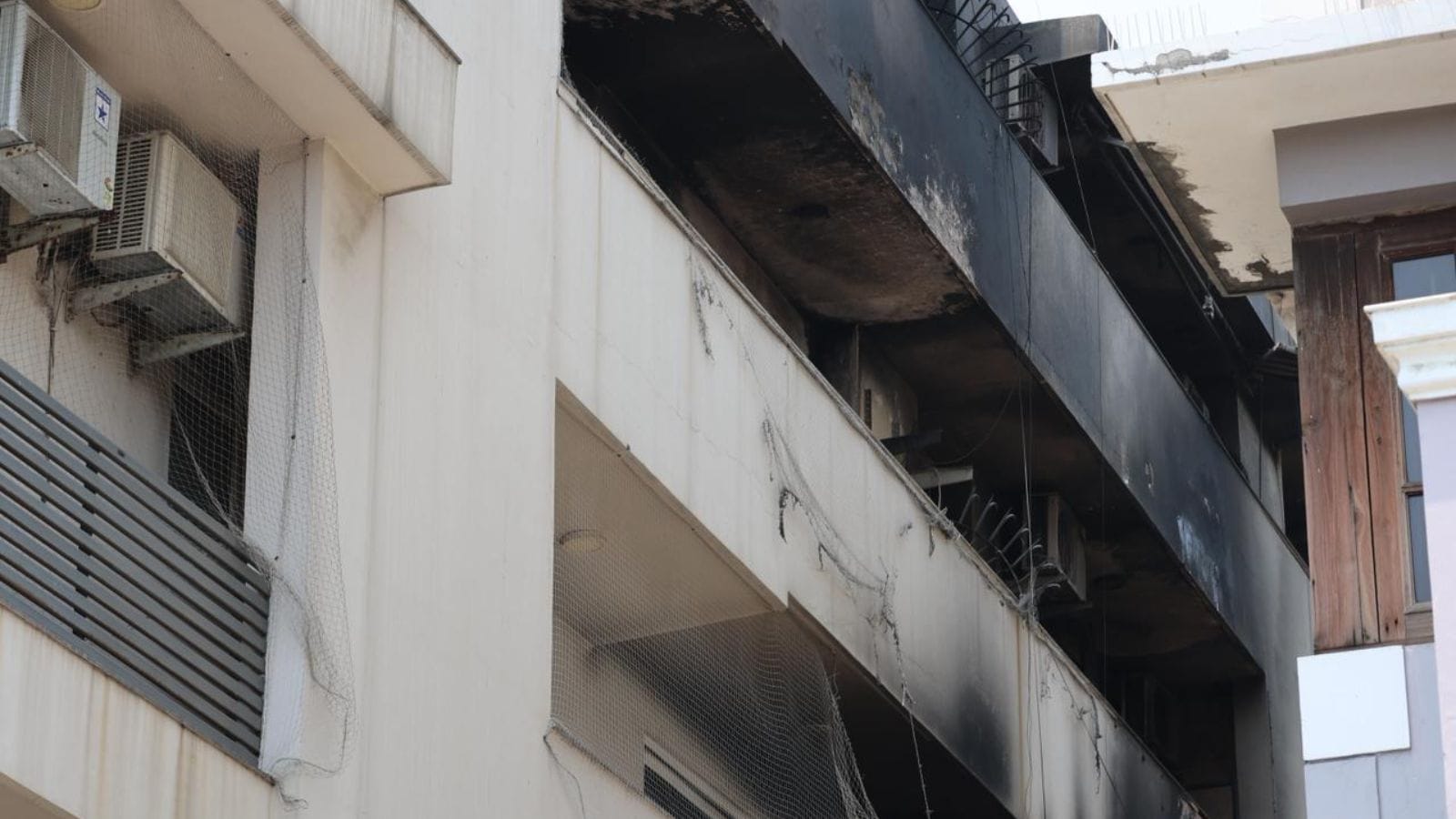
In the lanes of Vivek Vihar in East Delhi, where buildings are packed tightly enough to share both light and shadows, the early hours of Sunday were broken by screams. From the first-floor balcony of the home where he has lived since 1984, Gurdeep Singh Gill watched the fire begin around 3.30 am. It was a flicker on the second floor of a neighbouring building which, within minutes, turned into something else entirely.
“There was no space for people to get out,” Gill said hours later, standing outside the four-storey, nine-year-old building where the tragedy had struck.
At the time of the incident, the residents were asleep when the fire broke out in a second-floor flat on the rear side of the building. Initial findings suggest that the fire may have been caused by a short circuit in the AC in that flat.
When the fire brought flames, smoke and panic, the incremental additions to the structure, to grab space to dry clothes or keep potted plants, became life-and-death barriers.
From Gill’s balcony, he watched the second floor disappear behind smoke. Within half an hour, he said, the fire had cut off the only escape route for those on the higher floors – the stairs that lead up to the terrace.
The neighbourhood was ringing with voices — the screams of terrified children, wails of traumatised victims, shouted instructions from those who had gathered. Gill said he ran to fetch a pipe and aimed a jet of water upwards from his balcony at the flames.
But the heat pushed him back. “It was so hot,” he said.
Story continues below this ad
Inside the burning building, the panic was rising quickly. Two teenage girls were trapped on the second floor. Gill said he joined others below to drag mattresses into position, laying them out in the hope of cushioning the fall, should they choose to jump. Rescuers worked to cut through the grills so that people could slip through.
“We managed to cut a part of the metal to make space for people to come out. Three people could be taken out through the opening; two others jumped,” Gill said.
The family of Arvind Jain lived on the second floor. His wife and daughter were caught inside. The wife would not come out; she seemed either too terrified or was incapable, Gill said.
By then, the smoke was so thick that nothing could be seen. The building had effectively vanished behind a dark, acrid, choking, swirling screen. “No one on the third floor was visible,” Gill said.
Story continues below this ad
The Fire Brigade had arrived, but the firemen found their task had been made difficult by the additions that had been made to the building over the years.
“The residents were stuck in the back of the building,” Gill said. Firemen had access from the front, but the rear, where the fire was raging, had been blocked by the very features that residents had added over time. “If they weren’t there, maybe some lives could have been saved,” Gill said.
Manik Malhotra, an IT professional who lives in the neighbourhood, said he reached the building around 4 am. By then the fire, which had begun on the second floor, had engulfed the third floor and was licking at the fourth. The first floor, Malhotra said, was largely intact.
It was evident that the dense layers of grills and plastic netting at the back of the building were making the crisis worse.
Story continues below this ad
“There was a 4-inch gap,” Malhotra said. “Even getting a pipe through was difficult.”
At one point, three people — including two elderly women — managed to edge out onto a narrow ledge behind the netting, gasping for air as smoke filled their home, witnesses said.
From a neighbouring house, residents brought an angle grinder, a handheld machine meant for cutting metal. The power supply had been cut, so someone started a generator, witnesses said. Firefighters took the tool and began slicing through the grill.
“That helped, the firefighters cut through it completely,” Malhotra said.
Story continues below this ad
Through the opening, three people were pulled out using ladders. But the higher floors remained sealed behind thicker, denser layers of netting. Ladders had to be carried in by hand; hoses repositioned repeatedly. The rear lane was too narrow for the fire trucks to enter.
“If it wasn’t for this net, the casualties would have been reduced,” Malhotra said. In his assessment, “All of them on the third and fourth floors could have been saved.”
Once the fire was put out, residents of the neighbourhood stood around the blackened building with its hollowed out windows. They spoke about what happened, why, and what could have been.
“People need space,” Gill said.
“They cover everything,” Malhotra added. With flames on the one side and sealed exits on the other, “no one could get out, and no one could go in”, Malhotra said.

