

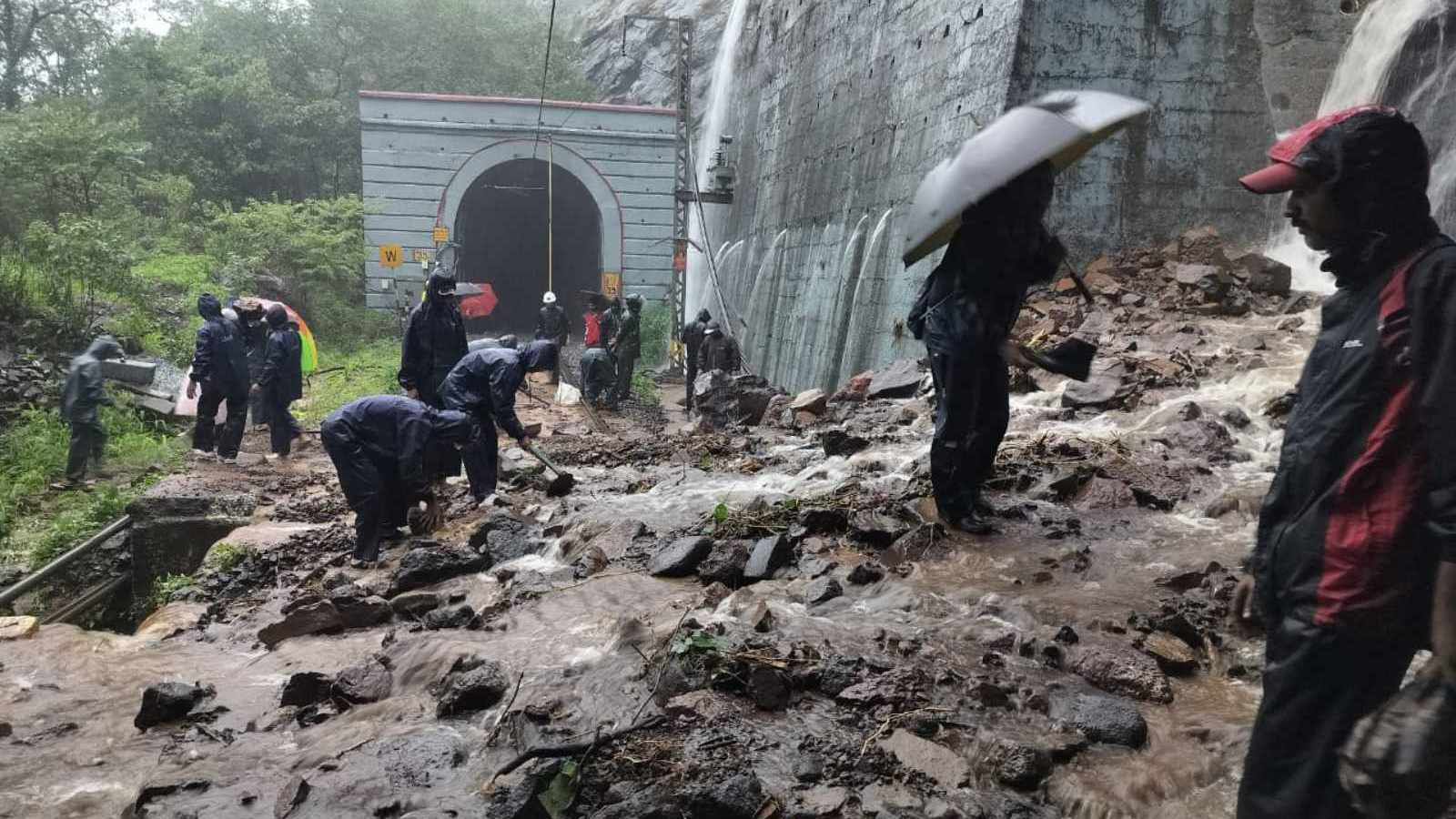
Barely nine weeks after it was inaugurated as Maharashtra’s answer to the Mumbai-Pune Expressway’s most notorious traffic bottleneck, the Rs 6,695-crore Missing Link suffered its first major monsoon disruption on Monday, with a landslide damaging a retaining structure near one of its tunnels and forcing the closure of the Pune-to-Mumbai carriageway, as Maharashtra received record rainfall with 670 mm of rain battering Lonavala in over 24 hours.
Mumbai surpassed its average rainfall quota for July in six days even as Pune recorded 108 mm of rain in 24 hours until 8.30 am on Monday, the fourth-highest reading for the month since records started being maintained in 1896.

The landslide that took place around 3.30 am brought down boulders and debris from the hillside, even as heavy rain and water flow across multiple stretches of the expressway paralysed the vital corridor between the two metros for several hours. Traffic on the Old Mumbai-Pune Highway (NH-48) was also disrupted due to rain-related incidents.
Pune-bound traffic resumed later in the morning, but the Mumbai-bound carriageway remained shut till late evening despite debris clearance by 5.30 pm, with traffic diverted via the old highway and Ghat section as MSRDC conducted safety inspections and repairs.
#WATCH | Maharashtra: A major landslide occurred on the Missing Link section of the Mumbai–Pune Expressway near the Khandala Exit. Consequently, the Mumbai-bound lane has been completely closed.
According to preliminary information, no casualties have been reported. Efforts are… pic.twitter.com/pRUSGhHabx
— ANI (@ANI) July 6, 2026
The Maharashtra State Road Development Corporation (MSRDC), however, defended the ambitious engineering project, attributing the incident to exceptionally heavy rainfall and describing it as “nature at play” rather than a construction failure and saying heavy rainfall was akin to “act of God”. Officials maintained that the tunnel itself remained structurally sound and that the damage was confined to the retaining structure and the tunnel’s external false frame.
Traffic on the Mumbai-Pune carriageway through the Missing Link was restored around 10 am. However, the carriageway remained closed as debris removal, repair and technical audit of the retaining structure continued, with Mumbai-bound traffic diverted via the old Mumbai-Pune Highway and Ghat section of the Expressway. By 5.30pm, officials from the MSRDC said, the landslide debris was cleared. However, the tunnel did not open to traffic, as safety and technical assessments were goin on.
“As a precautionary measure, a detailed inspection of the slope above the tunnel is underway to assess the presence of any loose material. Owing to persistent heavy rainfall and strong winds, the inspection is taking longer than anticipated,” said an official. While not giving a tentative time when the Mumbai-bound roads would reopen, officials said only two of the three tunnel lanes would be reopened, leaving one lane blocked. After the rain stopped, officials were considering measures to divert the rainwater and repair the false frame at the mouth of the tunnel.
 The incident marks the first major setback for one of Maharashtra’s most ambitious infrastructure projects.
Monday’s disruption also carried an element of irony. The road conceived to free motorists from monsoon disruptions on the old ghat section ended up diverting vehicles back onto that very route during its first rainy season. Adding to the chaos, parts of the old Mumbai-Pune Highway were also affected after a tree fell on power lines and heavy rain caused waterlogging at multiple locations.
Story continues below this ad
Officials said the landslide damaged a retaining wall, blocked the approach to the second tunnel and rendered the stretch unsafe for vehicular traffic. Speaking at a press briefing, Chief Minister Devendra Fadnavis said, “On the Pune–Mumbai Expressway, a major landslide deposited nearly around 100 tonnes of debris onto the roadway. This landslide occurred in a stretch where such incidents have not been reported in the past. Three lanes on the Mumbai-to-Pune carriageway were initially reopened to traffic and efforts were undertaken on a war footing to restore traffic on the Pune-to-Mumbai carriageway.”
MSRDC Vice-Chairman and Managing Director Anilkumar Gaikwad said the incident was triggered by unusually intense rainfall. “This is not the contractor’s fault; it is nature at play,” he said. Within 24 hours ending at 8.30am, Lonavala had seen 670mm of rain — the heaviest in the state. Explaining the damage, Gaikwad said, “Due to the intense rain, boulders from the top fell at the mouth of tunnel 2. The tunnel structure has not been affected, but the false frame — an external structure built at the edges of tunnels — has been damaged.”
Senior MSRDC officials said the slopes above the tunnel had been stabilised using rock bolts, steel mesh and other rockfall protection systems after detailed geological studies vetted by IIT Bombay. Those measures, they said, extend roughly 15 metres above the tunnel portal and remained intact despite the landslide. “The rockfall mitigation measures are in place and have been vetted by IIT Bombay… Such heavy rainfall is akin to an act of God, with little that can be done to prevent it,” an official said.
 Pune, Jul 05 (ANI): A JCB backhoe loader clears the debris after a massive landslide on the road leading to Rajmachi Fort completely blocks vehicular movement, at Lonavala, in Pune on Sunday. (Traffic and Local Police/ANI Video Grab)
Officials added that the existing protection systems significantly reduced the impact of the rockfall. “The barriers slowed the boulders and prevented them from crashing onto vehicles. Had these measures not been in place, the consequences could have been far more serious,” an official said. Last week, potholes appeared on the Missing Link that led to criticism of the government but Fadanavis downplayed it saying it was a small incident.
Story continues below this ad
MSRDC said it would undertake a fresh geological assessment after the monsoon to examine whether rockfall protection could be extended further up the hillside, though officials acknowledged that such work would involve substantial costs and require interventions in forest land.
Historical high in Mahabaleshwar
Mahabaleshwar has reset the historical statistics for July by recording 513 mm of rainfall in 24 hours on Monday, the highest for the month since the record began to be maintained in 1903. The second-highest rainfall in the recorded history of Mahabaleshwar in July was July 7, 1977, when the reading was 439.8 mm.
‘Rare’ weather event
Independent meteorologists said the incidents on Monday was due to rare weather events. “The region is used to 100 to 150mm rainfall in a 24-hour period, so 670mm is certainly extreme and rare,” said Akshay Deoras, senior research scientist at the National Centre for Atmospheric Science and Department of Meteorology, University of Reading.
“The monsoon winds are currently very active, with a low pressure area over Eastern India pulling in a lot of winds,” said Deoras.
Story continues below this ad
Landslides occur depending upon the quantum of rain, he said, adding, “Warmer tempertatures allows the atmosphere to hold more water vapour, which cause heavy rainfall. Global warming is making such events more frequent.”
Deoras warned that heavy rain is likely to continue until Tuesday, after which there would be a lull in monsoon for 10 to 15 days.
Jolt to an ambitious project
The incident marks the first major setback for one of Maharashtra’s most ambitious infrastructure projects, inaugurated by Chief Minister Devendra Fadnavis on May 1 after nearly three decades of planning and construction. The 13.3-km Missing Link was conceived as a permanent solution to the expressway’s accident-prone Khandala ghat section, where steep gradients, sharp curves and heavy traffic frequently caused long delays and fatal crashes.
Replacing a 19.8-km stretch between Khopoli and the Sinhgad Institute area, the new alignment shortened the journey by nearly six kilometres, cutting travel time between Mumbai and Pune by 20 to 30 minutes while allowing vehicles to travel at speed of up to 100 kmph. The project comprises two twin tunnels measuring 1.6 km and 8.9 km, two high-speed viaducts and a 183-metre cable-stayed bridge above Tiger Valley, the tallest bridge of its kind in the country. The main 8.9-km tunnel, excavated nearly 180 metres below Lonavala Lake using the New Austrian Tunnelling Method, is among the world’s widest road tunnels and was specifically designed to withstand the region’s dense fog, strong winds and intense monsoon conditions.

