

On April 4, Indian Potash Limited (IPL) issued a tender for import of 2.5 million tonnes (mt) of urea. The tender, which opened on April 15, received offers of over 5.9 mt, with the lowest price bids at $935 per tonne (cost plus freight) for supplying to west coast and $959 per tonne for eastern Indian ports.
Compare this with the previous tender on February 18 by Rashtriya Chemicals and Fertilizers (RCF). It attracted bids for around 3.1 mt and secured offers of up to 1.3 mt at $508 and $512 per tonne for west and east coast delivery respectively.
It’s not only urea. The most recent imports of di-ammonium phosphate (DAP) by Gujarat State Fertilizers & Chemicals were at about $865 per tonne (cost and freight, India), as against a pre-war level of $720 and last year’s $680 at this time. Current expected landed prices are higher at $925 per tonne.
The same goes for intermediates that go into making finished fertilisers. Pre-war prices of sulphur imported into India were $550 per tonne and still lower at $300 in April 2025. Today, it isn’t available at below $900. Ammonia is, likewise, priced at $850-900 per tonne, up from a year-ago average of $435.
“The ammonia facilities of QatarEnergy and Saudi Arabia’s Maaden are shut following Iranian strikes, forcing us to source mainly from Indonesia and Malaysia. Saudi Arabia was also our largest DAP supplier. Now, it is Morocco and Jordan that have to also cater to South America and other markets,” noted an industry source.
The kharif challenge
All this could pose a challenge for the ensuing kharif crop season, whose plantings will take off with the southwest monsoon’s onset from June.
Story continues below this ad
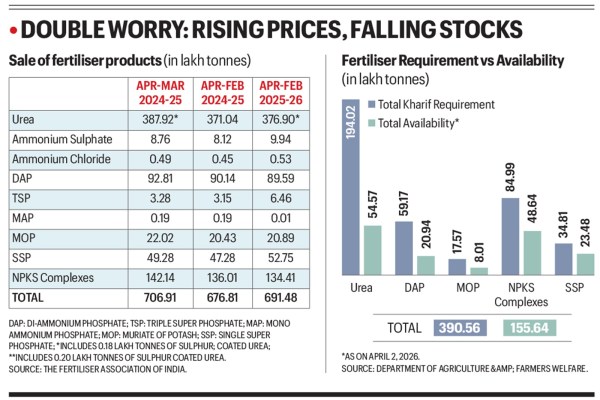
The accompanying chart shows the total requirement of urea for kharif 2026, as assessed by the Union Agriculture Ministry, at 19.4 mt. Actual availability at the start of this month, on the other hand, was hardly 5.5 mt.
India annually consumes 39-40 mt of urea, with 30-31 mt produced domestically and the balance 9-10 mt imported. The Gulf Cooperation Council countries — Oman, Qatar, Saudi Arabia, United Arab Emirates (UAE) and Bahrain — accounted for nearly 40% of India’s urea imports pre-war. Over 60% of its imports of liquefied natural gas (LNG) — the feedstock used for indigenous manufacturing of urea — came from Qatar, UAE and Oman.
“We normally produce roughly 2.5 mt of urea per month. In March, we could do only 1.5 mt due to LNG supply disruptions. This month, too, it would be 1.7-1.8 mt. Even if the war ends soon and LNG starts coming in through Hormuz, we will not reach 2.5 mt before June,” said the earlier-quoted industry source.
The IPL tender had called for the vessels loaded with the contracted 2.5-mt cargo to set sail latest by June 14, for timely arrival during the kharif season. For the 1.3-mt NFL imports, the last loading date had to be extended from March 31 (under the original tender) to April 30 because of ships either not being available or stuck in the Persian Gulf before the Hormuz maritime chokepoint.
Story continues below this ad
Lower imports as well as domestic production can constrain urea availability in the upcoming kharif. The availability-to-requirement ratio is better for DAP, muriate of potash (MOP), single super phosphate (SSP) and complex fertilisers containing nitrogen (N), phosphorous (P), potassium (K) and sulphur (S) in different proportions.
“We may somehow pull through kharif (these crops are mostly planted in June-July and harvested in October-November). The real problem will be in the rabi season (sowing in October-December and harvesting in March-April),” the source added.
Meeting the challenge
From the table, it can be seen that urea has a 55% share in India’s annual fertiliser sales of 70-71 mt. At No. 2 is DAP (at 9-9.5 mt), followed by NPKS complexes (14.2 mt in 2024-25, including 7.2 mt of the popular 20:20:0:13 grade) and SSP (5-5.5 mt).
The war-triggered shortfalls might, however, lead to reduced consumption of the heavily subsidised commodity fertilisers, especially urea and DAP.
Story continues below this ad
Take DAP, which contains 46% P along with 18% N. In a scenario where ammonia (the source of N) is scarce, there could more sales of triple super phosphate (TSP, which has 46% P with no N) or even mono ammonium phosphate (MAP: 11% N and 52% P). Farmers also use SSP, although it has only 16% P with 11% S.
As regards urea (which has 46% N), a prominent manufacturer from Uttar Pradesh proposed that the government let companies coat commodity fertilisers with micronutrients (zinc, iron, copper, boron, manganese and molybdenum) and free these fortified products from maximum retail price controls.
“Allow us to coat urea or DAP with micronutrients or secondary nutrients (sulphur, calcium and magnesium). Farmers won’t mind paying more if the fortified fertilisers result in higher grain yields. Many of them are already applying zinc sulphate (a non-subsidised fertiliser) on top of urea. Here, they will get urea uniformly coated with a thin lining of the micronutrient. It saves them the cost of separately buying and applying zinc sulphate,” he pointed out.
The present crisis may also be a shot in the arm for India’s fledgling biostimulants industry. Biostimulants, unlike fertilisers, don’t contain nutrients per se. Instead, they are products derived from microbes (bacteria and fungi), soil organic matter (humic and fulvic acids), seaweed extracts and other naturally occurring substances; these can enhance the nutrient use efficiency of the fertilisers applied by farmers.
Story continues below this ad
“The N, P or K present in fertilisers aren’t necessarily available for uptake by the plant. For example, P is often locked in soils, making it unavailable to the plant roots. Even the nutrients that are taken up by the plant may not convert into biomass and yield. Biostimulants basically modify internal plant processes to improve their functionality and nutrient use efficiency,” explained Renuka Diwan, co-founder of the Pune-based BioPrime AgriSolutions Pvt. Ltd.
Biostimulants include phosphate solubilising bacteria that convert insoluble P in soil into soluble orthophosphates, which are immediately available for plant uptake and use. “We can have similar biomolecules extracted from microbes and plants that can even be blended with chemical fertilisers. It will make the latter work better, thereby reducing their consumption,” said Diwan, whose company claims to host India’s largest library of 17,000-plus plant microbes collected from 400 different locations.

