

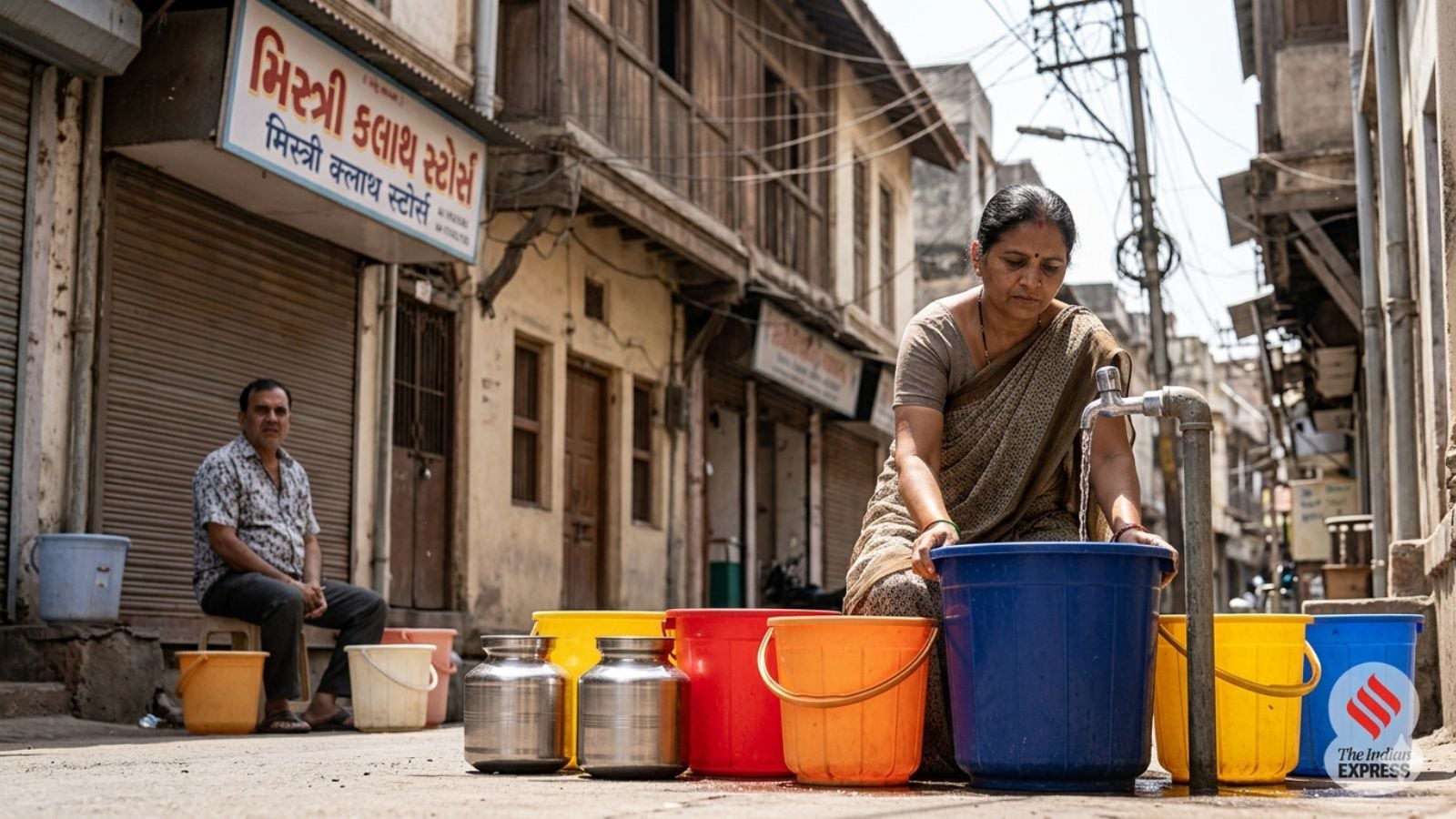
For Ahmedabad residents, water supply has always been a luxury since the1990s. For over 25 years, the city has enjoyed largely uninterrupted water supply, mainly from the Narmada and Mahi rivers, thus ensuring a regulated level of Total Dissolved Solids (TDS) than the city’s ground water.
On May 7, the Ahmedabad Municipal Corporation (AMC) announced a 10-day cut in water supply on account of pre-monsoon repair work of the Reinforced Cement Concrete (RCC) lining of the Narmada Canal to be carried out by the Sardar Sarovar Narmada Nigam Ltd.
By that time, a yellow alert had been declared in Gujarat’s biggest city as temperatures hovered around 40-43 degrees Celsius.
Kotarpur Water Works, which treats and provides nearly 70 per cent of the city’s total water supply of 1,100 million litres per day, saw a shortfall of nearly 60 MLD. A 10 to 15 per cent cut in the daily supply of water hit a population of nearly 50 lakh across the city’s five zones — North, West, East, Central and South.
Officials say that shortage in supply was adjusted with borewell water, however, most of the residents The Indian Express spoke with complained of deterioration in the quality of water, pressure issues and shorter supply duration.
Janak Mistry, a shop-owner and resident of Kalupur in the walled city, said: “The water supply in the morning is only running for one-and-a-half hours now. We don’t even get water two hours. The pressure has also greatly reduced.” His wife Kalpana said she now finds it difficult to run the household. “We’ve reduced water usage quite a bit; our courtyard has been unwashed for the past three days. We generally fill buckets of water in the morning and splash it across the courtyard in the afternoon to help cool down the house. But we’ve been unable to do that because we don’t have any water left after completing our daily chores,” she said.
Story continues below this ad
For some residents, the water cut is just an amplification of an existing struggle. Bhalabhai Thakor, a resident of Shahpur, says water pressure has always been a problem in his neighbourhood. “We have installed a motor. Without it, the water flow is very weak and we struggle to fill our tank.” He also complained that there had been no official communication or prior notice from the AMC before the water cut. His family only found out when they experienced the disruption themselves.
Housing societies and co-operatives have been scrambling to cushion the blow for their residents. Hemant Patel, the chairman of a six-storey building in Naranpura, said they made the arrangement early.
“We have decided to rely entirely on the borewell for these 10 days,” he said. “Usually, our water comes from a combination of the AMC supply and the borewell. We have 12 families here, so it is not a hardship, but it is causing increased electricity use.” Daily routines, he added, have so far remained undisturbed.
Not everyone has had it as easy. Rajesh Patel, a businessman residing in a Navrangpura residential society, said his Resident Welfare Association (RWA) gave residents a day’s notice to prepare. “My wife and I do not need as much water as a joint family would, but we had guests and had to fill extra buckets just in case.” His wife, Neeta, agreed with this. “I filled an extra bucket and kept it aside for kitchen chores.”
Story continues below this ad
While some commercial establishments have managed to remain relatively insulated from the crisis due to private borewells, several residents say the situation has become difficult due to the heat wave.
A manager in a mid-size hotel in Paldi Gaam said the water shortage had not directly affected the hotel’s operations as it relies primarily on borewell water. “Most hotels depend on borewells. Tankers are needed only if the bore pump gets damaged,” he said.
According to the manager, the hotel, which has around 27 rooms, uses nearly 3,000 litres of water daily, with water usage increasing during summers. “Every year during summer, there will be some water supply issues. It has now become important for us to have borewell facilities as a security measure during emergencies,” he added.
While hotels and commercial establishments with borewell facilities have found temporary alternatives, several residential areas remain dependent on the limited municipal supply. The situation appears more difficult in residential areas that do not have alternative water sources. A resident of Motera, who works as a driver at a hotel near Ellisbridge, said his society depends entirely on AMC water supply and does not have borewell facility. According to him, the water supply has become “irregular” since the beginning of summer.
Story continues below this ad
“Water comes around two times a day. In the morning, supply starts around 5:30 am and continues for around one-and-a-half hours. In the evening, water comes around 4:30 pm, but with very low pressure,” he said. To manage the situation, he has installed a water storage tank at home.
“People have now started using water carefully. It is a good thing, but they are doing it because there is a shortage,” he said.
Near Paldi’s Kochrab area, a daily-wage earning family living in the shanty next to Jhaveri tower described the shortage as a “daily struggle”. Kamuben Parmar, a resident of the shanty, claimed that the reduced water supply began after the Sabarmati river cleaning work. “There is no proper water pressure now,” a family member said.
The family said water is supplied between 6 am and 8 am and for a short duration between 5:30 and 6 in the evening. Earlier, they used to receive nearly two hours of water supply both in the morning and evening. “We now have to take help from nearby societies for water.
Story continues below this ad
Sometimes, the security guards refuse to let us take water,” Kamuben said.
Water conservation
As temperatures continue to rise in Ahmedabad, residents across several localities say water conservation has now become a necessity rather than a choice.
In Jamalpur, residents reported both reduced water pressure and concerns over water quality. An operations manager at a hotel near Ellisbridge, who resides in Jamalpur, said the issue has persisted for nearly 15 days in the area. While the water supply timings have remained unchanged, the water pressure has reduced significantly, he said. “When we first open the tap, smelly and contaminated water comes. After some time, clearer water starts coming,” he said.
Residents in some affected localities showed buckets filled with dark and muddy water, stating that such contaminated water initially flows through taps before comparatively clearer water arrives after some time. They alleged that the water often comes with low pressure and an unpleasant smell, forcing families to wait before using it for daily household needs.
Story continues below this ad
Several households were also seen storing water in buckets and containers to cope with the ongoing shortage and irregular supply timings. According to him, borewell facilities are limited in many parts of Jamalpur, making residents heavily dependent on municipal supply.
“We cannot use water according to our needs anymore. We have to manage with less water in daily life,” he said. He claimed that complaints regarding the issue had been raised with local corporators and the area MLA. “AMC informed people about the water cut through newspapers,” he said.
Little impact on public facilities
Ajaybhai, the caretaker at the Jasumatiben Chimanlal Barot Park in Shahibaug, said that they have been relying on borewells. “While we do receive water from the AMC supply in the morning, the evenings are a little harder to manage, since we only receive water for half-an-hour. That is of no use to us. However, we do use the water supplied in the morning. We have seven tanks around the park, and tend to fill them in the morning itself. The morning supply has been cut short for the past few days but the borewell water makes up for it.”
Smitaben, caretaker at the Sardar Bagh in Lal Darwaja, had something similar to say. “We have to depend on borewells because the usage of water is so high, especially because of the hot weather. We have to water the plants, run sprinklers, clean the washrooms and so on.
It is difficult for us if we depend on the AMC water supply, especially since it is so irregular. The heat is an issue too.”
Story continues below this ad
‘Normalcy by Sunday’
An AMC official said that during the maintenance work on the Narmada canal where water flows to the Kotarpur water works by gravity, “ water was supplied by running a 100 per cent pump (standby) in the water pump house in the Kotarpur. There was a shortage of 10 to 15 per cent of the daily supply, which was fulfilled by running the borewell at the water distribution station”.
By Saturday, (May 15), the repair work was nearly complete, ahead of its 10-day deadline, AMC’s water project department officials told The Indian Express.
“The 10-day repair work is near complete today and we have started releasing water slowly and gradually raising the level,” Jagdish Asari, Additional City Engineer, Water Project, told The Indian Express.
The repair work had led to a reduction of the Narmada canal water level from 6.6-6.9 metre to 6.4 metres. From May 16 onwards, this water level is being gradually restored to 6.8-6.9 metres, officials said.
Story continues below this ad
Recalling this as one of the major maintenance works leading to such a long water shortage in the city in the last 25 years, Asari said, “Though we worked hard and planned alternate arrangements in advance in the affected five zones, the impact was more in some areas. At some pumping stations, the normal water supply was reduced by 15-20 minutes.”
However, he added that from Sunday (May 17) onwards, “regular water supply will commence”.
Ruling out this shortage to have impacted the quality of water, Asari said, “Since it was not entirely borewell water but merely the shortage of 50-60 MLD was met through the borewell water which is mixed with Narmada river water so there was not much impact on the quality.”
Manushi Patel and Saqlain Ahmed Jafri are interns at The Indian Express, Ahmedabad.
Water treatment plants in Ahmedabad City
| Water treatment plant | Numbers | Capacity | Currently utilised |
| Kotarpur Water treatment plant | 3 | 1150 MLD | 1050 MLD |
| Jaspur Water Treatment Plant | 2 | 400 MLD | 400 MLD |
| Raska Water Treatment Plant | 1 | 200 MLD | 200 MLD |
| Total | 6 | 1750 MLD | 1650 MLD |

