

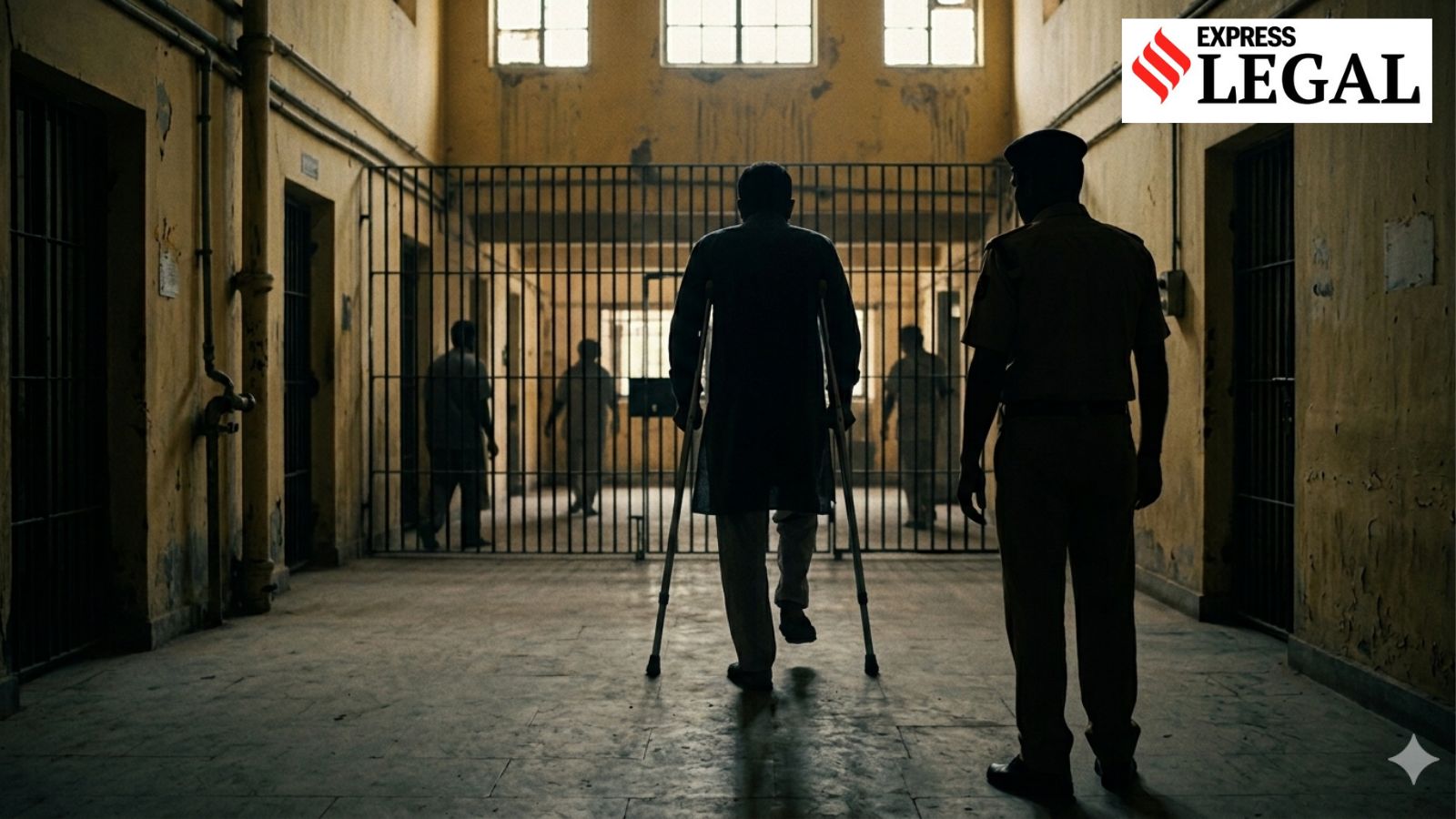
Supreme Court news: The Supreme Court has moved to tighten the enforcement of disability rights inside India’s prisons, flagging uneven compliance by states and shifting the focus from guidelines to implementation by placing the issue under the supervision of a High-Powered Committee.
A bench of Justices Vikram Nath and Sandeep Mehta was hearing a writ petition filed by one Sathyan Naravoor who approached the apex court raising concerns that prisoners with disabilities across India were being denied basic rights, accessibility, and dignity within prison systems.
“The rights of prisoners with disabilities must be recognised and effectuated in a manner that accords with a humane, rights-based approach, ensuring that incarceration does not, in any manner, dilute or abridge the fundamental protections enshrined under Articles 14 (equality before law) and 21 (protection of life and personal liberty) of the Constitution. The concerned authorities are, therefore, duty-bound to ensure faithful and effective implementation of these directions, in both letter and spirit,” the Supreme Court said on April 21.
Fresh directions to ensure accountability
To operationalise its decision, the Supreme Court issued a series of binding directions:
- It directed senior officials from the Department of Empowerment of Persons with Disabilities at the Centre, as well as state-level departments of Social Justice and Welfare, to actively participate in the proceedings before the High-Powered Committee.
- All states and Union territories have been asked to submit their compliance affidavits before the committee within six weeks, detailing the steps taken to implement the Supreme Court’s earlier and present directions.
- The court further tasked the committee with ensuring effective compliance with its rulings and empowered it to issue necessary directions to states and union territories.
- It also directed the committee to prepare a comprehensive action plan for the provision of assistive devices, mobility aids, and other support systems, taking into account both accessibility needs and prison security concerns.
- Additionally, the committee has been authorised to seek assistance from expert bodies, institutions, and civil society organisations working in the field of disability rights to ensure informed and practical solutions.
Systemic gaps
The case arose from concerns over systemic gaps in the treatment of prisoners with disabilities and the lack of effective mechanisms to enforce existing legal protections concerning the conditions, safeguards and institutional mechanisms available to prisoners with disabilities across the country.
The plea highlighted systemic gaps in the implementation of the Rights of Persons with Disabilities Act, 2016, pointing to the absence of accessible infrastructure, lack of assistive devices, inadequate healthcare, and the failure to put in place effective grievance redressal mechanisms.
The plea essentially argued that despite existing legal protections and earlier court directions, disabled inmates continued to face neglect, discrimination, and barriers to equal participation in prison life, warranting urgent judicial intervention.
Story continues below this ad
The Supreme Court noted that while it had already laid down a detailed framework in earlier rulings, including its decision in L Muruganantham v. State of Tamil Nadu, the challenge now lay in ensuring uniform and faithful implementation across all States and Union territories.
On December 2, 2025, the Supreme Court had expanded the earlier framework by issuing additional directions aimed at strengthening accessibility, accountability, and inclusion within prison systems.
Comprehensive framework
The Supreme Court reiterated that its earlier directions covered a wide spectrum of reforms necessary to make prisons disability-inclusive. These included mandatory identification of prisoners with disabilities at the time of admission, creation of accessible infrastructure such as ramps and toilets, and provision of healthcare, assistive devices, and mobility aids.
The top court had also directed authorities to ensure sensitisation and training of prison staff, conduct accessibility audits, maintain disability-related data, and formulate inclusive prison manuals.
Story continues below this ad
Monitoring mechanisms were to be put in place to track compliance and ensure that these measures were not reduced to mere formalities.
In addition, the Supreme Court had mandated the establishment of independent grievance redressal mechanisms, access to inclusive education for prisoners with disabilities, and the extension of provisions of the Rights of Persons with Disabilities Act, 2016 to prison establishments.
It also emphasised enhanced visitation rights for prisoners with benchmark disabilities to support their emotional and psychological well-being.
Partial compliance
Despite the detailed directions, the Supreme Court expressed concern over the pace of implementation. When the matter was taken up on April 8, it was informed that only 12 states and Union territories had filed compliance affidavits.
Story continues below this ad
The bench observed that such partial compliance pointed to a lack of coordinated effort and risked undermining the objective of ensuring equal and consistent standards for prisoners with disabilities across the country. Fragmented implementation, it noted, could not address systemic issues effectively.
High-powered committee to oversee implementation
- In response, the Supreme Court decided to entrust the matter to the High-Powered Committee constituted in Suhas Chakma v. Union of India (February 26).
- The court noted that the body was well-equipped to handle systemic prison reforms.
- The committee would provide a “structured, continuous, and expert-driven” mechanism to assess compliance, review practices, and recommend improvements.
- It would also help ensure a coordinated and uniform framework across states and Union territories, avoiding duplication and fragmentation of proceedings.
- The committee could undertake periodic reviews, call for reports, and evolve practical solutions based on administrative realities, thereby bridging the gap between judicial directions and on-ground implementation, the Supreme Court highlighted.
Towards uniform rights-based framework
The Supreme Court emphasised that a centralised oversight mechanism would enhance accountability and ensure uniformity in implementation. It noted that such an approach would help standardise practices, provide an accessible forum for grievance redressal, and ensure that issues faced by prisoners with disabilities are addressed in a timely and effective manner.
The court said that the ultimate objective was to align prison administration with constitutional values of dignity, equality, and substantive justice, ensuring that prisoners with disabilities are not subjected to neglect or discrimination.
Next hearing
The ‘High-Powered Committee’ has been directed to submit a consolidated status report within four months, outlining progress made, challenges encountered, and further measures required.
Story continues below this ad
The matter is scheduled to be heard next on September 1, along with related proceedings.

