

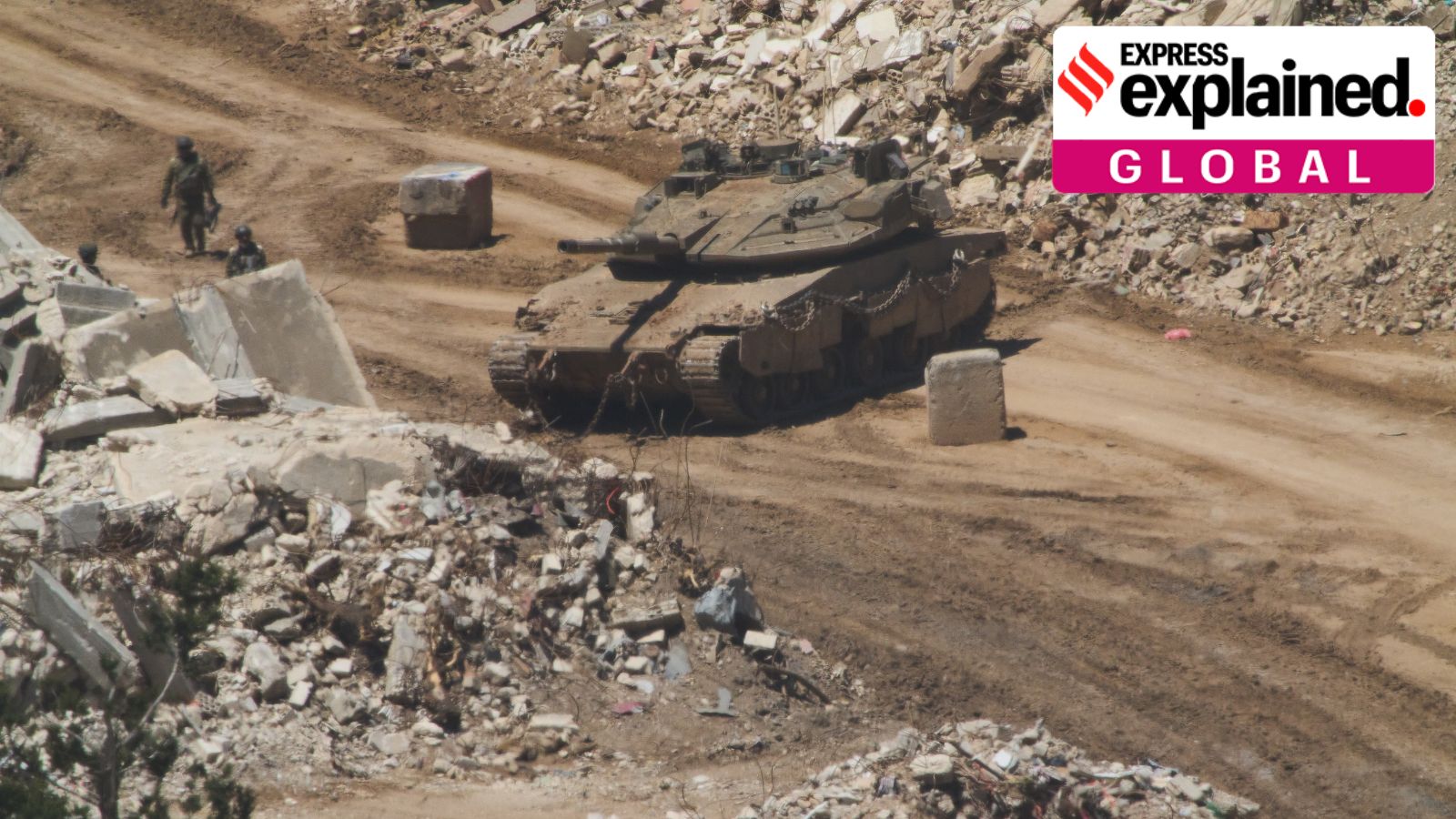
‘Ecocide’, a term that has been used for decades to describe widespread environmental harm caused by human actions, has come into prominence as global conflicts disrupt entire ecologies.
Environmental groups have called for the inclusion of the term as one of the international crimes under the Rome Statute that governs the International Criminal Court (ICC). But severe environmental damage is already covered under international law. So why the push?
The reason lies in focus, scope and effect. Here’s a look at what ‘ecocide’ means and why the term matters.
Ecocide refers to the very worst harms caused to the environment by human actions, usually on a major industrial scale or affecting a huge area.
The term was coined in 1970 by Prof Arthur W Galston — a Yale plant biologist whose early research contributed to the development of Agent Orange — to describe massive, long-term environmental devastation, particularly caused by the herbicide’s use in the Vietnam War.
Two years later, at the UN Conference on the Human Environment in Stockholm, Swedish Prime Minister Olof Palme used the term to refer to the Vietnam War.
Indeed, Vietnam became the world’s first country to codify ecocide in its domestic law in 1990. Since then, the use of the term has become more widespread, with many countries — such as Russia, Ukraine, Chile, France and Belgium — incorporating ecocide (or its equivalent) into their laws.
Story continues below this ad
In 2021, an expert panel constituted by a non-profit called Stop Ecocide International proposed a definition of the term: “Ecocide means unlawful or wanton acts committed with knowledge that there is a substantial likelihood of severe and either widespread or long-term damage to the environment.”
However, there is no universal recognition of “ecocide” as an international crime.
How does ‘ecocide’ differ from current provisions in international law?
Many international conventions and statutes deal with widespread environmental damage, even if they don’t explicitly mention ‘ecocide’.
For instance, under the Rome Statute, it is a war crime to intentionally launch a disproportionate attack knowing that it will cause “widespread, long-term and severe” damage to the natural environment if it directly impacts humans, such as causing displacement, inflicting great suffering or injury on victims, or even causing death.
Story continues below this ad
The Geneva Conventions, which establish standards for treatment of non-combatants, require that warring parties not use methods of warfare that cause “widespread, long-term and severe damage to the natural environment”.
The widely adopted Environmental Modification Convention (ENMOD), in force since 1978, prohibits the deliberate manipulation of natural processes when it causes “widespread, long-lasting or severe effects”.
But these are hardly the only avenues to consider environmental damage. For instance, a violation of state sovereignty — a foundational principle of international law — could also be used as an argument in cases of environmental harm, and even ecocide, according to senior advocate Avi Singh, who has extensive experience in international criminal law.
He pointed out that cross-border environmental damage has long been treated along the lines of traditional tort principles. “If I poison your river and it flows into your country, it has always been a violation of international law,” he said. “Now whether that would qualify in international law based on the current allegations of deliberate metaphoric poisoning of the well to constitute a new tort of ecocide, which is not anthropocentric, and treats the environment as a victim in itself, would have to be considered by the International Court of Justice.”
Story continues below this ad
So how does ‘ecocide’ differ from the present international law framework? Singh told The Indian Express that the difference is in the focus. “The laws we have are anthropocentric. They put human beings at the centre of harm, while ecocide puts the environment as a separate entity that is being damaged.”
Where do current laws fall short?
To begin with, scope. Take for instance the Rome Statute, which recognises four serious crimes — the crime of genocide; crimes against humanity; war crimes; and the crime of aggression.
It classifies serious damage to the environment under ‘war crimes’ — meaning it would be applicable only during war.
Another hurdle is jurisdiction. Iran and Lebanon, for instance, are not State Parties to the ICC, which could complicate the prosecution pathway, pointed out Mrinalini Shinde, Visiting Lecturer of International Environmental Law at the University of Cologne. ICC jurisdiction, however, could still arise through a UN Security Council referral or ad hoc acceptance.
Story continues below this ad
One more issue is criminalisation. Most existing international instruments do not establish enforceable international criminal liability for environmental destruction.
For instance, the International Union for Conservation of Nature (IUCN), a global body that advises on environmental policy, limited itself to “recognising the crime of ecocide” in October 2025. “It will hopefully encourage more States Parties to push for inclusion of the crime domestically and within international law,” said Shinde.
This is what is behind the advocacy to include ‘ecocide’ as an international crime in the Rome Statute, alongside genocide, war crimes, crimes against humanity and the crime of aggression.
Inclusion, however, is easier said than done. “For inclusion into the Rome Statute, a State Party to the Rome Statute would introduce the amendment of the Statute at the Assembly of States Parties, and would require 2/3rds majority of States Parties to be successful. There will be further conditions for such an amendment to come into effect,” said Shinde.
The enforcement challenge
‘Ecocide’, however, is not completely missing from international frameworks.
Story continues below this ad
There is the IUCN’s motion that recognises ecocide as a crime.
More importantly, the Council of Europe adopted the Convention on the Protection of the Environment through Criminal Law in 2025. This is the first legally binding international treaty to criminalise severe and large-scale environmental destruction — “conduct that many term ecocide”, it says.
Under this convention, even acts committed abroad can be prosecuted in European domestic courts.
“There is universal criminal jurisdiction for crimes against humanity. With this, there is a potential to bring actions in domestic criminal law irrespective of where the event happens,” said Singh.
Story continues below this ad
“So, for instance, if whoever is committing an environmental crime travels to Europe, then somebody can bring a criminal action against them, saying that they have committed ecocide, and they should now be criminally charged and tried.”
The biggest issue, perhaps, is compliance. According to both Singh and Shinde, no direct prosecution has ever been launched over environmental destruction caused by war.
This raises questions on whether introducing ‘ecocide’ as a separate criminal principle under the Rome Statute would serve any purpose.
According to Singh, affected parties have to keep asking questions of the existing mechanisms. Whether the other side accepts jurisdiction is another question.
Story continues below this ad
“All international law — if the people who have the bulk of power do not play by international law rules — only has a moral element of saying that they are acting outside the law,” said Singh. “So that’s all international law can do. Unless the people who have the monopoly of power act through it, it is mainly a moral force. It’s a sense of shame, and it serves as a sort of guardrail. It also prevents the powerful within the international system from claiming that they are acting under the rules.”

