

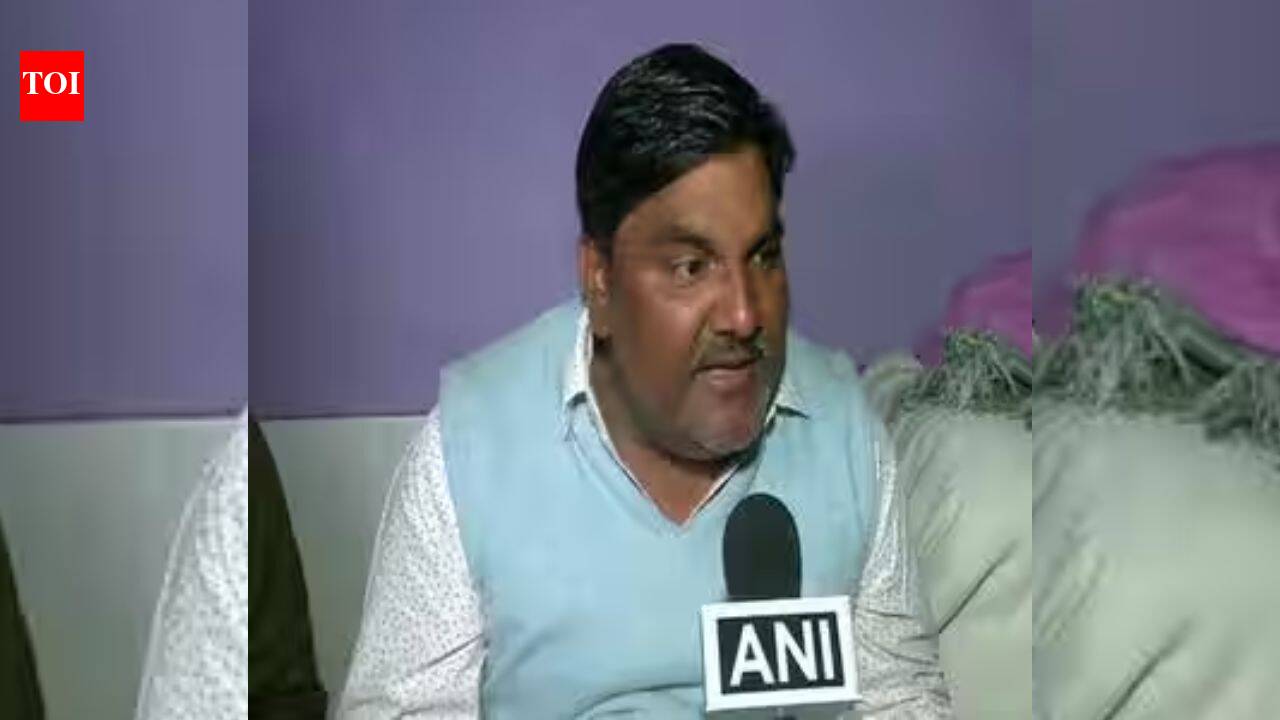
NEW DELHI: A Delhi court on Friday sentenced former AAP councillor Tahir Hussain and four others to life imprisonment for the murder of Intelligence Bureau (IB) officer Ankit Sharma during the 2020 northeast Delhi riots, rejecting the prosecution’s plea for the death penalty after holding that it had failed to prove the convicts were beyond the possibility of reformation.Additional Sessions Judge Praveen Singh pronounced the sentence after hearing arguments from both the prosecution and the defence on the quantum of punishment. The court said the prosecution had not established that the case met the threshold for awarding capital punishment, even though it had convicted Hussain and four others for Sharma’s murder earlier this month.The judgment was delivered in the physical presence of Hussain and the other convicts amid tight security at Delhi’s Karkardooma Court.
Why the court awarded life imprisonment instead of death
While the Delhi Police had argued that the case fell within the “rarest of rare” category warranting capital punishment, the court concluded that the prosecution had not proved that the convicts were incapable of reform, a key principle laid down by the Supreme Court for awarding the death penalty.Additional Sessions Judge Praveen Singh observed that the prosecution was unable to establish that the convicts were beyond reformation, leading the court to impose life imprisonment instead.The prosecution had sought the death penalty for Hussain and the four co-convicts, arguing that the murder was brutal, deliberate and carried out without any provocation.
Prosecution sought death penalty
During the sentencing hearing, Special Public Prosecutor Madhukar Pandey described the crime as “anti-social and abhorrent” and argued that it qualified as one of the “rarest of rare” cases.Pandey told the court that Sharma was subjected to a cold-blooded and savage attack with a heavy cutting weapon and that the killing could not be viewed in isolation because it occurred during the northeast Delhi riots in which 53 people lost their lives.According to the prosecution, Sharma sustained 51 injuries, seven of which were independently sufficient to cause death.The prosecution further submitted that the convicts acted without provocation and displayed complete disregard for the consequences of their actions.Earlier, Pandey had argued that the accused had fallen to the “level of being animals” while assaulting Sharma and said:“Those who are asking for mercy today should have shown mercy themselves. No mercy was shown from anyone’s side. No one even took Ankit to the hospital. They are asking for mercy after committing such a brutal murder.”The prosecution also argued that Hussain, being an elected municipal councillor at the time, had a greater responsibility to protect citizens instead of becoming part of the unlawful assembly.
Defence argued case did not qualify as ‘rarest of rare’
The defence, however, urged the court to show leniency, arguing that not every murder warranted capital punishment and that aggravating and mitigating circumstances must both be considered.Senior advocate Rajiv Mohan, appearing for Hussain, argued that six of the eleven accused in the case had already been acquitted and that the prosecution had failed to establish any conspiracy during the trial.The defence maintained that Hussain’s conviction rested on his membership of an unlawful assembly and common intention rather than evidence showing he personally inflicted fatal injuries on Sharma.The counsel further argued that there had been no preparation or conspiracy, that Sharma had been attacked by a large crowd during widespread rioting and that Hussain’s conduct during custody had remained satisfactory.Advocate Tara Narula also urged the court to consider Hussain’s family circumstances, submitting that he had three children, an elderly father and that his wife was a homemaker dependent on rental income.Counsel representing the other convicts similarly pleaded for leniency, citing their family responsibilities and arguing that both communities had been involved in the violence.The court, however, rejected several of the defence’s contentions before pronouncing the sentence.
Court’s conviction order
On July 13, the court convicted Hussain and four others for Sharma’s murder.In its conviction order, the court held that Hussain was a member of a heavily armed mob that had assembled with animus against Hindus to commit rioting, arson and looting before murdering Sharma in what it described as a “savage and relentless assault.”The court further held that the prosecution had proved members of the unlawful assembly knew that pursuing their common object could result in death.
Murder during Delhi riots
Ankit Sharma, an Intelligence Bureau officer, was killed during the northeast Delhi riots in February 2020 in the Dayalpur area. His mutilated body was later recovered from a drain.Hussain was convicted under Sections 302 (murder), 365 (kidnapping or abducting with intent secretly and wrongfully to confine a person), 147 (rioting), 148 (rioting armed with a deadly weapon), 153A (promoting enmity) and 188 (disobedience to an order duly promulgated by a public servant) of the Indian Penal Code, read with Section 149 relating to unlawful assembly.
Share your thoughts in the comments
Be respectful · TOI community guidelines
With Friday’s sentencing order, Hussain and the four co-convicts will serve life imprisonment, while the court’s decision underscores that despite the brutality of the crime, the legal threshold required for imposing the death penalty was not met because the prosecution failed to prove they were beyond the possibility of reformation.

