


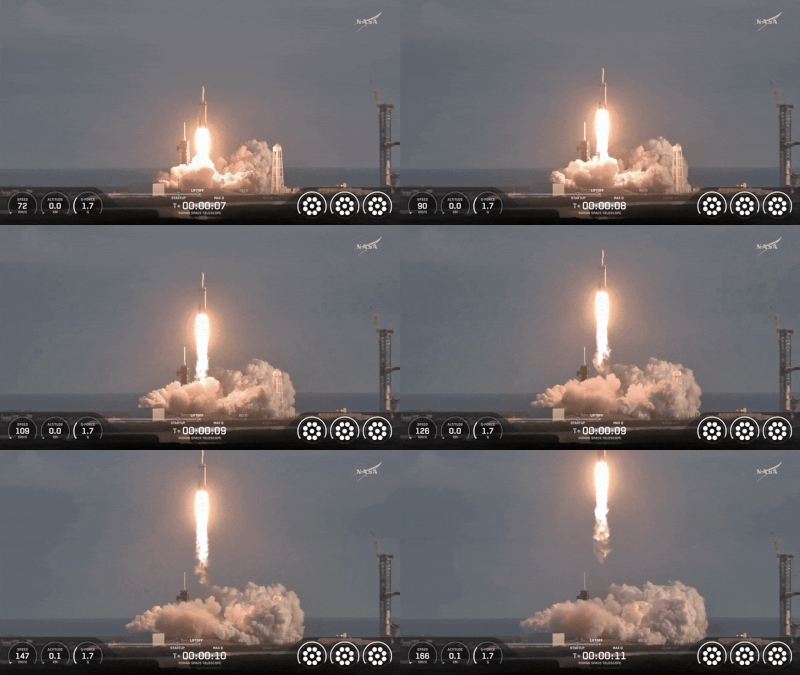
Nasa has launched its Nancy Grace Roman Space Telescope on a mission to investigate dark matter and dark energy, study black holes and search for planets beyond our solar system. The agency expects Roman’s surveys to uncover roughly 100,000 new exoplanets.The telescope lifted off from the Kennedy Space Center in Florida on Sunday morning local time aboard a SpaceX Falcon Heavy rocket. The rocket released Roman 31 minutes into the flight, sending the observatory on a three-month journey to its final orbit around the second Sun-Earth Lagrange point, or L2, about one million miles from Earth.Roman’s Wide Field Instrument will allow scientists to examine far more of the sky in a single observation. Nasa says its field of view will be at least 100 times larger than Hubble’s. Its distant location will also help Roman’s infrared instruments. Astronomer Jenifer Millard told the British Broadcasting Corporation this is to make sure infrared light from the Moon and Earth does not interfere with the cameras.“Roman is going to change the way we look at the Universe,” said Nicky Fox, a Nasa administrator.
Roman could discover up to 100,000 exoplanets
One of Roman’s main scientific goals is to search for exoplanets, the name given to planets beyond our solar system. Fox said Roman “is going to discover tens of thousands, maybe even 100,000 new exoplanets” – referring to planets located outside of our solar system.It is expected to identify thousands of worlds in the Milky Way while its wider surveys reach much farther into space. “Why do we care so much about exoplanets? Because one of our main goals at Nasa is answering the question, ‘Are we alone in the universe’?” she added. “One of our main goals at Nasa is answering the question: are we alone in the Universe?” Fox said at a Sunday morning news conference.The search will also contribute to scientists’ broader efforts to understand whether worlds beyond our solar system could be habitable. “With Roman, we are going to make this giant leap forward… that is going to allow us to look at these distant, distant worlds and start to really resolve the atmosphere around them to let us know: could they be habitable?”Roman’s destination is more than four times as distant from Earth as the Moon. Astronomer Jenifer Millard said the telescope will be four times further from Earth than the Moon is, where a lot of infrared space cameras – made to pick up what she describes as “heat light”- operate.Webb, which was launched in 2021, operates at a similar distance from Earth around the Sun-Earth L2 point. Roman, however, is designed to cover a much broader area of sky in a single observation. Hubble has been in space since 1990 and circles Earth at an altitude of roughly 300 miles.
Roman will probe dark matter and dark energy
Roman will also examine dark matter and dark energy, two phenomena that together are thought to account for about 95% of the Universe.Dark matter cannot be observed directly, but its presence can be inferred from its gravitational effects. Dark energy is the term scientists use for the still-unexplained phenomenon associated with the accelerating expansion of the Universe.Nasa says its “crisp, sweeping surveys will help scientists investigate dark energy and dark matter, discover and characterise exoplanets, map billions of galaxies, study black holes, and explore objects from our own solar system to the edge of the observable Universe.”By observing galaxies across enormous distances, Roman could also give scientists a picture of how the Universe has changed over cosmic time. Millard said, through the work of telescopes like Roman, scientists are hoping to create “enormous cosmic maps” of the Universe at various stages.“They’ll be almost like an onion, so you can peel back layer upon layer… and see how the distribution of galaxies changes through cosmic time,” she said. “What we want to do is use this distribution to try and figure out dark matter and dark energy because we know they exist, we see their effects, but what they are is a real mystery.”
Scientists hail successful launch
The launch later brought reactions from the scientists and officials involved in the mission.Jackie Townsend, a project manager on Nasa’s Roman telescope, described it as “glorious” at a news conference afterwards. “The ride was magnificent. It put us right where we wanted to be.”US President Donald Trump joined the space agency’s news conference by phone to congratulate the scientists involved in Roman. “You’re the hottest in space, and we have the hottest country anywhere in the world. So, let’s keep it all going. You’re a big part of it,” he said.
Telescope honours Nasa pioneer Nancy Grace Roman
The observatory is named after physicist Nancy Grace Roman. She became Nasa’s first chief astronomer in the 1960s and was also the agency’s first female executive.Roman spent years helping build support for the telescope that eventually became Hubble, including working to secure congressional approval and funding. She later identified dark energy as Hubble’s most interesting discovery: the same mystery the observatory carrying her name will now help scientists investigate.Nasa plans five years of primary scientific operations for Roman and hopes the observatory can remain in service for a decade.

