


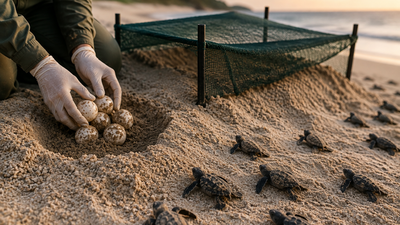
As rising temperatures, flooding and erosion put sea turtle nests at greater risk, conservationists often step in to move vulnerable eggs to safer parts of the beach. The practice can prevent an entire clutch from being destroyed by high tides, extreme heat or other immediate threats. But a new two-year study suggests that relocation may come with consequences that are not always visible when conservation success is measured simply by counting how many eggs hatch. Researchers studying green turtles on Heron Island, off the coast of Queensland, found that relocated nests could produce fewer hatchlings, while some of those that did emerge were smaller and performed less well than hatchlings from natural nests. A study published in the journal Marine Biology by researchers from the University of New South Wales and the University of Queensland showed that warmer relocated nests could dramatically skew the sex ratio, with only an estimated 8% of sampled hatchlings being male during one nesting season.
Saving nests from danger
Sea turtle eggs are vulnerable from the moment they are laid. Nests located close to the high-tide line can be flooded, while erosion, predators, human disturbance and extreme temperatures can also destroy developing embryos. For conservationists, relocating a nest that is likely to be washed away or otherwise lost can therefore be an important intervention. But recreating a turtle’s natural nesting environment is more complicated than simply digging a new hole in safer sand and transferring the eggs.The study, titled More than just temperature: the effects of nest relocation on incubation environment and hatchling quality in green turtles, examined 48 green turtle clutches over two nesting seasons, from late 2022 to early 2024. The research was conducted on Heron Island on Australia’s southern Great Barrier Reef. Researchers compared nests left in their original locations with nests that were moved to another site, either under shade cloth or left unshaded.The comparison allowed scientists to investigate not only whether relocation affected the number of eggs that hatched, but also whether it influenced the size, sex and physical performance of the hatchlings.
Temperature changes everything
For sea turtles, the temperature inside the nest plays a particularly important role because sex is determined by incubation conditions. Generally, warmer nests produce more females, while cooler conditions produce more males. The researchers found that unshaded relocated nests were warmer than both natural nests and shaded relocated nests, particularly during the final stages of incubation. In one nesting season, the warmer conditions resulted in an estimated sampled sex ratio in which just 8% of hatchlings were male.Shading helped reduce nest temperatures and produced a more balanced sampled sex ratio. This suggests that artificial shade could be useful when conservationists are trying to prevent nests from overheating and becoming heavily female-biased. However, the findings also revealed that temperature was only part of the issue.
Cooler nests still faced problems
One of the most important discoveries was that shaded relocated nests could reach incubation temperatures similar to those of nests left in their natural locations, yet still produce poorer outcomes. Compared with hatchlings from in situ nests, hatchlings from shaded relocated nests had lower hatching success, were smaller and were less successful at righting themselves after being turned upside down. This indicates that simply reproducing the right temperature may not be enough to recreate the conditions needed for optimal development.The researchers suggest several possible explanations. Moving eggs to a new site can change moisture levels, sand structure, gas exchange and microbial conditions. Nest depth may also differ from that of the original nest. Any of these factors, or a combination of them, could influence embryo development. The study did not identify a single cause. Instead, it highlights how complex the environment inside a sea turtle nest can be.
Why hatchling quality matters
A turtle hatchling’s journey does not end when it breaks out of its egg. On Heron Island, the young turtles must make a roughly 50-metre journey across the beach while avoiding predators such as birds and ghost crabs before they even reach the sea. Size and physical performance can therefore matter. A smaller hatchling or one with reduced ability to right itself may face greater challenges during the dangerous first moments of life. According to the researchers, only a tiny fraction of hatchlings will survive long enough to reach breeding age, meaning that even relatively small differences in early development could potentially have consequences for survival.The findings also showed differences between the two nesting seasons, suggesting that wider environmental conditions, including hotter and drier weather, may interact with relocation practices to influence outcomes.
A question of trade-offs
The research does not mean that conservationists should stop moving sea turtle nests. In many cases, relocation may remain the best option available. A nest that is certain to be flooded or destroyed could have little chance of survival if left in place. Instead, the study points to the need for more careful decision-making. Where possible, leaving nests undisturbed may provide the best developmental conditions. But when relocation is necessary, conservationists may need to consider more than just finding cooler sand.The characteristics of the new site, including shade, moisture, sand properties, depth and other features of the nest environment, could all matter. The study also suggests that interventions designed to solve one problem, such as overheating, may not automatically eliminate other risks associated with moving a nest. As climate change and coastal pressures make nesting beaches increasingly difficult environments, relocating threatened turtle nests may become an even more important conservation tool. But the new research offers an important reminder: saving eggs from an immediate danger is only the first step.For conservation efforts to give sea turtles the best possible chance, scientists may need to focus not only on how many hatchlings emerge from relocated nests, but also on the quality and condition of the young turtles that eventually make their way towards the ocean.

