

The last few days have seen three important events in the Chinese military and space sectors, with new appointments, tests indicating expanding technical capabilities, and more.
On July 3, Chinese President Xi Jinping signed orders to promote two senior military officers to the rank of general, which is the highest active rank for an officer. These come at a time when “anti-corruption” purges have led to churn and removal in China’s key military bodies.
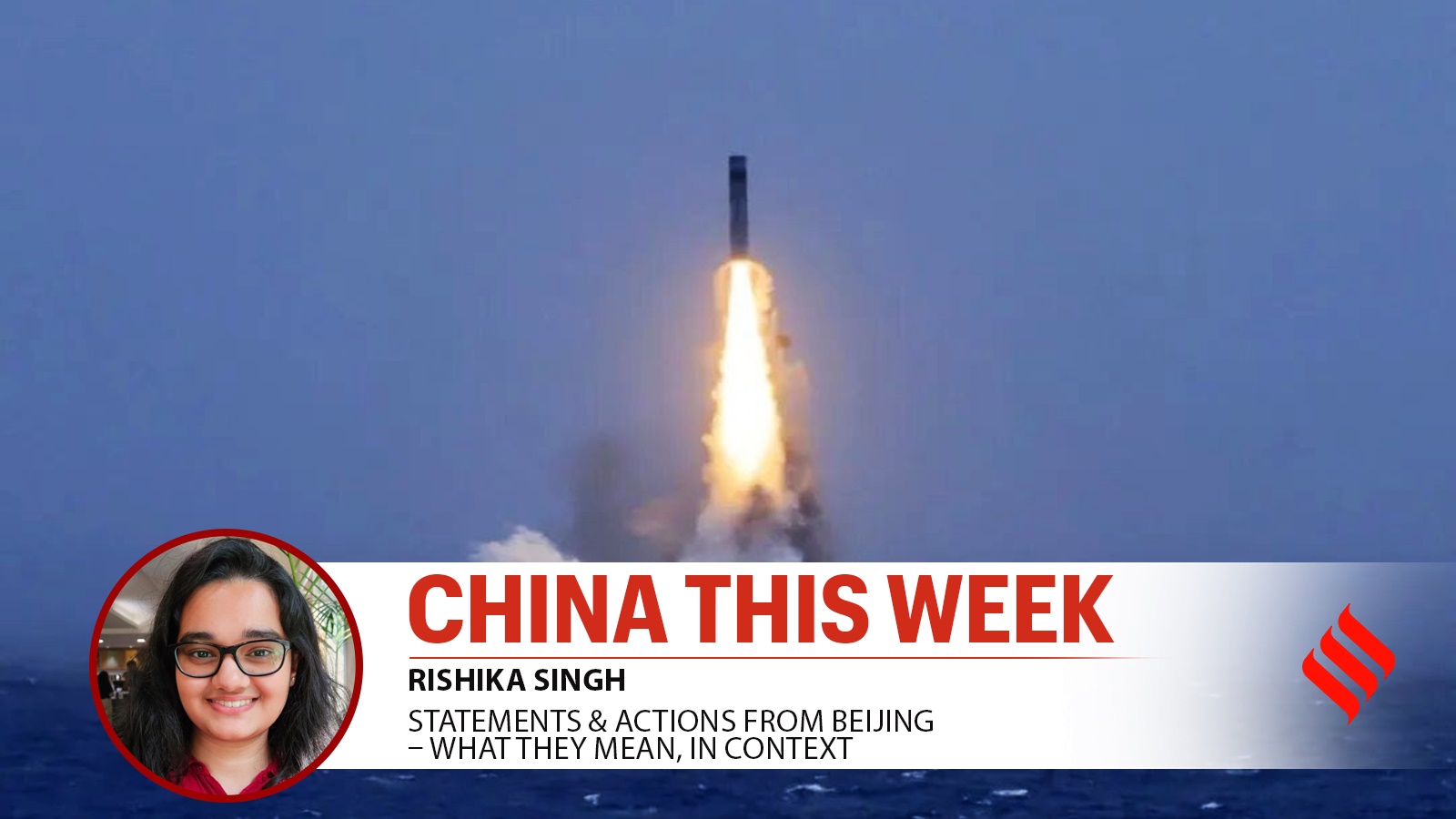
A few days later, state media reported that the People’s Liberation Army (PLA) Navy successfully conducted the test launch of a strategic missile by a submarine. Countries such as Japan and Australia expressed concern and criticism in its aftermath.
Later in the week, it launched the Long March-10B carrier rocket on July 10, achieving its “first-ever controlled recovery of a carrier rocket’s first stage.” The event was compared to the launch of Elon Musk-owned SpaceX’s rockets, which helped make rocket launches cheaper and, by extension, much more frequent in the United States. We detailed the science and what this means for China.
Here is a closer look at these developments:
1. Two new generals appointed
The two promoted officers are Zhang Shuguang, secretary of the Central Military Commission (CMC) discipline inspection commission and director of the CMC committee of supervision, and Wang Gang, commander of the PLA Air Force.
While the CMC is the apex military administration body, the discipline inspection commission is tasked with anti-corruption work. It is one of the 15 sections of the CMC.
Around the time of the announcement, the South China Morning Post reported that the seating chart of a gala marking the 105th anniversary of the Communist Party’s founding indicated the importance that the two leaders now hold.
Story continues below this ad
“Lieutenant generals Zhang Shuguang and Wang Gang were seated at the front of the section reserved for military leadership… the pair of generals sat alongside Defence Minister Dong Jun and General Han Shengyan, commander (one of the top two leaders) of the Central Theatre Command. Both Dong and Han are full generals,” it said.
UPSHOT: Analysts have read the appointments as part of Xi’s efforts towards re-staffing the CMC. After Generals Zhang Youxia and Liu Zhenli’s removal in late January, five of the seven CMC positions are now empty due to the former members being investigated for “violating discipline” — a euphemism for corruption.
Lyle Morris, Senior Fellow for Foreign Policy and National Security at the Asia Society Policy Institute, wrote in a post on X about who the other future CMC members could be. In the absence of official announcements and opacity in such processes, China watchers and analysts study party and official gatherings to understand the relative power that leaders hold at a given moment.
Story continues below this ad
Morris also referred to the Communist Party meeting, writing, “Defence Minister Dong Jun and General Han Shengyan, commander of the Central Theatre Command, were pictured on Monday seated next to each other at a gala… It was the first time they had been pictured alongside other senior PLA commanders.” This, he said, could hint at a possible CMC membership.
The reshuffling is not just about the internal balance of power, but also becomes important in the face of China’s increasing assertiveness in its neighbourhood and its claims on the island of Taiwan.
Ahead of the party’s next five-year congress that is a little more than a year away, Xi may be attempting to staff the CMC with officers who enjoy his trust and can be entrusted with sensitive and strategic decisions in relation to Taiwan.
2. ICBM launch, major test after 2024
Story continues below this ad
According to state media outlet Xinhua, the PLA Navy said that a strategic nuclear submarine successfully launched a strategic missile carrying a dummy warhead toward relevant high seas of the Pacific Ocean. It “landed precisely within the designated waters.”
It framed the test as a “routine arrangement of the annual training of the PLA Navy”, which was not aimed at any specific country, and that they had “already notified relevant countries in advance.”
Reuters reported that this was an intercontinental ballistic missile or ICBM, which can generally travel a distance of over 5,000 km.
UPSHOT: The test marked several firsts. Analysts at the Center for Strategic and International Studies (CSIS) wrote that this was the first time that “China has ever launched a submarine-launched ballistic missile (SLBM) into international open waters”. It was also the first public demonstration showing that China has a strategic nuclear strike capability launched from a nuclear-powered submarine.
Story continues below this ad
China conducted another ICBM test in the region back in 2024. The latest trial comes amid China’s heightened tensions with several players in the Indo-Pacific, specifically Taiwan and Japan. New Zealand and Australia also criticised the test. The fact that such publicly revealed tests are not common for the country also speaks to an attempt to send a message in its neighbourhood and beyond.
CSIS analysts pointed out another piece of important context: “China is undergoing the largest qualitative and quantitative expansion of its nuclear arsenal ever, tripling the size of its nuclear arsenal from 200 weapons to over 600 in the last six years.”
3. Reusable rocket tests, history and larger ambitions
China launched the Long March-10B carrier rocket from its southern Hainan Province on Friday, marking its first-ever controlled recovery of a carrier rocket’s first stage.“The Long March-10A, 10B and 10C will collectively form the backbone of China’s space transportation system,” an expert at the Chinese Academy of Engineering told Xinhua.
Story continues below this ad
UPSHOT: The rocket family is named after the Long March, a historic trek that Mao Zedong led during the mid-1930s, before the foundation of modern China, where he and the communists fought the members of the rival Nationalist Party. Tens of thousands are believed to have died over the course of the over 10,000 km-long journey. It solidified Mao’s position as the leader of the party, which would later emerge victorious in the Chinese Civil War, heralding the communist state’s formation in 1949.
That the name has been associated with a space programme shows the importance China accords to advancing its science and tech capabilities, all the while reminding its people about the centrality of the Communist Party in such endeavours.
Of late, China has also prioritised the development of indigenous technological systems to gradually reduce its dependency on the West. State media reports also spoke of future aims to “bolster China’s commercial space competitiveness and accelerate routine reusable launches, while advancing the next-generation crewed rocket program.”

