

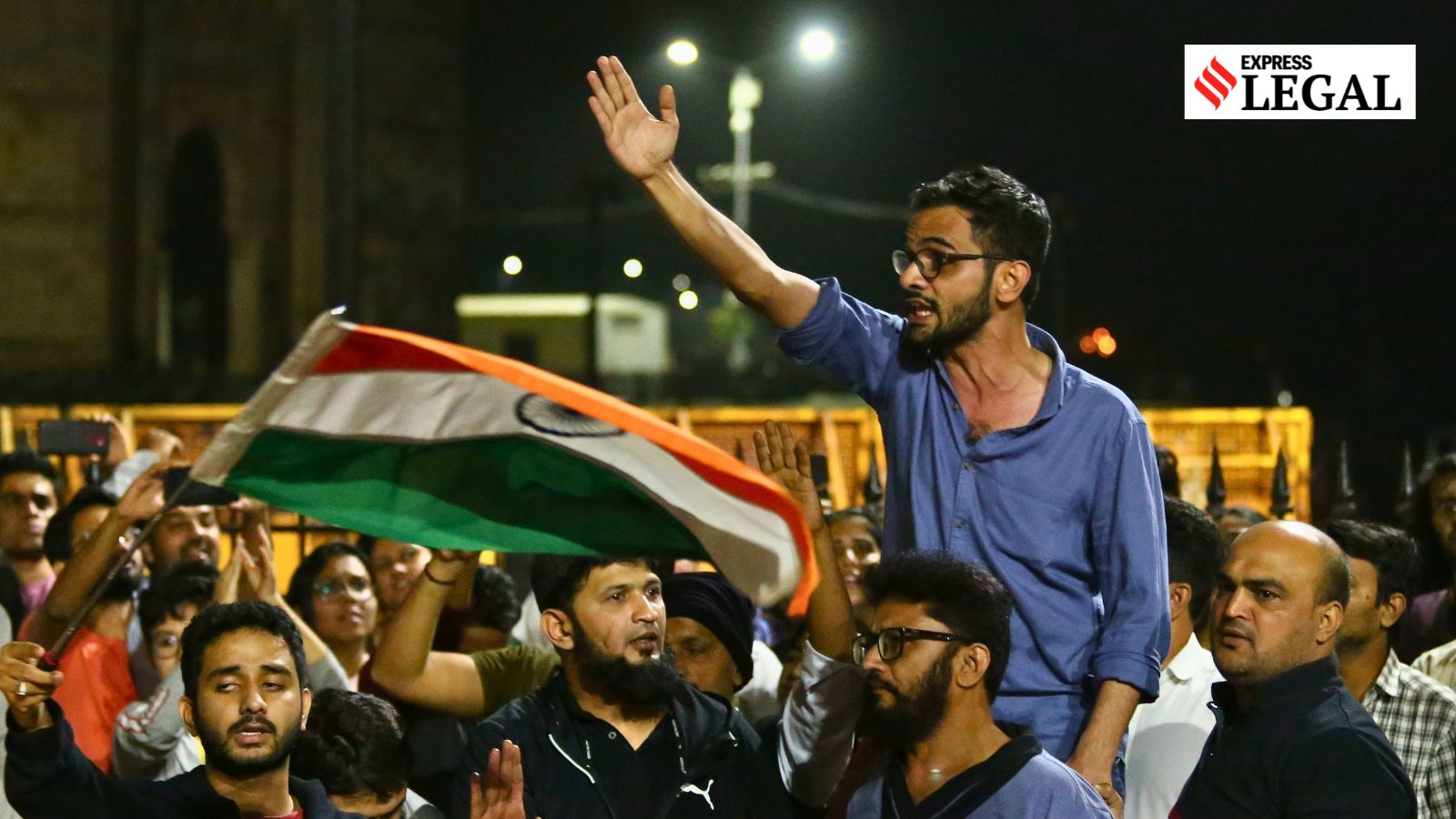
Delhi court Umar Khalid news: A Delhi court on Tuesday dismissed an application for interim bail filed by Umar Khalid in the February 2020 Northeast Delhi riots conspiracy case. Khalid had sought a 15-day release to attend the 40th-day ritual (chehlum) of his late uncle and to visit and take care of his mother, who is set to undergo surgery.
“No doubt that on previous occasions, as mentioned by Counsel for the applicant, not only the applicant but other co-accused persons have been granted interim bail and they never flouted the conditions as imposed by the Court, but it doesn’t mean that on every occasion whenever the accused seeks bail, the Court should grant the same. The Court has to consider every fresh application on its own merits and should allow the same only when the grounds are reasonable,” the 4-page interim bail rejection order stated.

Additional Sessions Judge Sameer Bajpai was dealing with an application moved under Section 483 (special powers of high court or court of session regarding bail) of the Bharatiya Nagarik Suraksha Sanhit (BNSS), read with Section 439 of the Criminal Procedure Code (CrPC).
 Additional Sessions Judge Sameer Bajpai said that attending the Chehlum ceremony of his uncle is not necessary.
Umar Khalid, an activist and a former JNU student, is facing charges of criminal conspiracy under the Unlawful Activities (Prevention) Act in connection with the riots, which left 53 people dead and hundreds injured. He was arrested in 2020, and since then, there have been multiple court hearings to date.
Umar Khalid’s counsel, Sahil Ghai, submitted that though his household comprises his father, mother, and five sisters, his father is 71 and not in a position to attend and take care of his wife, i.e., the mother of the applicant.
It was further submitted that the mother of the applicant has been sick for quite a long time, was medically examined, and advised to undergo surgery for a lump excision.
Ghai submitted that four of Umar Khalid’s sisters are married and reside away from the parental home in different locations, and as the applicant is the eldest and the only son in the family, only he can take care of his mother before and after the surgery.
Story continues below this ad
Court’s findings
While denying bail, the court said that on previous occasions, as mentioned by counsel for the applicant, not only the applicant but other co-accused persons have been granted interim bail, and they never flouted the conditions imposed by the court, but it doesn’t mean that the court should grant bail on every occasion that the accused seeks the same.
It added that the court has to consider every fresh application on its own merits and would allow the same only when the grounds are reasonable.
“Attending the Chehlum ceremony of his uncle is not necessary. Things would have been different if the ceremony were for a person who was in immediate relation to the applicant. Further, if the relation was so immediate and thick, the applicant would have asked for the release at the time of the death of his uncle only, and not now, after such a long time. Therefore, the Court doesn’t find this reason to be just,” the judge said.
The order further noted, “As far as the surgery of the mother of the applicant is concerned, the applicant has himself said that he has five sisters. Although, as per the applicant, his sisters do not live nearby, they are definitely expected to come for the help of their mother. Further, the father of the applicant is also there to take care of the mother of the applicant. Further, as said by the prosecution, the surgery is very simple, i.e., just for the removal of lumps, and there seems to be no actual requirement or help from the side of the applicant.”
Story continues below this ad
State’s stand
- Special Public Prosecutor Ayodhya Prasad opposed Umar Khalid’s application on the ground that the accused was just misusing the leniency of the court.
- It is further submitted that earlier, the accused has been granted interim bail on many occasions when the reasons were found to be reasonable, but this time, the reasons as given by the accused are not at all reasonable.
- Further, as far as attending the chehlum ceremony is concerned, the applicant’s uncle does not fall in the category of close relations, and it is not at all necessary for the accused to attend this ceremony.
- He stated that other members of the family of the accused are there to do the formality of attending the ceremony.
- Regarding Umar Khalid’s mother, he submitted that first of all, there are a number of persons i.e. sisters of the accused who can help their mother before and after the surgery and, secondly, the surgery is not a serious one and is just a minor surgery in which only local anesthesia is given and as such, there is no need for the accused to attend to his mother.
10 reasons why Supreme Court denied bail to Khalid, others
Denying bail toUmar KhalidandSharjeel Imamin the2020 Delhi riotscase, theSupreme Court in January highlighted them as the “principal accused” who had a “central and directive role in conceptualising, planning and coordinating the alleged terrorist act”.
A bench of JusticesAravind KumarandN V Anjariarejected the bail plea ofDelhiriots accusedUmar KhalidandSharjeel Imam,listing out its crucial reasons.
- By considering the bail applications in general and under special statutes like UAPA, the report discloses that all the applicants do not stand on equal footing as regards culpability.
- The prosecution material, taken at face value as required at this stage, discloses a prima facie attribution of a “central and formative” role by Umar Khalid and Sharjeel Imam in the alleged conspiracy.
- The complexity of the prosecution, the nature of the evidence relied upon, and the stage of the proceedings do not justify the enlargement on bail at this juncture.
- In the alleged conspiracy, the material suggests involvement at the level of planning, mobilisation and strategic direction, extending beyond episodic or localised acts.
- Acts that disrupt supplies or services essential to the life of the community, as well as acts that threaten the economic security of the nation.
- This reflects the Parliament’s recognition that threats to sovereignty and security may arise through contact.
- The liberty enshrined in Article 21 of the Constitution is of foundational importance, and no constitutional court can be unmindful of the gravity of restraining liberty before guilt is adjudicated. At the same time, the Constitution does not concede liberty in isolation, the security of the community, the integrity of the trial process.
- The hierarchy of the participation emerging from the prosecution’s case itself requires the court to assess each application individually rather than proceed on the premise of equivalence.
- Treating all accused identically could risk transforming pre-trial detention into ability mechanism diverse from individual circumstances.
- Liberty is invoked where continued detention is not shown to be necessary to serve a legitimate purpose recognised by law, the court must not hesitate to restore liberty, subject to stringent conditions that safeguard.

